Every February the Florida State Fair takes place in Tampa at the fairgrounds. When my girls were little, we pulled them out of school for a day of petting animals, watching shows and marveling over the different kinds of fried food vendors offered. As the girls got older, and more busy with school and activities, we didn’t make our annual visit.
Until a few years ago. My youngest daughter, older now and clearly nostalgic, wanted to visit the fair. So for the past four years, we’ve make a full day of it.
Cracker Country is a favorite of mine. Old wooden buildings were moved to fairgrounds to show how people lived in the 1800’s. A one-room schoolhouse, general store, post office, church, train station, just to name a few, now celebrate Florida history. Children can walk though the structures and hear stories from volunteers, informing curious minds about what went on in the buildings and how things are so very different today. Volunteers wear period costumes and work just like they lived back then, dipping candles in hot beeswax, pounding out nails from scraps of metal, twisting rope, and giving us a glimpse of what life was like before electricity.
Then there are the art projects from students all over the state. Oil, watercolor, ceramics, fabric, photography, from first grade on up, each as intriguing as the next.
Of course, you can’t go to the fair and not visit the animals. Baby goats are my favorite. There are also plenty of livestock to observe and every year a calf or two is born.


This year’s highlight? My daughter rode a camel. A camel.
Then there are all the free shows and exhibits; illusionists, trained rescue dogs who are clearly treated well and loved by their owners, 4H projects, and the pig races. Yep, we have those too.
Probably the most important aspect of the outing is this; spending time with my family, unplugged for a few hours of simple entertainment and enjoyment. Spending the day outdoors, under the sun, eating food that is not good for us in any way, shape or form. But hey, you can’t beat deep fried Oreo cookie dough. I figure once a year won’t hurt me.
Tara Randel is an award-winning, USA Today bestselling author of fifteen novels. Family values, a bit of mystery and, of course, love and romance, are her favorite themes, because she believes love is the greatest gift of all. Look for her Harlequin Heartwarming romance, HIS ONE AND ONLY BRIDE, available now. Visit Tara at www.tararandel.com. Like her on Facebook at http://www.facebook.com/TaraRandelBooks. Sign up for Tara’s Newsletter and receive a link to download a free digital book.






 Hannah and I are going to share more about the book during our Facebook Party Thursday, February 15th, 8pm Eastern on my






 According to CliffsNotes: “In a work of literature, a theme is a recurring, unifying subject or idea, a motif that helps us understand a work of art better. With a novel as richly ambiguous as Moby-Dick, we look at themes as guides, but it is important to be flexible while we do so. A good deal is left to individual interpretation so that one reader might disagree with another without necessarily being ‘wrong’ or ‘right’ about what the novel is saying.” Well, if CliffsNotes gives us “permission” to come up with our own ideas, it can’t be wrong. Right? (I took the fuzzy picture on the left.)
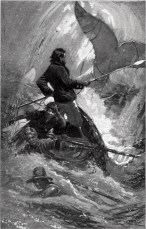 Anyway, while many people list themes by single words—revenge, religion, defiance, I consider these to be subjects. For me, a theme is a complete idea expressed in a strong, declarative sentence. For instance, one subject found in the pages of Moby Dick is revenge. The theme would be: The man bent on revenge will ultimately destroy himself and all he holds dear. With revenge as the subject of Melville’s greatest tome, the destruction of Captain Ahab and all he values becomes the inevitable end of his quest, hence the playing out of the theme. And yet there are other themes that can be considered even deeper. (Picture by I. W. Taber – Moby Dick – edition: Charles Scribner’s Sons, New York, Public Domain.)
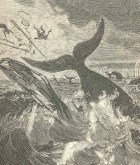 To Captain Ahab, God is an unjust Creator who capriciously wounded him by sending a great white whale to bite off his leg. A proud, successful man, Ahab cannot accept this assault on his person as others might accept adversity. Rather, seeing the whale as a “pasteboard mask” behind which hid this cruel Being, Ahab sets himself above God and defies Him. He sets out to avenge himself, seeking actually to kill God by destroying His instrument. In his monomaniacal quest, he instead destroys his ship, his crew, and himself, crying out in defiance with his last breath: “…thou all-destroying but unconquering whale; to the last I grapple with thee; from hell’s heart I stab at thee; for hate’s sake I spit my last breath at thee.” Moby Dick, Ch. 135. And so ends the tale, as told by Ishmael, the ship’s only survivor. Ahab is dead. He died defiantly cursing God. (Picture at left is from Wiki Commons and is in the public domain.)