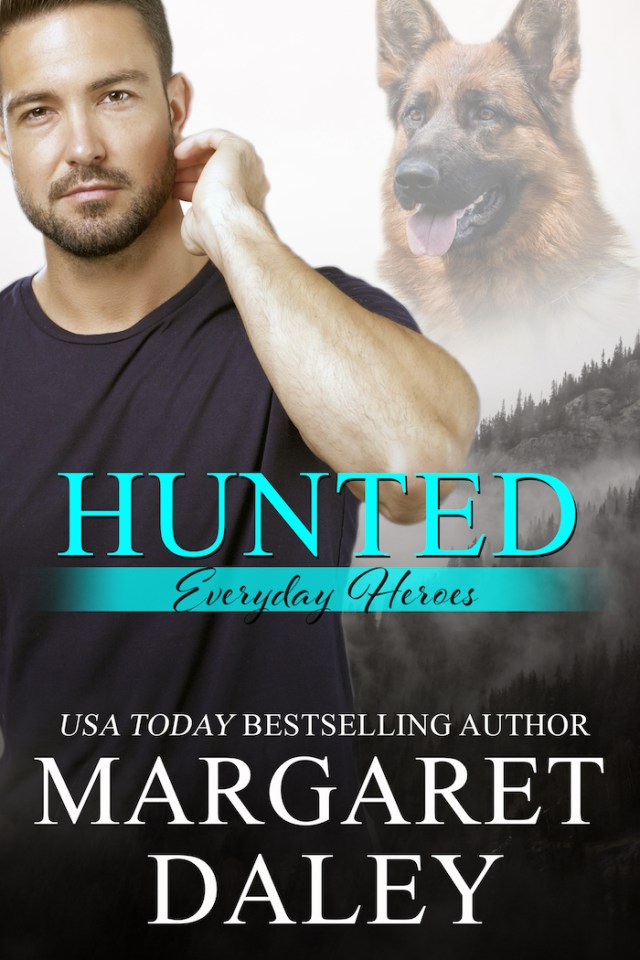
New Release: Hunted by Margaret Daley—Interview with the Hero

New Release: Hunted by Margaret Daley—Interview with the Hero

Luke Michaels, tell me the most interesting thing about you.

I don’t know if it’s necessarily interesting, but I love working with animals from the horses I own to my German shepherd, Shep. He is a well-trained search and rescue dog. We are a team.

What do you do for fun?

I hike and camp. I love the outdoors.

What do you put off doing because you dread it?

Facing my feelings about my wife who died suddenly. I never go to say good-bye.

What are you afraid of most in life?

Confronting my past. I worked on Wall Street and made a lot of money, but at the sacrifice of my marriage.

What do you want out of life?

To appreciate life and the beauty around me. Also, to help others in need.

What is the most important thing to you?

My family and friends. For many years I worked constantly and had little to do with my family and my friends—no, acquaintances—were my business colleagues.

If you could change one thing about yourself, what would it be?

Put my trust totally in the Lord. I grew up believing in God but when I began to work seventy to seventy-five hours a week, I pulled away from what’s the most important thing in life: God.

If you could travel back in time, where would you go and why?

I could say back to when I graduated from college and choose to work on Wall Street, but that part of my life has made me the man I am today. Out of tragedy, I’ve grown and made my life mean something other than making a buck.

Hunted Final small

Blurb for Hunted:

Murder. On the Run. Second Chances.

Luke Michaels’ relaxing camping trip ends when he witnesses a woman being thrown from a bridge. He dives into the river to save her, shocked to find her wrapped in chains. As a canine search and rescue volunteer, Luke has assisted many victims, but never a beauty whose defeated gaze ignites his primal urge to protect. When Megan Witherspoon’s killers make it clear they won’t stop, Luke fights to save her, but can he keep her alive long enough to find out who is after her?

Buy links: Amazon, Barnes and Noble, Apple, Kobo and Google Play

Posted in Uncategorized | Leave a comment

A Passion (by Hannah Alexander)

Last week I was working my way through a mountain of documents and paperwork, tired of the whole thing and wishing I could just burn it all. Tax documents? Who cares. Yeah, yeah, I know, the minute I throw something away I’ll get one of those nasty letters from the IRS telling me that I’m not really a writer, just a hobbyist, and that I owe them every bit of the deductions I’d taken five years ago–yeah, they do sometimes search past the three year period, but I’ve been there, done that, proved them wrong. Twice. So what are the odds they’ll try again?

Still, I was really sick of the whole thing.

But  just as I was ready to find a book of matches or a lighter and have a bonfire, which would probably have lit half of Nebraska on fire with all the wind, I came upon something unexpected, something I hadn’t seen before. It was a very old booklet kept by Mel’s paternal grandma, and in it were pockets that held Mel’s report cards throughout his school years, lovingly signed by either his mother or his father.

I was touched to see that someone recognized what a special young boy he was, and what a wonderful man he grew into. In fact, one of the notes by one of his teachers made it obvious she had never had a student like him–and that’s in a good way.

I knew all these things, of course, after being married to him for over 22 years, but it warmed my heart to see that, intellectual that he was, and bullied though he might have been, he turned into one of the kindest, most insightful, brilliant men I’ve ever known.

I enjoyed reading through each report card (He made me promise not to reveal that there was one time in his school career that he did not make an A) and reading notes and comments about him–nothing I didn’t already know.

His grandmother kept this booklet faithfully throughout those 12 years. That is, until his final year, his big finale, when he was hugely successful in his more intellectual pursuits, and had good reason to be proud. You see, he knew since he was ten that he was going to be a doctor when he grew up, and he excelled at science and math and read every medical journal he could get his hands on. He also loved English, debate,  and could type faster than anyone his teacher had ever seen. So well rounded.

His senior year, when he was valedictorian of his class and had the world at his fingertips, there was no report card in the pocket. Nothing  about his senior year.

It wasn’t until I glanced over at a picture of his father by the wall in the den that I realized what had happened. That sweet grandma who had kept her grandson’s school records all those years? Her own son died. Mel’s father fought cancer for seven years, taking his treatments, swallowing his pills before he went out to plow on the farm or milk the cows. Mel’s senior year was the year his father succumbed to that cancer. Their lives flew apart, and so did the life of Mel’s grandma. When I realized this I just sat and cried for that  poor lady and the young man who never got a chance to have his father sit out in the audience watching his valedictory speech.

So many years have passed. We know Mel’s father is with his mother in heaven now. Not long after his father died, his maternal grandparents died within six months of each other, casting a pall on the family that had hovered in the background for seven long years.

I don’t know how I’d have recovered from that. I think we’re realizing now, more and more, that one doesn’t recover from such a tragedy. One finds a new normal. Mel struggled as anyone would, but he never lost sight of his dream. Ten-year-old Melvin wanted so badly to be a doctor so he could heal his father. That passion still drives the grown-up Mel. Helping people heal is one of the driving forces in his life, and it makes him who he is.

My passion is writing. It’s what gets me up in the morning. Mel and I are both Christians, and we hope our testimony reveals itself in our chosen professions, because God drives us to our passions.

What gets you up in the morning? I’ve heard a lot of people say they don’t actually have a passion in life. I say dig a little deeper and find it. Maybe it’s hidden. But don’t stop looking. Never stop looking. Never let the tragedies in your life keep you from living your passion.


Posted in Hannah Alexander | Tagged , , , | 2 Comments

What Is Your Story? by Tara Randel

IMG_20180210_174540792_HDR

At my church, we’ve been talking about story. What is it? How does it apply to our lives? The fact is, everyone has a story. As a writer, this topic falls right into my wheelhouse. I love coming up with a story premise, building a plot, adding page-turning conflict and creating interesting characters who keep readers turning to the very last page. But as we’ve been discussing story, it’s clear that this is more than just about mechanics. So how does it affect our daily lives?

Let’s look at some favorite themes in books; love, second chances, reunions, forgiveness, redemption, to name a few. Why are they so popular? Because these themes relate to real life. And all of these themes can be found in the Bible. There is great wisdom, insight, instruction and advice in the Word. Along with some compelling stories. Jesus even used parables, stories, to teach a spiritual principles.

So the question is, do you tell your stories to others? Do you talk abut the things that have happened to you and relate it to Jesus? The depths of despair or the moments of supreme joy? How your life changed when you accepted Jesus as your Savior and what your walk looks like now? Has He taken you from a circumstance where you saw no hope and instead through His grace, turned it around to His glorious light? As many people as there are in the world, that’s how many stories there are. And wouldn’t it be wonderful if Jesus was in the middle of each one?

Conversely, do you listen to people when they share their stories with you? Do you listen with your spirit? It’s surprising how often we can overlook the surface story, but everything changes once you discover what makes a person tick and why. What kind of world would we live in if we truly listened to those with hurting hearts and broken spirits?

Let the message about Christ, in all its richness, fill your lives. Teach and counsel each other with all the wisdom he gives. Sing psalms and hymns and spiritual songs to God with thankful hearts. Col 3:16
Telling a story is a way to talk to people about Jesus. We don’t have to thump people over the head if we simply tell folks what Jesus has done in our lives. Opening up a conversation and being honest about who God is in your life and sharing the amazing things He’s done for you is a beautiful way to show others who God is, His nature and how much He loves us. It’s an interesting idea that we can take our story and use it to further the kingdom of God.

So, are you willing to tell your story so that others might see Jesus?

Tara Randel is an award-winning, USA Today bestselling author of sixteen novels. Family values, a bit of mystery and, of course, love and romance, are her favorite themes, because she believes love is the greatest gift of all. Look for her Harlequin Heartwarming romance, HIS ONE AND ONLY BRIDE, available now.  Visit Tara at www.tararandel.com. Like her on Facebook at http://www.facebook.com/TaraRandelBooks. Sign up for Tara’s Newsletter and receive a link to download a free digital book.


Posted in Tara Randel | Tagged , , , , , , | Leave a comment

I Get By with a little Help from my Friends.

By Marilyn Turk

A writer’s life can be lonely and isolated – separated from the activities of the world outside his or her office.

However, the isolation is a choice dictated by the profession, a condition under which the writer does her best work. Distractions can be devastating derailments to the story the writer is trying to get out of her head. The writer is employer and employee at the same time, setting independent goals that she must manage to achieve. The brainstorming, the ideas, the writing and the editing must be done by that one person – an overwhelming task.

Unless that writer knows and communicates with other writers. One of the best rewards of being a writer is finding those other writers. We’re in a world of our own making when we’re writing, and no one understands the mood, the trials and the frustration of that world better than other writers.

How did I find these other writers? By going to conferences and joining writing groups. I firmly believe networking is half the battle in getting published. Knowing who to talk to about what is invaluable, plus finding out what’s going on in the market, and meeting agents and editors face to face are some of the benefits of going to conferences. But oh, the support of writer-friends is just as important and has helped so much to encourage and inspire me on this journey.

Thanks to email and Facebook (and for some Twitter and Instagram), I can “talk” to other writers every day and get their feedback on various topics. I belong to several private groups on Facebook where only the writers of a particular genre or publisher communicate. I also belong to a writing accountability group and critique group which is very helpful to motivate me.

But writers aren’t the only people that motivate me. I am thankful to have personal friends, church friends and reader friends who support and encourage me as well.

After a few years on this journey, I can honestly say I wouldn’t have made it this far without help from my friends.  This profession isn’t as lonely as it used to be – before conferences, before social media – and I am so thankful it isn’t.

Here’s an opportunity for you to meet other writers: Blue Lake Christian Writers Retreat, May 2-5, 2018. Go to http://bluelakecwr.com for more information.


Posted in Marilyn Turk, Uncategorized | Tagged , , , | Leave a comment

Step Five in Our Journey

What kind of woman would Captain Ahab fall in love with?

PequodAhab would not be Ahab if he fell in love with a typical Victorian woman. But to figure out what sort of woman he would choose, we must look at more of his character, personality, and history. (At right, picture of Pequod whale ship from miniseries is used by permission of the photographer and found at Wiki Commons.)

I believe Ahab will be attracted to someone with his same zeal for life. Although he probably would not disdain a woman experienced in intimacy, it is also probable he would not choose a promiscuous woman simply because he’s probably known many of them over the years. Being educated—“Ahab’s been in colleges”—he will marry an intelligent woman. Having traveled the world, he may find favorable the idea of taking his young bride on a world tour both to show her the world and to show her off to the world. (Today we would call her “arm candy.”) Ahab is not insane when they meet, but he is intense. Their romance is passionate because he is a vital, active, healthy man in all respects. The woman he loves must be all of those things as well.

Since he marries before he loses his leg, (not three voyages wed at the time of the Pequod’s departure; lost his leg the previous voyage of the Pequod), I am curious to know what kind of man he was before that tragedy. Why does he react as he does when it happens? Other men with similar losses, i.e., the English captain who lost an arm to Moby Dick, have managed to recover and adjust without Ahab’s rage against the White Whale.

He married “past fifty” and thought it might have been a great evil to marry Hannah because he sailed the next day, leaving her a widow while she was still a wife. Though at the time of their marriage and his departure, he left only “one dent in his marriage pillow,” the fact that he returned to her at least two more times (not three voyages wed, but at least two) means they would have had more marital bliss. Because their child is young enough to take a noon nap, he would be younger than six or seven years, and he would have been conceived after Ahab returned from that first voyage.

Ahab’s voyages would have been shorter than average, but still successful. The average whaling voyage took three years, and usually more, so Ahab becomes a legend by his less-than-three-year successful voyages. My whole story must take place when he is past fifty and before he dies at fifty-eight. By the time Moby Dick takes place, he has spent only three years out of forty on shore. He sailed for the first time at eighteen. He is “rich as a potentate” and has no need to continue whaling. He does so perhaps because it is the habit of his lifetime, but also because he has a passion for the savagery of the whale hunt, much as a career soldier thrives on battle, i.e., continually proving his manhood.

Even Ahab does not completely understand why he is compelled to pursue the White Whale. He even tries to stop when he sees his loved ones reflected in First Mate Starbuck’s eyes. But he is overwhelmed by his mania. Where did it come from? What is the real target of his rage? Why is he enraged? Surely it must go beyond the loss of his leg. A man of his courage could have faced his loss with the support of his loving family.

The theme of Ahab’s rage has been the subject of so much commentary, I feel inadequate to try to address those deeper issues. My purpose is to show just enough of his inner conflict to demonstrate how it affected his wife. She is my protagonist. Still, in creating her, I must base her every strength or weakness on something either that Melville has provided in the original work or something that fits into the time period.

Here is what I decided about my heroine: Hannah will not be a Nantucket girl, but like those indomitable women, she will possess an independent spirit and strong character. She is unlike her mainland friends who embody the typical nineteenth-century views of a woman’s “place.” Like Ahab, she will be an “Isolate” by her own choice.

Staying true to the historical times: The 1830s were a time of great discovery. The mysteries of the world were opening up to whoever wanted to travel. Hannah wants to travel and see the world (or at least parts of it), but she is still young and inexperienced enough to be unfocused in her desires. She also has no close female influences because her mother died when she was born. This device gives Ahab the responsibility and pleasure of teaching her about life, a marital circumstance not atypical of the time period. She will be beautiful enough, yet different enough to attract Ahab’s attention and love.

Love at first sight: The initial attraction between Hannah and Ahab is physical. To Hannah, the successful Captain Ahab appears to be the epitome of all the classical heroes she has read about from childhood, the godlike men who sparked her imagination and made ordinary men appear far too inferior to deserve her attention.

Florence_Folger Victorian BrideAhab is attracted to Hannah because: To Ahab, lovely Hannah, all dressed in white, is purity personified. He meets her at a time when he has become sea- and world-weary and has begun to long for something in his life beside whaling. But what begins for Ahab as a playful flirtation to annoy the young minister, who has the audacity to try to convert him, quickly becomes a fascination in the young woman who is different from any female of his social rank he has ever met. Her courage and desire to learn about life beyond her sheltered world inspire him to become her private tutor in the latest philosophies, even as he advises her father in his failing whaling business. (The Victorian bride picture at left is from Flickr through Wiki Commons and has no known copyright.)

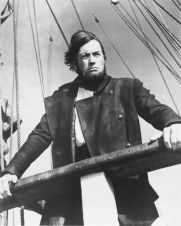
Peck_Moby_DickHannah is attracted to Ahab because: Hannah has never met a man, other than her indulgent father, who values her mind as well as her beauty. That Ahab regards her as an equal becomes his most compelling virtue, and her heart is won. As the time draws near for his departure on another long whaling voyage, she fears he will forget her unless she secures his affection with a betrothal. At her prodding and against his better judgment, he proposes only days before leaving. (At right, the picture of Gregory Peck as Captain Ahab is in the public domain from Wiki Commons.)

Surprised by love: Hannah will be as surprised by love as Ahab is, for, unlike her friends, she is not looking for it. She is not attracted to Ahab’s money, but rather his intelligence, generosity, and handsome appearance. As with most people in love, she sees him in a unique light that others may not understand. Though she had not planned to marry, she grasps for happiness before Ahab leaves on his voyage. When Peleg says she is a “sweet, resigned girl,” I’ll take the sweet (though not too sticky sweet), but not the resigned—you may recall that last time I said Peleg isn’t a totally reliable witness to Ahab’s character—because a spirited man such as Ahab would not have married a resigned girl. She must have spirit. Hannah’s only resignation is to his inevitable decision to sail again, and that resignation comes after painful disappointments. With her inexperience in life, she cannot comprehend her husband’s inner conflicts. With wealth to spare and no further need to continue whaling, why can he not be content to stay home with her?

More about Hannah and Ahab next time!

Posted in Uncategorized | Leave a comment

Put a little humor into it…

hilaughing

I love to laugh. Most of us do. With so many serious things happening in the world around us, I think it’s important to find ways to put laughter into each day of our lives.

So what makes you laugh? Is it a joke? A funny story? A humorous TV show? A book?

All those things, but also, for me, I love seeing cute babies and animals doing funny things. So I thought I’d share a few of my favorites here to give you a good laugh for the day.

This little boy is so cute.

Who doesn’t like a couple of cute kittens.

Ever wonder what your pets do when you’re not home?

And my all time favorite. I’m going to try this some day.

So here’s hoping your day if filled with laughter…

Mary Alford

Heart of Texas by [Alford, Mary]

Heart of Texas – Available at Amazon

Laney Winters gets the biggest shock of her life when she learns she’s pregnant…on the same day she finds her husband in bed with his secretary. With her blissful life exposed as fraud, and her husband wanting nothing to do with raising a child, Laney faces divorce and her greatest fear–moving back home to live with her two eccentric old-maid aunts.Hiding the demise of her marriage and helping to manage the family diner should be uneventful, but a new man in town has the gossips speculating. Laney’s two aunts create an exciting mystery around the stranger, and Laney is sucked into an entertaining game of “Save Jake Montgomery from Aunt Thelma.” When her aunts’ latest victim turns out to be the town’s new family doctor, Laney must entrust him with her secrets, and along the way, discover that when your life flips upside down it’s God’s way of giving you a different perspective…and a fresh start.


Posted in Uncategorized | Leave a comment

Editing and Being Humbled

by Nancy J. Farrier


Have you ever worked hard to make something only to have others find fault? For instance, if you spend hours cooking a meal from a new recipe and your family sits there looking at the food with the expression that says, “You want me to eat that?” Those moments always feel so personal because of the work and time you’ve invested.


I am going through the editing process on book two of my Land of Promise series, Ranchero. I don’t know if you are familiar with the editing process, but after weeks, and often months of writing a book, then more weeks of self-editing, an authoBandolero-Kindler sends their story to an editor. The editor then looks at the story with fresh eyes, finding everything from plot holes or inconsistencies, to misspelled words or typos.


Every time I send off a finished manuscript, I have the hope there will be few, if any, changes. Perhaps this time I will have a perfect book, polished and ready to go to my readers. So far, this hasn’t happened. I believe that is good, although it isn’t always pleasant. Sometimes, it’s downright embarrassing to see my mistakes.


I have never enjoyed criticism. I used to get pretty bristly when someone found fault with anything I did. Now, I wonder if God allowed me to become a writer so I would learn to accept constructive criticism that is meant to improve what I’ve created. I know now, that if I believe every word I write is perfect, there is no way for God to continue to mold me into His image. At that point, I am far from humble.


When my editor catches mistakes like—The afternoon wained… and changes it to, The afternoon waned…, I am grateful. When she notices my characters continually chuckle, or rub their nose or roll their eyes, she reminds me to vary the mannerisms giving my characters more depth, and I am thankful. When I capitalize Uncle and should have used uncle, she catches that and sends me a reminder of the grammar rule. I am happy to have her help to improve and as I go through her corrections and reminders, my writing skills are strengthened for the next book I write.


Each book edited is a learning experience in being humbled. While I’m still not excited about my family turning up their nose at a meal I’ve worked hard to cook – not that it happens often – I have learned to appreciate, and welcome, constructive criticism. It’s a great way for me to grow into a better person as well as a better writer.


“The fear of the Lord is the instruction of wisdom, and before honor is humility.” Prov. 15:33 NKJV

Posted in Nancy J. Farrier | Tagged , , , | 1 Comment

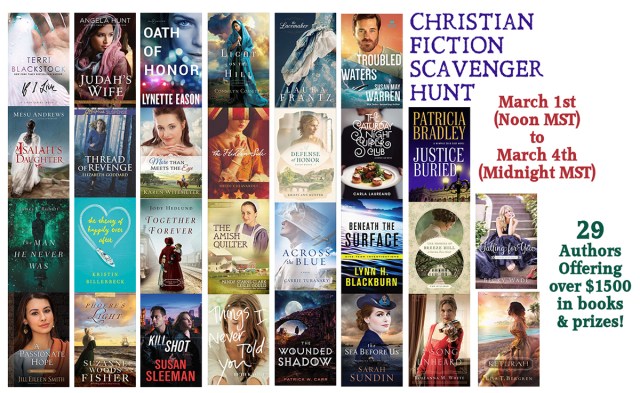
The Christian Fiction Scavenger Hunt is on!

by Elizabeth Goddard

Good morning my Christians Read friends!

I’m late in posting to you this first Saturday of the month (my days to post). The sun has finally shown its face, pushing away the gray clouds of a Michigan winter.

I never thought I’d be excited for spring because it ushers in summer, and as a 7th generation Texan, I simply can’t abide summer. Ha! But in Michigan, well, I welcome spring because it ushers in summer. It’s all about perspective.

For my post today I thought you would be most interested to hear about the spring Christian Fiction Scavenger Hunt!

It ends tomorrow night—Sunday, March 4th—at midnight (MST) so you have plenty of time to hunt and learn about new authors, all while gathering clues that could potentially leave you with prizes.

ScavHuntCombined020318


To begin the hunt, start HERE AT STOP #1!

Happy Hunting!!!

Elizabeth Goddard

Posted in Uncategorized | Leave a comment

Surprises and Fun While Researching

On a visit to Iowa for some research, I had the fun of visiting the Antique Car Museum of Iowa in Coralville, not far from the Amana Colonies. I’d never before stayed in Coralville and wasn’t even aware of the car museum, but visiting seemed a natural since it was within walking distance of our hotel.

Needless to say, I took lots of pictures. Even if you aren’t a fan of antique cars, you’d enjoy the cars in this museum. Making the visit even more fun was the fact that Lorna Seilstad, who was with me on the trip, found an REO that she was featuring in one of her novels, When Love Calls. She had chosen the 1908 Reo Gentleman’s Roadster for her male protagonist, Lincoln, to drive. Although the one in the museum was a 1909 model, we.

What fun it was when we discovered they had one at the museum.  The Roadster cost $1250 for a twin-cylinder and $650 for a single-cylinder, according to one ad. Another said it had a list price of $1040, with top, side curtains, and storm front. It had a top speed of 45 mph, and it was cosmetically racier than other automobiles with its longer fenders, longer hood, and seat set further back.  It had a 12-gallon gas tank, two speeds, and reverse. Always nice to have reverse!

But, below is the car that surprised me the most–a Sears 1912 Runabout. I honestly never knew that Sears produced cars. However, they manufactured cars in Chicago between 1908 and 1912. This particular model was sold through the Sears catalogue as #21R333 and sold for $445. It came with two seats in the front and room in the rear for another seat or more cargo space.

Note the tiller-type steering wheel on the left-hand side of the vehicle and buggy configuration with no doors. Top speed? 10 miles per hour. I learned this vehicle (still in original condition) was found in an enclosed grain bin of a grain storage facility along the Texas-Oklahoma border.

And this was the runner-up for surprises. For any camping enthusiasts among us, here’s a car, a Cadillac, that had a built-in bunk bed for those camping trips or unexpected stops along the road for a rest! I’d never seen one of these, either. What fun it would be to put one of these in a book!

And speaking of camping, do tell me what fun things you’re planning for your spring and summer fun! Any camping in your future? If so, I hope your accommodations are more comfortable than those offered in this picture.

May you find joy in the beauty of nature as the seasons change. ~Judy

Posted in Uncategorized | Tagged , | Leave a comment

My Journey with God As I’ve Developed As a Christian Writer By Margaret Daley

My Journey with God As I’ve Developed As a Christian Writer

By Margaret Daley

In the past few years my faith has deepened. Actually it has grown quite a bit through the years I’ve written for the Christian market. God led me to write inspirational stories in the late 1990s. At first I ignored the nudge, but as the Lord so often does, he kept nudging me until I took up the challenge. And of course, he was so right. I found my writing home in the Christian market.

Several times in the past few years I’ve seen God actively working in my life. First, he gave me a story I had to tell. It became the first book in The Men of the Texas Rangers Series, Saving Hope. The story is about human trafficking, and I knew it would be a difficult sale, but I didn’t give up hope selling it because it was a story the Lord gave me. I felt him totally behind me. There was someone out there who needed to read it. I have felt that way about all my books in The Men of the Texas Ranger Series. The second book, Shattered Silence, is about bullying. He has given me passion about certain social issues and the desire to tackle them in a story.

DSC02161

When I ran for the president of American Christian Fiction Writers, I did because He wanted me to run. I did out of obedience, not really expecting to win. I had books contracted and I was already serving on the board as Volunteer Officer. I didn’t envision myself as the president. I hated getting up in front of large crowds and giving a speech. I did win, and He assured me He would help me with giving the speeches. And He did. He is amazing.

My most recent journey with the Lord has me working on giving control over to Him. For so many years I tried to do everything by myself. I loved the Lord, but I didn’t need Him. Or so I thought. What has come home to me is that I can’t do it alone anymore. That I can’t do it without the Lord. Even knowing that, it has still been hard to give everything to Him. Not to worry. Not to forge ahead without considering what He wants me to do. As I’ve told people, I’m a work in progress, but with the Lord on my side, I can’t go wrong.

Posted in Uncategorized | Leave a comment

Growing Up by Julie Arduini

It’s a busy writing year, and that’s a good thing. I started a Christmas novella as part of a collaboration with Inspy Romance authors. This summer I start You’re Amazing with our daughter.

And as soon as I find the courage, I need to scrap the 10k I’ve already written for my contemporary romance, Anchored.

At least, I think I need to start over. The story is in my head, and in there, it’s complex but beautiful. On paper, it’s just not there. I tend to be character-driven, but even that seems lacking. The premise is there, a series based on sextuplets who stay in the spotlight because of tragedy. Each book features a sibling trying to find a love like what their parents had. In my head it has a This is Us feel to it, showcasing the Southern Tier of Upstate NY.

I started during NaNoWriMo and decided to write in third person POV. That’s not my preference, I love writing first person, present tense. I wonder if that’s what I need to do. The heroine is strong, Jordyn Collins is the oldest. She feels obligated to take care of her father and siblings. That’s a blessing, but it has its drawbacks. I think first person can make Jordyn shine. Jordyn is going to have her share of conflict between taking care of her family and a job opportunity that challenges her at every turn.

bin-160459_960_720

I’m not looking forward to starting over, but the good news is I’m willing. Someone once told me that a hobbyist resists re-writing and critiques, but an author welcomes the changes. All writers have a part of themselves invested in their work, but I want the story to engage readers and transform lives. For that, I need to do whatever it takes. The critiques already reflected that it needs sharpening. I knew it, and that was confirmation.

Once I have a little more written with the Christmas story, I plan to look at Anchored with fresh eyes and start over. I believe the time I take making it right will be worth it.

How many drafts do you think an author goes through before a book is complete? Are you surprised to learn that sometimes we have to scrap our work and start over?

Posted in Julie Arduini, Uncategorized | Tagged , , , , , , | 3 Comments

Grist for the Mill (by Hannah Alexander)

There was a sudden, repeated jangle of the doorbell–not once but many times. Then came a pounding at the front door at our house yesterday. Someone was yelling, but I couldn’t hear what she said.

I was, of course, in one of the most compromising positions, inside the bathroom next to that front door, with no robe with which I could dress myself to answer the door, and then there was more pounding, louder and louder and more aggressive. I had no idea what to do and no idea who could possibly be trying to break into our house unless it was a neighbor in trouble.

I didn’t know if Mel could even hear the noise, but it was loud enough that in a few seconds I heard him talking to someone at the front door.

I waited until she left before coming out in my inappropriate sleepwear. “What on earth?” I asked Mel, who had managed to throw his jeans on.

“It was the police.” He shook his head in disgust. “I’m wanted at work.”

“What? And they couldn’t pick up the phone and call you from the hospital? They had to call the police on you?” He was on call, for Pete’s sake, not obligated to be on duty at the hospital at that moment.

At this abrupt and very rude summons, he went to work.

And no, this isn’t fiction. It’s certainly grist for my fiction mill, but it happened yesterday morning. Someone couldn’t find our home phone number–though Mel always sees to it that the number is right there at the desk–and Mel’s cell was going straight to voice mail for some reason. The person in charge ordered them to call the police on my husband. I’m hoping that Mel made it clear that this was not to happen again.

But this incident will become grist for the mill in our next novel–or the next. We’ve learned how to take bad experiences and simply turn them into something creative. Writing helps calm me when I have an experience like this. So many of the scenes in our books have a lot of moments of truth in them–honed from experience.

How about you? Is life taking a turn sideways for you? You can stew about it the way I did too much yesterday, or you can create something different out of it. You can imagine how the situation might have been handled differently, or you could take steps to make sure that the same thing doesn’t happen again. We’re short-timers now here, so when we’re living in the Wyoming Rockies and hiking those trails, this experience will be a thing of the past. If nothing else, when bad things happen, try to focus on things that make you happy.

Um, I think it’s time to take my blood pressure again. Have a great week!


Posted in Hannah Alexander | Tagged , , | 4 Comments

Fiction is a Different Kind of Truth

by Jim Denney

“All good books have one thing in common — they are truer than if they had really happened.”
—Ernest Hemingway

Hemingway'sDeskKeyWest-Sepia

Ernest Hemingway’s writing desk in his home in Key West, Florida. Image: Public Domain

I’m a fan of Lawrence Block and Stephen King, but there’s something these two fine writers have said that sets my teeth on edge: They’ve called fiction a “lie.”

Two of Block’s books for on the craft of fiction are Telling Lies for Fun & Profit (1981) and The Liar’s Bible (2011). (Despite the titles, I highly recommend them to anyone studying the craft of writing.) In Danse Macabre, Stephen King said, “Fiction is the truth inside the lie.” Clearly, King’s focus is on the truth, not the lie, because he goes on to say, “Morality is telling the truth as your heart knows it.”[1]

Neil Gaiman made a similar statement: “Stories may well be lies, but they are good lies that say true things, and which can sometimes pay the rent.” Khaled Hosseini, author of The Kite Runner, said, “Writing fiction is the act of weaving a series of lies to arrive at a greater truth.” And Kurt Vonnegut, in the preface to Mother Night, said, “Lies told for the sake of artistic effect . . . can be, in a higher sense, the most beguiling forms of truth.”[2]

Why would a practitioner of the art of fiction slander his art by calling it a “lie”? Granted, fiction is an account of events that didn’t actually happen — but does the nonfactual nature of fiction make it a “lie”?

The dictionary definition of a lie is “a false statement made with deliberate intent to deceive.” Fiction does not try to deceive anyone. The reader knows a novel or story is not a factual account and approaches it in a state of (as Samuel Taylor Coleridge termed it) “willing suspension of disbelief.” Without intent to deceive, there is no lie.

I have a high opinion of stories and the people who write them — and I have contempt for lies and the people who tell them. I’ve been lied to by people who tried to deceive me, manipulate me, or steal from me, and I don’t like it. But I love being entertained by a good story.

“The basis of art is truth, both in matter and in mode,” said Flannery O’Connor. “The person who aims after art in his work aims after truth.”[3] Great fiction can’t lie. Fiction, in order to function as entertainment, must be true. Sure, the reader knows it isn’t factually true — but the reader expects it to be true in a deeper way. As novelist Emma Donoghue has said, “Stories are a different kind of true.”

Orson Scott Card’s short story “Lost Boys” first appeared in the October 1989 issue of The Magazine of Fantasy and Science Fiction. The first-person protagonist of the story, Step Fletcher, represents many aspects of Card’s own life. Card himself didn’t realize how much of his own personal truth, including his emotional pain, was woven into that work of fiction until some months after he had written it.

Much of the pain of that story centered on Card’s own real-life son, Charlie Ben, who was severely afflicted with cerebral palsy (and who died more than a decade after the story was published). At the time Card wrote the story, he thought he was writing a simple ghost story featuring a fictional boy named Scotty. Instead, he had inadvertently told the truth about his repressed grief over his real-life son, Charlie Ben. In an afterword appended to the story for its initial publication, Card reflected:

In all the years of Charlie’s life . . . I had never shed a single tear for him, never allowed myself to grieve. I had worn a mask of calm and acceptance so convincing that I had believed it myself. But the lies we live will always be confessed in the stories we tell, and I am no exception. The story that I had fancied was a mere lark, a dalliance in the quaint old ghost-story tradition, was the most personal, painful story of my career — and, unconsciously, I had confessed as much by making it by far the most autobiographical of all my works.[4]

Great writers don’t lie — they reveal the truth through fiction. Their stories are morally, emotionally, humanly true. Great fiction is convincing. It touches a responsive chord of truth within our souls. Fiction must resonate with eternal, universal, spiritual truths, or the reader will throw the book away in disgust.

When a writer sits down to compose a story, he or she should reveal reality, not spin a lie. One of the best storytellers who ever lived was the One who called Himself the Way, the Truth, and the Life. If we want to convey Truth to the world, I can’t think of a better way to do so than by telling a good story.

“Rather, speaking the truth in love, we are to grow up in every way into him who is the head, into Christ.” —Ephesians 4:15

__________________________________

battle-before-time-cover-1


Note: Battle Before Time, the first book in my newly revised and updated Timebenders series for young readers, has just been released in paperback. Click this link to learn more.

And if you’d like to learn more about how to write faster, more freely, and more brilliantly than you ever thought possible, read my book Writing In Overdrive, available in paperback and ebook editions at Amazon.com. —J.D.


[1] Stephen King, Danse Macabre (New York: Gallery, 2010), 430.

[2] Kurt Vonnegut, Mother Night: A Novel (New York: Dial Press, 2009), ix-x.

[3] Flannery O’Connor, Mystery and Manners: Occasional Prose (New York: Farrar, Straus and Cudahy, 1961), 65.

[4] Orson Scott Card, Maps in a Mirror: The Short Fiction of Orson Scott Card (New York: Tor, 1990), 119.

Posted in Jim Denney, Uncategorized | Tagged , , , , , , , , , , | 1 Comment

Step Four in our journey with Moby Dick

How did I choose to write my master’s thesis about Moby Dick? Here’s the first part of my thesis introduction.

Norton Edition Moby Dick CoverSince the 1920s, Herman Melville’s great American novel Moby Dick has been the subject of literary, religious, social, and psychological analysis, movies, television mini-series, Far Side cartoons, Internet sites (both serious and humorous) and countless other forms of commentary. In every generation and with each new academic approach, this multi-layered work continues to inspire interpretation in many forms. Though many non-academic people may not have read the novel, who has not at least heard about Captain Ahab, the monomaniacal whaler who chases to the death the white whale who bit off his leg? (At left is a picture of my much-used copy of the book.)

After hearing of Moby Dick all my life, I at last read it for a class in graduate school and was surprised at how complex and, at the same time, how simple the story is. Because I am a romance writer and I am always looking for romantic stories, one minor detail of the epic tale jumped off the page as I read: Captain Ahab had a wife! Who knew? Immediately, I was intrigued. What kind of girl—Ahab calls her his “young girl-wife”—would marry such a crazy old man as Ahab? What made her fall in love with him? What kind of romance did they have? What did she do while he was away at sea? How did she cope with his monomania after he lost his leg?

After perusing hundreds of articles and books on Melville, and on Moby Dick in particular, I was surprised to see that very few commentators make reference to this wife or to the child she bore Ahab. It seems as if Melville, by mentioning her only in passing, is merely using her as a tool to demonstrate that “Ahab has his humanities, as Captain Peleg assures us. This incidental mention by the author rightly concerns feminist readers, who see it as a typical example of nineteenth-century dismissal of the value of women and women’s work to society. But, after all, Moby Dick is first and foremost a book about one man’s attempt to avenge himself against the whale who wounded him. And, of course, Herman Melville did not write about women with any great degree of understanding in any of his books or stories.

Still, I am intrigued by the idea that a young woman would marry this old whaling captain. I am also curious to know why Ahab would marry “past fifty” when he had been content to be a bachelor all his life. On the surface, there is not much to go on. There are only two mentions of this unnamed wife in the entire four-hundred-and-seventy-page Norton Critical Edition of the book. To my feelings of intrigue and curiosity, add the element of challenge. I’m going to find out who these people are, and I’m going to write the story of their romance! But how do I make this character my own?

What do we know about Captain Ahab? All we know of him is related to us by Ishmael, who narrates the novel. But in addition to his own observations, Ishmael gives us the words and viewpoints of others, so we have much scuttlebutt and many opinions about Ahab. To whom should I listen if I am to find out why our young girl, whom I have named Hannah, loves Ahab? I decided that Ishmael’s views of Ahab can be trusted. He writes from the viewpoint of one who loves/admires Ahab but who also sees his flaws. What Ishmael observes can be believed, for only he speaks with affectionate objectively. The ideas of other characters who speak of Ahab must go through a filter to strain out superstition, fear, anger, self-delusion, and self-interest. Thus, if Ishmael is reporting something another character has said about Ahab or his wife, I don’t necessarily have to believe it, for it merely forms a part of the myth of Ahab.

A wise and brilliant captain: FMIB_34731_On_his_Back,_with_his_Jaw_in_the_First_Biting_PositionFrom Ishmael, I learn that Ahab’s “firmest fortitude [and] determinate, unsurrendered wilfulness” earn him the respect and awe of his crew. His lance (harpoon) is the “keenest and surest” out of Nantucket. He “lowers”—gets into the whaleboat—along with the rest of the crew in the active pursuit of the whale. He is a wise and brilliant captain, knowing how to rule his tiny shipboard kingdom in order to keep everyone alive at sea for three or four years at a time (89). He can be a harsh taskmaster to his crew, but he is not unjust. He will reward hard work and give incentives to his men at the appropriate time. This is what the real-life whaling captains of American history were like. (The picture above is from Wiki Commons: https://commons.wikimedia.org/w/index.php?curid=42887975.)Moby_Dick_final_chase

Admirable qualities: Adding to the typical attributes of a good captain, Ahab has many other admirable qualities. He is a strong, powerfully built man, resembling Cellini’s cast bronze statue of the Greek hero Perseus. Despite a rod-like scar down one side of his face, he is strikingly handsome in appearance. He has had a long, successful career in whaling to the point that he has become a legend in the industry, especially in his home port of Nantucket. He is a god-like man and far above average. He has visited other cultures and has learned to accept hard-working men of all races without prejudice. He can be tenderhearted, as in the case of poor, mad Pip, his little cabin boy. He dotes on his son, speaks fondly of his wife, and would gladly be back home to sit with her by the fireside if he were not driven by his quest. He has confidence in his wife’s love and devotion, knowing she will tell their son about him every day. (Picture above from Wiki Commons.)

Less admirable qualities: We also learn of Ahab’s less admirable qualities from Ishmael. He acknowledges that there is a God, but he is angry with Him even before his injury, seeing Him as unjust. Ahab has had prophecies made about him ever since the time his “crazy, widowed mother” gave him the name of an evil Biblical king and a Gay Head Indian woman, Tistig, said it “would somehow prove prophetic.” Others have made prophecies about him, as well, usually because of some aberrant behavior on his part. He has had a checkered past, having done numerous rash things in his younger years, such as spitting in a calabash (breaking a heathen taboo) and fighting with a Spaniard in a church (breaking a Christian code of behavior). And he lost his leg according to a prophecy.

Believable reports: In addition to Ishmael, I believe Starbuck’s insights regarding Ahab because the young Quaker is a practical man, courageously but carefully involved in the dangerous pursuit of whales only in order to provide for his family. He is also a man of integrity and spiritual insights. He cannot rebel against or kill Ahab to save himself or the crew because of his religious conviction against murder. Yet he is filled with anger toward Ahab, knowing that his monomania will destroy them all. Therefore, when he looks into Ahab’s eyes and sees that the captain has a moment of sanity, he seizes that opportunity to beg Ahab to forsake his mad quest. As a loving husband and father, Starbuck recognizes another man’s love for his family. I also believe the prophet Elijah and Pip because they both are mad and see with the eyes of mystics.

Less believable reports: On the other hand, comments made by Captain Bildad, Captain Peleg, or any crew members may be filled with rumors and superstition and therefore may not be accurate. For instance, the lightning scar that extends down Ahab’s face and disappears beneath his collar is thought to extend clear to the sole of his foot. But the man who relates that story has never seen that it does and is only passing on what someone else has said. If I doubt an account, I do not have to give it credence.

Putting it together: Using these tools, I began my construction of my own Captain Ahab. I think that, as a man who has proven himself with prodigious success in his own arena, Ahab will be comfortable with himself no matter where he goes, including the upper echelons of the whaling society. Just as he knows how to figure out any problem that arises on his ship in the middle of the ocean, he can also figure out how to navigate social waters. Though not ashamed of his Nantucket heritage, he may forsake his usual Quaker-sounding “thees” and “thous” until he is certain that it will not bring contempt from his listeners. He has learned some hard lessons in life and will avoid unnecessary unpleasantries in social situations, which are, after all, only temporary gams to him.

More rocky parts of Ahab’s history: An important factor in Ahab’s development concerns an incident that happened to him “off Cape Horn…when he lay like dead for three days and nights” some years before he lost his leg. This undetailed report from Elijah provides me with an opportunity for creating a reason for Ahab to take a ship from New Bedford rather than his home port, Nantucket, from whence he has always shipped. If he had an illness while at sea, it may have sobered him from his rash ways. He might have begun to rethink his life and to make a few changes after thirty years of whaling, if only to try shipping out from a different port.

My creative juices start to flow: At this point in Ahab’s life, these events might also prime him for meeting an appealing woman and getting married, though I do not think he would be aware of that aspect of his search for change. Ahab will be surprised by his love for Hannah. From the moment he sees her, he will be thinking “What a woman!” But what kind of woman might Ahab fall in love with? We’ll discuss that next time.

Posted in Uncategorized | Leave a comment

A Never Ending Story – The Series by Mary Alford

To Be Continued words on a clock to illustrate a movie, tv show,

Have you ever reached the end of a great book and thought, “No! That can’t be it. I’m not ready for it to end…”

I think most of us have had that type of reaction to a book that drew us in from page one and held us captive until the end. I know I certainly have on many occasions.

This is the very reason the series is so appealing to us. The story we fell in love with goes on, just in a different way. We can still catch up with our favorite characters, but in addition, we’re introduced to a whole new story that will hopefully make us fall in love all over again.

Still, not every book is destined to be a series.

So what makes a book series worthy? Well, at the core of every series you have great characters:

Obviously, a key ingredient in creating any great series is having an array of interesting secondary characters to complement the hero and heroine and make the reader want to know what happens to them as well.

But there has to be more to a good series than its characters. You need a fresh storyline that’s different from the first book and one that will set it apart and make the reader want to read it.

So, we have a great set of characters and a storyline that is intriguing. What’s next?

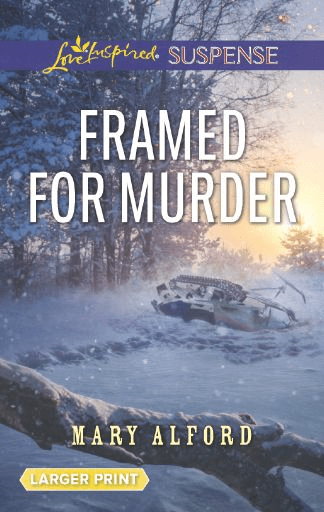
Location, location, location. The location where the story is set is key to the story and the series’ success. In Framed For Murder, book three of my Scorpion Team series, is set in the mountains of Colorado as well as the tundra of Alaska. The rugged backdrop of the mountains adds to the suspense of the story.

So, we have great characters, and intriguing storyline and the perfect location. Now comes the end?

Surprise! – The Perfect Ending.

I think what makes for a great series is that the ending both surprises and satisfies us. The story ends, but there’s still room for more.

framed for murder cover 1

About Framed for Murder – available at Amazon:

FALSELY ACCUSED

Framed for helping her partner smuggle guns—and then murdering him—CIA agent Liz Ramirez must find the evidence that will prove her innocence…before she’s caught or killed. So when her squad’s leader attempts to bring her in for questioning, she knows her future depends on convincing Aaron Foster to go rogue and help her. On the run from the rest of her team and the gun dealers who are convinced she knows the location of their missing weapons, Liz risks losing the proof that would clear her name. But will eluding her pursuers—and trying not to fall for the handsome commander—prove to be fatal?


Posted in Uncategorized | Leave a comment