Comics-Yeah, I love ’em. You? by James L. Rubart

When people ask where my story ideas come from sometimes I say, “From too many comic books as a kid.” That response is a bit tongue in cheek, but only a bit.

I do get ideas from the comic books I devoured in my pre-teen years.  Even though there can be heavy doses of corn in comic books, the stories are also epic and contain universal themes that capture our imaginations. I see that eye roll, but they are and do.

Like The Avengers. Biggest weekend opening for a movie EVER. $200 million. Das ist big. (Yes, I’ve seen it. Yes, I loved it. )

What about you? If you’ve seen The Avengers did you like it? Did you read comics as a kid? Do you read them now?

And yes, I think reading comics counts as reading. Don’t laugh at me or the Hulk will smash you puny human.

Posted in Honored Alumni, James L. Rubart, Uncategorized | Tagged , , | Leave a comment

About Writers’ Conferences by Kathi Macias

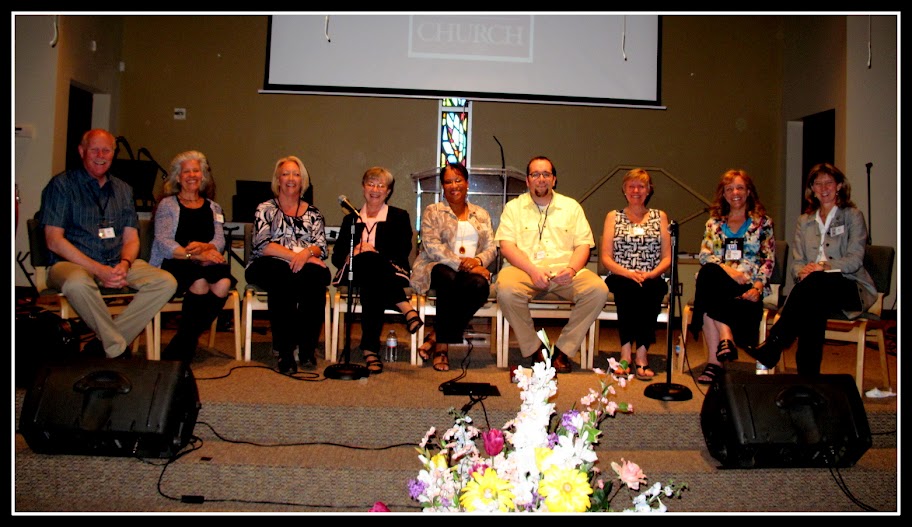
***The faculty (including myself, fourth from left) just before a panel discussion at the AV Christian Writers’ Conference this past weekend.

I just returned from keynoting and teaching at a Christian writers’ conference. As conferences go, it was relatively small but enthusiastic and positive.

Because I speak at several writers’ conferences throughout the year and each seems to have its own unique “personality,” I’ve thought at lot about how those individual conference personalities draw and minister to attendees. Conferences vary according to size, venue, length, and focus, but each has something to offer–IF the attendee has done a little homework first in order to know what to expect.

The conference I attended this weekend was strong on the basics of writing and publishing, particularly for new writers. As a result, though it was only a Friday night/all-day Saturday conference, those who came looking for clear direction on how to get started in the writing/publishing industry probably came away feeling satisfied. If conferees were looking for something more substantial==a chance to connect with several agents and/or acquisitions editors from publishing houses–may have felt they made a wrong choice in attending.

Writers’ conferences are, for the most part, one of the most effective ways for an up-and-coming writer to spend his/her money. The larger conferences offer one of the few ways a previously unpublished writer can meet agents and publishers face to face and have their manuscripts get at least a cursory consideration. They are also a great way to expand writing relationships and networks. Local critique groups are most effective in establishing ongoing, regular communication with others of like mind, but conferences connect writers with others in the industry–a key in getting established in the publishing world.

Many Christian writers’ conferences are focused on just that–writing, at all levels, including marketing (which, yes, goes hand in hand with successful writing, particularly with books). To a smaller degree, some conferences stress an evangelical or social issues theme–i.e., the persecuted Church or human trafficking. Some offer free time for writers to break away from workshops and sessions so they can spend time alone with God and/or with other conferees, which some keep attendees racing at break-neck speed from one event to another, ensuring that everyone has the opportunity to soak up as much knowledge and information as possible. In addition, some conferences offer critiques of your existing manuscripts, while others don’t, so this is should be a major deciding factor if you have a manuscript for which you are seeking personal, professional feedback.

If you or someone you know is considering attending a writers’ conference, I can’t stress enough the importance of checking out the conference’s website first, as well as obtaining any additional, specific information possible. (Clarifying all expenses involved is also necessary, as some conferences include housing and meals in the conference fee, while others do not.) Be clear with yourself on what you’re looking to obtain from a conference, and then check around to see which conferences sound most suited to your needs.

I would love to hear from anyone who has comments or questions on writers’ conferences, whether those questions and comments are born out of previously attended conferences or whether you are considering attending one for the first time. This can be an extremely positive venture–or not. Like anything else, doing your homework first makes a huge difference.

Posted in Kathi Macias, Uncategorized | Tagged , , | 2 Comments

Being a Healthy Reader by Camy Tang

I will admit that I’m a very unhealthy reader. Why? Because I love eating while I read. It’s literally my favorite thing to do: curl up with a good book, a pot of tea, and some snack.

And I’m not talking healthy snacks. I’m talking chips, cookies, and chocolate.

I have tried healthy snacks–carrots, celery, cucumbers, bell pepper strips, dried apples and other dried fruit. But my favorites are still chips and cookies.

However, I am trying to be healthier–plus I, erm, gained some weight and no longer fit in my clothes, and I’m too lazy/cheap to buy new ones so I want to lose the pounds and keep my Victoria’s Secret jeans. 🙂

So do other people eat while they read or is it just me???

Posted in Camy Tang, Uncategorized | 3 Comments

The Line Between Fair and Foolish by Vicki Hinze

The Line Between Fair and Foolish by Vicki Hinze

 © 2012, Vicki Hinze

Sometimes in writing books for others to read, it’s hard to find the line between fair and foolish.  Actually, sometimes the line is as clear as a sunny day but most often, it’s just as murky as the muddy Mississippi after a hurricane.


We think, as writers, that we’re being too obvious, too fair, and yet when others read, their feedback is as diverse as we were mixed minded in the writing.  Some felt we were too fair, some just fair enough and some foolishly fair and our handling diminished the suspense or message in the book.


I went to an online retailer and read all the reviews on five current bestsellers.  Then I went to a second retailer and read all the reviews on the same five books there.  Afterward, I went to a third retailer and read the reviews available on those same books posted there.


The results were that some liked one thing, some another, and still others liked nothing.  The mix was evident.  And it proved what writers have always known:


Readers are diverse, and writers are and should be grateful for it.  Otherwise, we’d need one writer and one book and that’d be the end of it.  Because readers are diverse, some will love what we write, some will hate it, and unfortunately some will also be indifferent.  Loving or hating is great.  Indifference stings.


The results also prove that the line between fair and foolish is fine.  It has earned its place.  Readers of one work will not be touched, but will be deeply touched by another work.  And those readers will hate, love and be indifferent to a third, fourth and fifth work.


This convinces me that writers should never hope for all five-star reviews.  They should aspire to a mixed bag of reviews and reader feedback.  Love, hate, and indifference is evidence that the writer is walking that fine line—and doing it well.


As I write this, I’m thinking of books that touched me deeply—both positively and negatively—and I’m having to search my memory hard for those books that left me feeling indifferent.  I’m not sure if that means I’m too opinionated or normal.  Maybe it means it’s normal to be opinionated.


Or maybe it means that we write books and trust that the right people will find them at the right time when the message in the book resonates for them—when this specific book is what the reader needs to read at that moment, in his/her current circumstance.


I’ve written a lot of books and I’ve always written each book for a purpose.  Sometimes it takes a while, but always someone will write me a note or an email and say that the book was just what they needed—and then go on to disclose why it was perfect for them at that time.  That perfect reason relates to the purpose for which I wrote the book.  It’s humbling to receive notes like those.  But it’s reassuring, too.  Because the indifferent rarely write.  They might post a review, but they rarely message the reader that the book did nothing for them.  Those who love or hate the book are far more apt to write the author.  They’re more invested.


In reviewing books I didn’t care for, I discovered that they hit hot buttons inside me.  And while that wasn’t fun, it was often helpful.  It gave me the opportunity to revisit that hot button and to make choices again on it being a hot button.  To explore why it was a hot button and reevaluate.  Even though I didn’t care for the experience, it was a beneficial experience, and now I wonder if that initial negative reaction wasn’t surface clutter, because beneath it there lay a great opportunity for me.   One tied to spiritual and/or emotional growth.


Now that potential fascinated me.  So on went the reviewing books that left me indifferent.  What I discovered was that they just didn’t speak to me at the place I was standing at the time I read them.  Later, when I reread them, some of those books actually spoke to me—and my second reaction was far different from the first!


And that’s my point.  The fine line isn’t just fine, it’s also tied to time.  Sometimes the timing is right, sometimes it’s not.


Have you looked at the books that you’ve loved and hated and been indifferent to?  Why did you love or hate them?  Did you later find an indifferent work, well different?  Relevant to you in a way it hadn’t been during the first read?


After all this, I’ll tell you.  My attitude has changed.  Some books I love and feel I’ll always love.  Some I hate for now and may or may not hate later.  Some are just plain not for me but more of them are snagged in shades of gray.  And of the ones I reacted to with indifference, I’ll say, “indifferent for today” and I’ll set them aside to read again later.


Because the line between fair and foolish is thin and tied to time.


And it seems we really only know if we’ve walked the line or crossed it in hindsight.


Blessings,


Vicki


Posted in Uncategorized, Vicki Hinze | Tagged , , , , , | 1 Comment

What’s The Perfect Length?

ImageI’ve  heard it said that a well-written book is always too short and a poorly written one is always too long. Do you think that’s true?

I admit that phrase reflects the way I feel. Right now I’m reading a nearly 1,000 page tome – fiction, believe it or not. When it was recommended to me by someone who loved it, I looked forward to getting into it. But it didn’t take long to see that some of the writing was less than stellar (passive, repetitive, including more information than necessary). It was set during a favorite era, though, so I didn’t want to give up (and perhaps more importantly I didn’t want to disappoint my friend by not reading her recommendation).

Then I resorted to the same trick I used the last time I read a book of this length. Although I had the print copy, I went to the library to see if they offered the audio version—and they did. So whenever I got into the car, I listened to bits and pieces of it. At the end of the day when I do my reading I’d scan through the written book until I found where I’d left off in the car. It worked to get me through several hundred pages that way, and long enough for me to become engaged with the characters. At least enough to want to finish.

But there’s still a problem with the size of the book. It’s difficult to hold and would be far better as an e-book. I nearly drop it every time I pick it up.

Here’s what’s so amazing to me, however. As much trouble as I had getting into this book, holding it upright, switching between audio and print versions, there did come a point when I cared enough about the characters to want to finish. The length ceased being an issue for me. I’m a little over 100 pages from the ending, and I might even be sad to close the cover for the last time.

What about  you? Does length matter before you even pick up a book, or are you ready to give any book a chance? If the characters draw you in, are you ready to stick with them all the way to the end—no matter how far that may be from the beginning? Or is it something other than just the characters—the setting, the subject, the plot? Or are you like my sister, who always finishes every book she starts, even if she doesn’t like it? She absolutely must finish whatever she starts.

Posted in Uncategorized | Leave a comment

Will There Be Novels In Heaven?

Do you wonder about that? I do, probably because I love to read and can’t imagine there not being stories in heaven. So, yes, I believe there will be stories in eternity. But I’m not sure we’ll find books there. We might find something far more powerful.

The combined gross of movies in any given year is significantly greater than the total number of book sales. Why? One reason might be the ability of movies to make stories visual in a way books can’t. So what if in heaven we’re able to create and read  stories that people not only can see, but can live in?

Might we be able to be inside the story, watching the events unfold as if they are standing on stage during a play. Or maybe we’ll be actual characters in the book.

I don’t know what it will be like. But if “”No eye has seen, no ear has heard, no mind has conceived what God has prepared for those who love him” is true—and I think it is—heaven will be a story lovers paradise.

What about you? Do you think there will be novels in heaven?

Posted in Uncategorized | Tagged , | 2 Comments

Want a good novel to read? Check out the Christy Finalists!

The list is here at Wynn-Wynn Media.

He won’t toot his own horn, but congrats to Jim Rubart for his Christy nomination!

Posted in Uncategorized | 2 Comments

Let He Who Has Ears Hear by Vicki Hinze (in for Hannah Alexander)

Recently I read a review on a work that made me think.  I love it when that happens—and o f course, I had to read the book to see what (and how) it was written to evoke that emotional response in the reviewer.

Understand that those who review books read all the time.  If they’ve been reviewing for any length of time, they’ve seen it all.  So it isn’t that they become cynical, it’s that they become familiar.  And familiarity makes snagging and holding their attention more difficult.  So when a book does hold a reviewer’s attention or excite him/her, I’m automatically curious.

This was a review of a faith-based novel, and the reviewer clearly loved the story, the characters and the premise.  The nugget that snagged my interest addressed an aspect of the novel that the reviewer felt was essential information to her own readers.  It was about the novel’s spiritual element and the way it had been incorporated into the book.  It diverged from the typical and yet the spiritual message came through clearly.

It diverged from the typical and yet the spiritual message came through clearly.


Hear and Listen

That’s the part that first snagged my attention and then my interest.  Must we as writers all write spiritual elements the same way?  Must we focus on that which is expected rather than what enhances the story we’re attempting to share?

These are valid questions worthy of serious consideration.  And, as we step around to the other side of the table and view works through the eyes of readers (and as readers), I wondered the same thing.  As a reader, do I expect every author and every book to address spiritual issues the same way?   And if I don’t, should I?

It would have been easiest to just dismiss these questions.  Or to tell myself that not all books appeal to all readers and that’s great because if they did, we’d only need one writer and, for that matter, one book.  But that was an off-the-cuff reaction that was superficial and the possibilities nagged at me, warning me to dig deeper and think seriously on this.

Then I remembered Acts.  In in Book of Acts, diverse groups of people were gathered and each individual heard what was being preached in his own language.  One speaker, and yet all who heard what that one speaker said heard it in his own native tongue.

That led me to thinking about how God interacts with us.  Some he whispers to while they sleep.  Some he appears to in the form of a burning bush.  Some he encounters on mountains.  And some he knocks off their horses to get their attention.  Think of Jonah.  He didn’t get a whisper or a whack or a mountain.  He got the belly of a whale.

Those are just a few examples of the divergent ways God communicates with us, and if He uses diverse means, we know it’s for our greater good.  It’s also for our understanding.   By His actions, God shows that it takes what it takes to get our attention.  We’re not one-way-fits-all receivers or communicators.  He gives us what we need in a way we understand.

I’m a simple woman.  Big big mental pretzels make me crazy, so I break them down into parts.  You can grasp just about anything if you understand the parts and then look at the bigger picture of the whole pretzel.

So back to the reviewer.  She clearly knew her readers.  She knew what they expected and needed from her to grasp their attention and let them know whether or not this book was right for them.  That they’d find what they expected to find, or not find what they expected to find in it.  She did what God does:  approached those with which she wished to communicate in a way she’d get their attention and give them what she had to share.

Getting simpler still, you could hand me the best book in the world.  But if it’s written in Latin, I can’t read it.  So no matter how excellent the book might be, the message in it is lost.

And that’s the reason we need diverse books with diverse approaches and reviewers who assist in getting the books from authors to the readers who have ears to hear them.

I’ve long believed that writing a specific book a specific way is the writer fulfilling purpose.  In this, the reviewers’ purpose grew clear.  And I discovered a deeper understanding about ears and hearing, which likely was God’s point in having me notice that specific review by that specific reviewer and it snagging my attention and nudging me to dig deeper in any analysis.

By the way, for me, the book spoke in a way that reached my ears.  I not only heard but listened to its message.  Two very different things, hearing and listening.

So my wish for you today is that the book you’re reading speaks to you in a way that reaches your ears and you hear its message.  The choice on whether or not to listen is yours alone.

Either way, I wish you many . . .

Blessings,

Vicki

©2012, Vicki Hinze


Posted in Hannah Alexander, Uncategorized, Vicki Hinze | Tagged , , , , , , , , , , , | 3 Comments

Fiction vs. NonFiction Popularity by Kathi Macias

I just returned from a lovely–albeit far too brief–visit to Canada, where I did the 100 Huntley Street program and thoroughly enjoyed it. I had a bit of a surprise, though, when I discovered that rather than discussing my newest books–in particular, the fiction series on human trafficking–the host wanted to talk about a nonfiction book I published a few years ago called Beyond Me: Living a You-First Life in a Me-First World. I was happy to do so, of course, as I absolutely believe in the book’s message, and it was Easter week, after all, so a “beyond me” focus was certainly appropriate.

However, a few days later I did a book-signing where I featured my newest books–all of which are fiction–but also included some of my nonfiction books from recent years. Once again I was surprised to find that the non-fiction books seemed the most popular. I sold out of those quickly and had to take orders for more.

Now that’s a great problem for an author to have, right? But it puzzled me. The Christian publishing world seems to be so fiction-oriented at the moment, and nearly all the contracts I’m getting are for fiction. But is that really what the reading public wants?

The more I thought about it, the more I thought ‘Christians Read” would be the best place to ask about this. Any of you readers want to chime in? Do you read both fiction and nonfiction, or one or the other exclusively? If so, why? Also, if you do read only one exclusively, what would it take to entice you to become a combination fiction and non-fiction reader? What topics and approach might make a difference? Finally, what is it that you want to gain or take away from your reading that might affect how we authors approach our writing? Do you primarily want to be entertained? If so, am I correct to assume you prefer fiction? Are you looking to be discipled via your reading, using books that are appropriate to individual or group study? Non-fiction might work best in that situation.

Overall, as one who has written both fiction and non-fiction books and who also likes to read both, I would very much like to hear from readers if you have any views on this. Were my two recent experiences just isolated instances, or is nonfiction regaining popularity? Please chime in, readers. We authors are all ears!

Posted in Kathi Macias, Uncategorized | Tagged , , , , , | 9 Comments

Books in a Series: Print, Digital, or Library– Which Format Do You Choose? by Elizabeth Goddard

On my last post I mentioned I’d started reading THE HUNGER GAMES so that I could read it before seeing the movie. I still haven’t seen the movie but I’m hoping to remedy that today. I mentioned, too, that this story isn’t the usual kind that I read—it’s not a romance, romantic suspense/thriller, or a historical romance. That being the case, I hated the ending because it wasn’t a HEA (happily ever after). That meant, of course, that I had to read the next book. When I looked it up on Amazon, I discovered the Kindle Owners Lending Library so figured I’d try that for this book. I’d already purchased the hard copy of the first book.

As Jim Rubart mentioned in his post this week, when you’re writing, it’s tough to find time to read, but I just turned in a book to my publisher this week and that means instead of writing and reading for endorsements or judging contests, I can get in some extra reading for pleasure.

Okay. So finished the second book, CATCHING FIRE, and now I have to know how this series ends because the book ending wasn’t a book ending—it was a series hook—so I figure I’ll just go right into the reading the next book by downloading from the Kindle Owners Lending Library again and that’s when I discover the CATCH.

I can’t rent another book from the Kindle Owners Lending Library because I can only rent one book a month! What a great marketing hook , right? Of course I immediately buy the third book, MOCKINGJAY. That’s fine, too, because I want to support authors, the blood, sweat and tears they put into writing a novel. I only meant to try the Kindle library anyway.

In the end, that means for this series of books I own the hard copy of the first book, I own nothing of the second book, and now I own the third book in digital format. I have to admit I’m a little frustrated by this–owning various forms of this series seems discombobulating to me.

There are several books that I own both digitally and in print copy. Do you have a collage of book formats?

Blessings!

Beth

(I’m still reading MOCKINGJAY and I’ll let you know how I feel about the ending next time.)

Posted in Elizabeth Goddard, Uncategorized | Tagged , , , , , , , , | 2 Comments

Is Reading Attached to your Happiness? by Maureen Lang

A friend of mine, author Sunni Jeffers, came across an interesting post that linked positive thinking to reading. Being an avid reader myself, it naturally made me wonder if I’m in a generally better frame of mind when I’m immersed in a book—either reading or writing one.

The answer to that is an absolute yes. The only thing that annoys me when I’m reading a good book is an interruption keeping me from reading that good book.

And when I’m writing a book, once the plot and characters have caught me and start acting everything out for me to record—well, there’s just nothing better. Those are the days I can’t help but walk around with a smile on my face. I feel like I was wired to write, and those kind of days just prove it.

The article talks about how the things we experience via reading can not only entertain and educate, but expand our experience level and give us more compassion. I absolutely believe this. A few years ago I wrote a story about a woman who is the mom to a severely handicapped child. Because of some especially challenging circumstances in her life, in one desperate attempt to end her life and her child’s, she attempted a murder/suicide. Not something I could imagine doing, or even sympathize.

Until I got inside the head of a woman desperate enough to do such a thing. Since that book, My Sister Dilly, is inspired by a true story, I had the opportunity to speak to a woman who’d been through such a horrific experience. Through her, I understood a least a little of what such a thing might have been like. And it gave me more compassion. I’ve heard from several readers that it did the same for them. It was even possible for me to maintain a positive attitude about a subject that, at least on the surface, might have been a downer.

So can reading improve our life? Our mood? Our attitude? What do you think?

Posted in Maureen Lang, Uncategorized | Tagged | 2 Comments

Finding Time To Read by James L. Rubart

I used to read for pleasure. A lot. It was one of my favorite things. (Insert Julie Andrews singing here–and you’re old enough to get that reference I love ya’!)

Yes, the dearth of reading comes from the time I now pour into writing, reading manuscripts for possible endorsement (which can certainly be fun at times, but it’s a different kind of reading) and a million different activities.

But if I’m honest, I let a lot of time get sucked way because of e-mail. I have this nagging belief I have to clean out my e-mail box every day. I made a resolution at the start of the year I wouldn’t let e-mail stack up again in ’12 like I did in ’11, ’10 … well, forever. I’m horrible at it and am currently about 3,000 e-mails behind.

It’s time to make a change. No, I’m not going into solitary till I can get caught up. I’m going to give myself the grace to say it’s okay to not answer every e-mail. And I’m going to take it a step further.

No e-mail on Sundays. And with that time I’m going to read. For me reading is soul food. And the beast is hungry. It refreshes me. Inspires me. Brings peace.

Do you feel that way? Have you fasted from e-mail? How did it go? What does reading do for you?

Posted in Honored Alumni, James L. Rubart, Uncategorized | Tagged , | 3 Comments

Plebeian Reading Tastes by Camy Tang

My name is Camy, and I have plebeian reading tastes.

Yup, uncultured, unrefined, lowbrow, philistine reading tastes.

My tastes do not run to poetic prose. I want the common, vulgar fiction known as popular fiction or genre fiction.

No artfully crafted literary fiction for me. The fewer college degrees the author has, the better (my exception might be Eloisa James who is a flippin’ smart college professor).

I would not choose to read a classic (except for Jane Austen). I would instead reach for a category romance. I will finish it in a few hours and probably not read it again. I will never need to reach for my dictionary to look up a word in the book. The characters will feel like my friends.

At the end of my book, the heroine will not die, nor will the hero leave the woman he loves in the arms of another man and go off to find himself a new life, nor will the main character see his son killed in front of his eyes and give up his greatest dream as a consequence. No, I will be blissful at the end because the characters live happily ever after.

I am also usually averse to spiritually or emotionally enriching nonfiction because I’d rather read a pulp fiction book. Yes, I am not interested in improving myself. I simply want to be entertained.

For part of my life I was made to feel ashamed at my coarse reading tastes. As a Christian, especially, I thought I needed to immerse myself in all the great Bible studies and books on how to walk deeper with God. I read my common novels in secret. I didn’t have anyone to share them with.

Then I got older and realized that like my faith, my reading tastes are personal, so why should I care about people who criticize either? If God doesn’t object to the fact I like simple romances, and not literary fiction or nonfiction, then no one else has the right to have an opinion about it.

So what do your tastes run to? I promise not to cringe if you love literary fiction if you promise not to sneer at my pulp fiction.

Posted in Camy Tang, Uncategorized | 6 Comments

Matthew 27: Wondering What Happened on Saturday by Julie Arduini

Matthew 27 (verse from BibleGateway.com)
The Guard at the Tomb

62 The next day, the one after Preparation Day, the chief priests and the Pharisees went to Pilate. 63 “Sir,” they said, “we remember that while he was still alive that deceiver said, ‘After three days I will rise again.’ 64 So give the order for the tomb to be made secure until the third day. Otherwise, his disciples may come and steal the body and tell the people that he has been raised from the dead. This last deception will be worse than the first.”

65 “Take a guard,” Pilate answered. “Go, make the tomb as secure as you know how.” 66 So they went and made the tomb secure by putting a seal on the stone and posting the guard.
good friday Pictures, Images and Photos

I don’t know if it’s a writer thing or just a curious Jesus girl thing but I’d like to know about Saturday. We have details about “Good” Friday where Jesus was crucified. We know all about Resurrection Sunday.

So, what do you think Saturday was like?

Matthew 27:62-65 gives us a glimpse and if I close my eyes, I can picture the scene.

Want to close your eyes and journey with me?

Those that loved Jesus are devastated and confused. Those that hated him are giving shouts of celebration and recounts of key moments. Government officials are proud. They took down the biggest threat to their government with no fight from this so called king. Barabbas? The real criminal? I imagine he’s overwhelmed with ideas on what to do with his new freedom.

All of them, I can guess, are spending Saturday with one eye over their shoulder.

Haunted.

Scared.

Anxious.

Sick.

I bet they see shadows in the pique of daytime. With that, they stop everything and look. Wonder.

Pilate and his officials take tentative steps all day. When Pilate brings a chalice to his lips— I’m sure his hands are shaking. The guards around the tomb are exhausted, even though their shift just started. The mental strain of waiting on the promises will do that.

Barabbas starts dozens of plans to satisfy self but can’t complete one evil idea. He knows where he belongs and he can’t shake it. For all the open spaces and freedom he slinks in a corner, the tomb in view. He wraps his knees to his chest and rocks back and forth. The same position he had in prison.

The devil paces back and forth, anxiety quadrupling with every step. His defeated hands over his ears. His minions keep repeating what he already knows.

What about the third day?

He knows God’s Word. Oh, he twists it, but he knows. And I suspect he can’t enjoy his victory because he knows it is short lived.

Heaven is muted. A sense of grief and confusion weaves throughout the streets of gold. Something is in the works. But what?

***

We know because of Friday, God hid His usual palette of color and painted a bleak gray scene for the world to interact in that Saturday.

How about you? What do you imagine happened?

Posted in Julie Arduini, Uncategorized | Tagged , , , , , , , | 1 Comment

Measuring Worth by Vicki Hinze (in for Hannah Alexander)

Measuring Worth by Vicki Hinze © 2012  (in for Hannah Alexander)

Due to a death in the family, Hannah Alexander is unable to post.  All of us at Christians Read offer our prayers for comfort and peace to Hannah and her family.


I’m filling in for Hannah today, and while I’m not gifted with her wit and charm, I do hope you’ll find something useful to you in this post.


This morning on Facebook, there was an ad on my vicki.hinze.author page.  It read:  FIND OUT YOUR WORTH and offered a free calculator as a gift for doing so.


It struck me as hilarious.  Imagine.  Measuring the worth of a human being in such a simplistic and silly manner.   But the more I pondered on it, the sadder I became.  And I soon found myself ashamed for finding humor in something so twisted.  If this is an indicator of how we view and measure ourselves, well, is it any wonder so many are confused and depressed and stay torn up inside?


Oh, we all know that in our current culture “net worth” is often measured by dollars and success is defined by money, position and/or power.  I admit that I’ve never understood that.  I know too many wealthy people who are miserable, used by others and lost.  Just hopelessly lost and struggling to find some meaning in their lives.  I know too many in positions of power that spend all their time worrying about keeping it, getting more of it, and fearing every other person in the world is manipulating them trying to steal it.  What kind of power is that… really?   You don’t often see contentment or peace at the top of their lists as what they have, but you do hear a lot about them wanting both and fearing they’ll never know it.


There are exceptions of course.  Those who think they’re above the rules and corruption doesn’t apply to them because of their special status.  Imagine the sad day that they realize they are accountable and in that accounting, there is no spin, no excuse, no bloviating, no ducking or running.  Comeuppance doesn’t discriminate.  We reap what we sow and we are accountable for every thought, word, action or deed—and yes, inaction is an action.


Earlier, I’d see something like this and just chuckle and mumble, “Lord, give them a clue.”


That didn’t happen this morning.  I looked at this through God’s eyes.  After all, He created us each and every one and loves us all equally.  And what flooded me was a deep and intense sadness.  His child hurting, His child clueless.  His child missing the point of a personalized life mission and purpose, of a personalized, handcrafted, molded mission that is evidence of each individual’s unique position and power and success.  Those things are infused in each of us by the very hand of God.  No two are exactly the same, and no other individual in the world can fulfill an indivudual’s specific purpose aside from the individual for whom it was crafted.


We are all special.  We are all powerful.  We are all incalculably worthy.


Worth can’t be measured in money or numbers any more than the measure of a man can be taken by his words.  The true measure of a man is evident in his actions.  That reveals what’s in his heart.


And that’s what I saw today in these deeper thoughts, viewing through my imagined perspective from God’s eyes.  And through that prism, I saw the pain He feels at our missing the significance of our purpose and our worth.  I saw the tragedy in the culture and the people who populate it in its kind of measures.  The hollowness of it all.


And so I’m moved today to remind you that you have a specific mission and you were created precisely as you are to fulfill it.  You have all the traits, all the abilities and skills required, or the ability to attain them, to fulfill this mission.  You have the wisdom and strength needed to exercise the judgement necessary to do the right thing for the right reason at the right time for the right person.


You see, our culture tells us we don’t change the world.  But it’s wrong.  We do.  When we impact one person in one small way, that person changes, and because s/he has, s/he will impact and change another who will change another and so on and so on.  The ripple keeps going.


That’s powerful—and often these seemingly insignificant situations are missed.  We diminish the value of them because we don’t recognize the value of them.


But if we pause just for a moment, we can position ourselves to see these things as God does—and to Him, I sincerely doubt any are insignificant.


What is the value of:


A kind word to someone lonely who hasn’t had human contact for a time?


A “well done” to a child who only hears what a rotten kid s/he is?


A smile to someone who has no one to smile at them?


A sincere “How are you today?” from someone who actually wants to know and listens to the response.


Mowing the neighbor’s yard because s/he has no mower or it’s in the shop?


Offering a worker a sealed bottle of water or something to drink?


Little kindnesses like these are said to cost us nothing.  That isn’t true.  They are treasures and cost us deeply.  They cost us something money can’t buy, no position or power can give.  They cost us a precious commodity we can’t bargain or extend.  They cost us our time.


Each sliver or segment is of the greatest value to us.  So when we share it, we’re giving our best.  We should realize that.  And so too should those with whom we share.


Measuring worth.  It’s like measuring time in a way, isn’t it?  Not in minutes or hours or years, but in moments.   Some are tender, touching, compassionate.  Some are sad, grief-stricken, shattering.  Some are joyful, elating, swell your heart until it feels too big for your chest.  But each is precious.


And the reason each moment is precious and it matters is because we know its worth.  What a gift it would be if in our culture we’d discover our own.


Blessings,


Vicki

————————————-

Latest Release:  NOT THIS TIME


Posted in Hannah Alexander, Uncategorized, Vicki Hinze | Tagged , , , , , , , , | 1 Comment