Late Roses by James R. Coggins

We have a rose bush that produced numerous beautiful roses this summer. I cut the dead flowers off as is recommended, and new roses bloomed on the end of the cut-off stems. As we moved into autumn, I cut off the dead remains of this next crop of roses as well. To my amazement, the bush produced more roses even though it was now mid-October and the days and nights were much colder.

This reminded me of the promise in Psalm 92:12-14:

            The righteous will flourish like a palm tree,

            they will grow like a cedar of Lebanon;

            planted in the house of the Lord,

`           they will flourish in the courts of our God.

            They will still bear fruit in old age,

            they will stay fresh and green.

I was thinking about this lately. I am now in my fourth quarter-century.

In my late 50s, I suddenly found myself unemployed and wondering how I could support myself and my family until retirement. I eventually launched into freelance editing and writing (emphasis often on the first syllable). But God provided all I needed and more. In my 60s, that led me to establish a book publishing imprint called Mill Lake Books. This imprint has now published over two dozen books.

Two new books have come out this fall. The first is a collection of my own short stories: The Cabin and other stories. I wrote the first of these stories in my 30s, but several of the stories, including the longest two, were written in my 70s. I am convinced that they are some of the best things I have ever written.

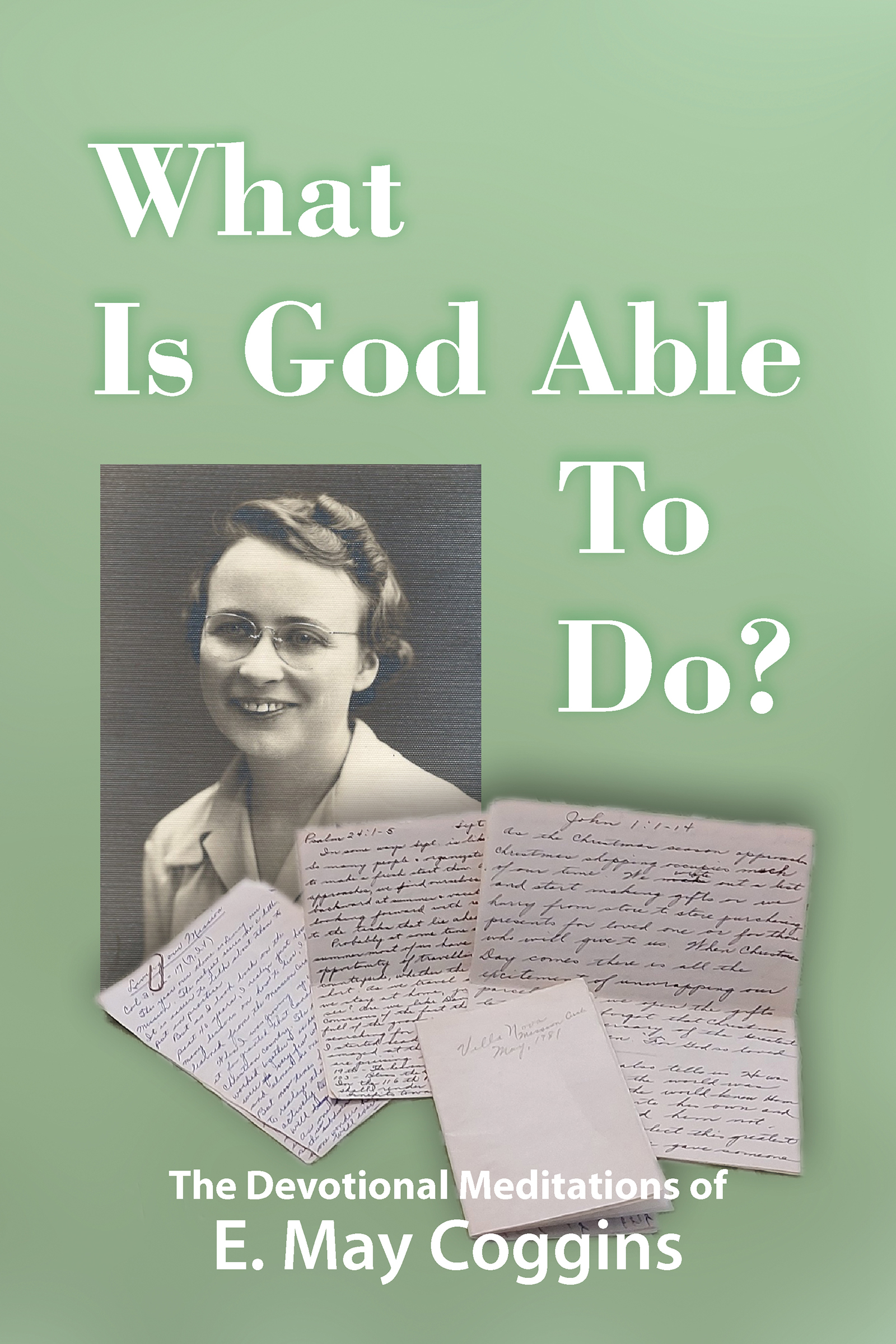
The other book is What Is God Able to Do? The Devotional Meditations of E. May Coggins. This is a collection of biblical meditations that my mother gave in women’s meetings and adult Sunday school classes over her long career. The earliest meditation was delivered when she was a single woman in the 1940s. The most recent was delivered in her 80s. She continued to serve and teach until her sudden death from a stroke at age 84.

Both books are available through the usual channels, bookstores and online retailers such as Amazon.

I do not claim to be righteous, but I and my mother placed our faith in Jesus, and He has promised to confer His righteousness on those who trust Him. As Psalm 92 makes clear, we can prosper only by the grace and blessing and goodness of God. I have been blessed into my old age, and I am grateful.

Posted in James R. Coggins | Tagged , , , , , , , | 1 Comment

When God Meets Us in the Mud Pies

There are few things more joyfully messy than an afternoon spent with grandkids—and I wouldn’t trade those moments for anything.

Although mine is older now, my granddaughters used to love to make mud pies. They’d create pies, cakes and cookies—all from mud. As child this was one of my favorite things to do as well.

When I knelt beside them, helping to mix their latest “recipe,” I realized that something beautiful was happening amid all that glorious mess. God was reminding me that sometimes the richest moments in life come when we’re willing to get our hands dirty.

Lessons from a Backyard Bakery

1. The best memories aren’t always neat.
There was mud everywhere on the little picnic table we used as our bakery, dirt streaks on our faces, and a load of laundry waiting inside—but there was also laughter. Pure, bubbling, contagious joy. It struck me that faith can be like that—messy, unpredictable, but full of life. God’s grace often shows up right in the middle of our chaos, not after we’ve cleaned it all up.

2. God delights in childlike joy.
Watching my granddaughters’ faces light up reminded me of Jesus’ words:

“Whosoever shall not receive the kingdom of God as a little child shall in no wise enter therein.” (Luke 18:17 KJV)
Children don’t overthink. They don’t worry about how they look or whether they’re “doing it right.” They simply dive in with their whole hearts. Maybe that’s what Jesus meant—don’t stand back trying to stay tidy when He’s inviting you into joy.

3. Mess can be ministry.
We may not all be called to preach from a pulpit, but every one of us can share love in the everyday places—on a muddy patio, over a kitchen table, or in a grocery store aisle. When I helped shape those little mud pies, I wasn’t just spending time with my granddaughters—I was building something eternal: trust, laughter, and the kind of love that points back to God.

A Thought for Today

Maybe your life feels a little muddy right now—plans that didn’t go as expected, days that look more like dirt than dessert. Remember: God can turn even that into something meaningful. He’s not waiting for the floor to dry or the clothes to be spotless. He meets us right where we are, muddy hands and all.

So go ahead—lean into the moment. Laugh louder. Love deeper. And don’t be afraid to make a few “mud pies” along the way. They just might become the sweetest memories of all.

A Simple Prayer

Lord, thank You for meeting us in the mess.
Thank You for the laughter of children, for simple joys, and for the lessons hidden in muddy hands.


Help us to embrace life’s imperfect moments with gratitude and grace,
knowing You can use even the dirt beneath our feet to grow something beautiful.
Amen.

Blessings,
Mary

Posted in Uncategorized | Leave a comment

Snapshots of Blessings by James R. Coggins

Recently, my wife and I took time to sit down and systematically look through our many photo albums. They chronicled our lives together for almost half a century. They were an opportunity for us to reflect on our lives.

I am not sure what I expected to learn or to feel.

The photos did not so much record everyday life. They recorded highlights and transitions. They depicted trips, holidays. friends, pets, sightings of wildlife, new cars, new houses, renovations, memorable meals, cakes, children, grandchildren, births, weddings, graduations, and achievements. They also recorded, deaths, lost relationships, disappointments, and struggles.

Looking back, I realized how blessed we have been. We have experienced a wonderful parade of trips, holidays, friends, pets, new cars, new houses, renovations, memorable meals, cakes, children, grandchildren, births, weddings, graduations, and achievements.

I also wondered what I could have done better. I had an overwhelming sense that I missed or overlooked too much. I should have enjoyed and valued those blessings, those friends, those family members even more than I did. I should have rejoiced in them, marveled over them, and been thankful for them. Blessings are not fully blessings if we do not exult in them, if we do not receive them with joy.

I also wish that I had loved more and better, that I had told friends and family members more often that I loved them and appreciated them and valued them. I wish that I had encouraged them more and that I had encouraged them to revel more in their blessings. I wish that I had thanked them better and more often for all that they did for me. I wish that I had comforted them better in their pain, that I had found the right words of comfort and wisdom to say, that I had found better ways to ease their pain and suffering. I wish that I had lived with more grace.

Posted in James R. Coggins | Tagged , , , , , , , , , | 1 Comment

Fourteen Years Ago by James R. Coggins

It is interesting to piece together the apostle Paul’s early history.

About 34-35 AD, was Paul converted on his way to Damascus to persecute Christians. Acts 9:23 says that he stayed there “many days” until threats on his life led him to flee. In Galatians 3:17-18, he says he went to Arabia, returned to Damascus, and then went to Jerusalem “after three years.”

This would mean that Paul went to Jerusalem about 37-38 AD. The Christians there were understandably afraid of their former persecutor, but Acts 9:27 says that Barnabas “brought him to the apostles.” However, in Galatians 1:18-19, Paul says he only met Peter and James, the brother of Jesus, and stayed with Peter fifteen days.

Again, Paul’s life was threatened, so Paul was sent to Tarsus, which was evidently Paul’s hometown (Acts 9:11). Tarsus was in the eastern part of what is now Turkey, in a region then called Cilicia (Galatians 1:21), just northwest of Syria.

Paul apparently spent several years there, but little is known about what he did. He does not appear to have done much preaching or evangelizing. As Jesus pointed out, prophets are often given little honor in their hometowns (Matthew 13:57). Perhaps, Paul spent some of that time studying what the Old Testament prophecies said about Jesus, preparing for his future ministry, even though he probably did not yet fully envision what that would be. There is no indication he ever returned to Tarsus later on after these quiet years, although Acts 15:41 says that on his second missionary journey Paul “went through Syria and Cilicia, strengthening the churches.”

When the church was founded in Antioch, in northern Syria, the church in Jerusalem sent Barnabas to help guide the new church. Barnabas went to Tarsus, which was only 100 miles or so farther north, and brought back Paul to help him with the teaching. This was probably about 45 AD because Paul taught there for “a whole year” (Acts 11:25), made another visit to Jerusalem, and shortly afterward was sent out on his first missionary journey, covering the years 46-47 AD.

Paul’s second missionary journey was longer, from 48 to 51 AD, during which he first visited Corinth (Acts 18:1-18). Paul then visited Jerusalem and spent considerable time in Antioch before going on his third missionary journey from 53 to 59 AD.  Paul only spent about three months in Greece on this journey (Acts 20:2-3), but during this journey he apparently wrote 1 Corinthians about 54 AD and 2 Corinthians about 55 AD.

In 2 Corinthians 12:2-4, Paul told the story of “a man” (almost all commentators believe this refers to Paul himself) who was “caught up to the third heaven.” Paul did not know if he went there physically or only in a vision. One explanation of this puzzling phrase is that, in Greek thought, the first “heaven” was earth’s atmosphere of air and clouds, the second “heaven” was the realm of the stars and planets, and the third “heaven” was the realm of the gods. What Paul was saying is that he had a similar experience to that of the apostle John when John was in exile on the island of Patmos and wrote Revelation—he was granted a rare vision of the throne room of God. In the presence of God, there is no room for personal pride, which was the point of Paul’s long defense of his ministry in 2 Corinthians 10-12. He was saying that even though he had had a much more illustrious ministry than the “false apostles” who were misleading the Corinthians, none of them had a right to boast before Almighty God. Knowing God and receiving revelations from God was a gracious gift, not an achievement.

When did this vision occur? Paul said it was “fourteen years ago,” or about the year 41 AD. This would have been during those quiet years when Paul was living in Tarsus and perhaps studying the Old Testament and learning more about Jesus in preparation for his later missionary work.

Posted in James R. Coggins | Tagged , , , , , | Leave a comment

The God Who Restores

In my latest Love Inspired Suspense book, Shattered Amish Identity, Hannah York’s story is ultimately one of restoration. And so is ours. God specializes in rebuilding what’s been broken and redeeming what’s been lost.

“And I will restore to you the years that the locust hath eaten…”
Joel 2:25, KJV

No matter what part of your story feels shattered — your past, your identity, your hope — God is able to piece it back together into something beautiful. And like Hannah, when you place your trust in Him, you’ll discover that your true identity was never lost… it was simply waiting to be revealed.

Shattered Amish Identity is more than a suspenseful story — it’s a reminder that even when everything you thought you knew is stripped away, God’s truth about you remains unshaken. You are chosen, loved, redeemed, and held firmly in His hands.

https://amzn.to/4n9j10J

All the best. . .

Mary

Posted in Uncategorized | Leave a comment

Being Bugged by Nancy J. Farrier

Photo by Michaela Merglová on Unsplash

I am part of the worship team at my church. This means some Sunday services I put up the words on the screen, and sometimes I play the keyboard with the worship team. This Sunday, I sang with the choir—not the traditional type of choir, but a group of six to eight singers who add volume behind the main singer. When serving as a keyboardist or as a singer, I participate in all three morning services.

No matter what slot I fill, I take being on the worship team seriously. It is a privilege to be part of drawing people into an attitude of worship, preparing them to hear God’s word. I do my best not to call attention to myself, but to lift up God and glorify Him.

This Sunday that proved a challenge. As we started the first song for the third service, I felt something inside my top. I quickly realized I had a bug crawling on me. As we sang, the bug made its way to my underarm and then down my side. Being up on the stage, I had no way to discreetly get that insect out. 

Many of you might be wondering why I didn’t leap off the stage and go somewhere to remove the bug, but like I said, I take my responsibility in serving seriously and don’t want to call attention to myself. I am there to glorify God. So, I waited as that little critter happily toured around me.

I’d prayed just that morning for something new and fresh to write for this blog post and it seemed God provided—just not in the way I expected. He showed me that serving can be uncomfortable at times, but to truly put Him first takes courage and fortitude.

At church, we are studying through the book of Acts. The disciples faced a lot of difficulties that are recorded there. They were imprisoned, beaten, reviled, and shipwrecked. Through it all their faith stayed steady. They didn’t bring attention to themselves, but they always used those trials to point the way to God. 

Isn’t that what we are to do too? When we face something that is uncomfortable or difficult, we must forget who we are and focus on Who God is. What does He want us to learn? What does He want us to share with those around us? How does He want to use us to further His kingdom?

The answer, of course, is to share Him. The trial we face is a good way to let others know how God came through for us and what He can do for them. Believe it or not, this often makes what we suffered less of a burden. 

So, whether we face imprisonment, reviling, or something as trivial as a bug on a journey that’s annoying, we must put God first. We must lift Him up and not make a show of what we suffered. 

At the break in the song service, I left the stage, went to the bathroom, and removed that tiny beetle who intruded where he wasn’t welcome. And, I thanked God for showing me that He comes first—always.

Posted in Nancy J. Farrier | Tagged , , , | Leave a comment

Balcony People by James R. Coggins

Some years ago, my family and I attended a fairly large church. Sunday attendance ranged from 1,400 to 2,000 people, which necessitated two Sunday morning services. Our family’s practice was to attend the first service and then Sunday school. There was a very vibrant adult Sunday school, where a lot of the fellowship took place. It was impossible to have close fellowship with a thousand people, but much easier to have fellowship with sixty.

The complication was that my wife was in the choir, which sang and led worship during the first half of both Sunday morning services, and this forced an adjustment to our routine. We would go to the first service and Sunday school, and then I would drive the children home, which was just a few blocks away. Then, I would return to church so I could pick up my wife when she was finished singing. I would usually get back about the time the second service started. Rather than sit in the main congregation and be a distraction by leaving in the middle of the service, I would go and sit in the balcony, from which I could exit more unobtrusively.

This is where I came to know about the balcony people. They were quite different from the main congregation. Many of them would come in during the first song and leave during the closing song at the end of the service, leaving little opportunity to talk with anyone else. Many, especially those at the back of the balcony, would not sing at all and would often remain sitting during the entire service.

In time, I came to understand that many of these attenders were troubled people. Some had been hurt by the church or by a death, a failure, or a broken relationship and were deeply grieving. Some were unsure, carefully and anonymously checking out this “church thing.” Some seemed uncertain that they would be welcome in the main body of the church due to their guilt, shame, social status, attire, or lack of social graces.

I am reminded that there were peripheral people in the New Testament too—Zacchaeus, who hid in a tree to watch Jesus pass by; Nicodemus, who came to Jesus by night; the woman who secretly touched Jesus’ clothing in search of healing (Mark 5:25-34); the pagan woman who begged for her daughter’s healing like a dog begging for crumbs under a table (Mark 7:24-30); the centurion who asked for healing for his servant but did not think he deserved to have Jesus come under his roof (Luke 7:1-10);  the nameless, sinful woman, not invited to the meal, who quietly washed Jesus’ feet (Luke 7:36-50); the tax collector who stood at a distance and would not even look up to heaven, but beat his breast and cried, “God, have mercy on me, a sinner” (Luke 18:13).

It is difficult to minister to balcony people. If they were approached directly, they would most likely flee in terror. And yet, I saw these same people came week after week. Despite all of their burdens, their insecurities, their doubts, and their fears, they felt irresistibly drawn to Jesus. Somehow, they knew that He had the answers.

Posted in James R. Coggins | Tagged , , , , , , , , | Leave a comment

Keep the wind at your back and the sun on your face EXCEPT…

Our Minnesota farm sits at the edge of the prairies where forested land begins, but most local land has been cleared to cultivate farms. That means the wind blows wild and free a ross the prairies.

I check daily wind levels to see if I will walk in what might be a blustery gale. Or get my exercise another way.

Today’s forecast predicted above 20 miles per hour, but I made myself walk anyway. After all, the wind would be at my back half of the way. It practically pushed me along, which I enjoyed, realizing that I heard the horse’s hooves and steel wheels of my approaching Amish neighbors more easily. And the luscious fragrance of freshly cut hay in round bales in the fields I passed.

At my halfway point when I turned around into a blustery wind, I found it wasn’t as hard as I expected. I was motivated to get home, and realized that even that is a spiritual truth.

When we’re homeward bound, with at least half of the journey behind us, the momentum of what we’ve travelled sharpens our focus and motivate us to reach home well. The distance doesn’t seem as long and I actually enjoyed feeling the sun on my face both ways.

I also like what author/pastor Cecil B. Murphy says in his current newsletter – “For every problem there is a solution. For every solution there is a problem. Both of them keep us growing.”

And making progress towards home…

Posted in Uncategorized | Tagged , , , | Leave a comment

The Dung Gate by James R. Coggins

Isaiah 60 contains a detailed prophecy about the rebuilding of Jerusalem after the Babylonian captivity. It envisions a prosperous city with wealth flowing into it from many nations: “The wealth on the seas will be brought to you, to you the riches of the nations will come” (Isaiah 60:5 NIV). It is a prophecy about the rebuilding of the actual city but also a metaphorical prophecy about the establishment and extension of the Kingdom of God on earth. It is a prophecy about the capital city of the Jews but also about the restored people of God, the worldwide Christian church composed of saved sinners.

Nehemiah 3 describes the actual rebuilding of the walls around the re-established city of Jerusalem. Included is this description: “The Dung Gate was repaired by Malkijah son of Rekab, ruler of the district of Beth Hakkerem. He rebuilt it and put its doors with their bolts and bars in place” Nehemiah 3:14). A Dung Gate is not something we would normally want to think about, but it was a necessary gate. All cities have a need to dispose of garbage and sewage and animal droppings (dung), and this was the gate in Jerusalem through which this was done. The Dung Gate was likely on the south side of Jerusalem leading to the refuse dump in the Valley of Hinnom, also called Gehenna, where fires burned continuously, and which Jesus used as a metaphor for hell (Mark 9:42-48).

We think of the wealth flowing into Jerusalem and into our lives. We all want to get more, to add more good things to our lives. But the Dung Gate reminds us there are things we need to get rid of, things that take up space in our lives, things that poison and corrupt and contaminate, things that cause disease and death, things that bring brokenness and separation, things that need to go in order to make room for the good to flow in. The New Testament lists some of them:

• “Get rid of all bitterness, rage and anger, brawling and slander, along with every form of malice” (Ephesians 4:31).

• “But among you there must not be even a hint of sexual immorality, or of any kind of impurity, or of greed, because these are improper for God’s holy people. Nor should there be obscenity, foolish talk or coarse joking, which are out of place” (Ephesians 5:3-4).

• “But now you must also rid yourselves of all such things as these: anger, rage, malice, slander, and filthy language from your lips” (Colossians 3:8).

• “Therefore, get rid of all moral filth and the evil that is so prevalent and humbly accept the word planted in you, which can save you” (James 1:21).

• “Therefore, rid yourselves of all malice and all deceit, hypocrisy, envy, and slander of every kind” (1 Peter 2:1).

Posted in James R. Coggins | Tagged , , , , , , | Leave a comment

A Heart at Peace

True peace isn’t found in the absence of problems but in the presence of God. As we draw near to Him — through prayer, His Word, and daily trust — He fills our hearts with a peace that defies circumstances.

“And the peace of God, which passeth all understanding, shall keep your hearts and minds through Christ Jesus.”
Philippians 4:7, KJV

“Thou wilt keep him in perfect peace, whose mind is stayed on thee: because he trusteth in thee.”
Isaiah 26:3, KJV

No matter how chaotic life becomes, we can anchor our souls in His unchanging promises. His peace is not temporary — it is eternal and unshakable.

All the best…

Mary

Posted in Uncategorized | Leave a comment

Retracing Our Steps by James R. Coggins

Recently, my wife and I visited some of the churches we had worshiped in previously, some many years ago. We were welcomed on our return, but the pastors seemed to lose interest once they realized we were not likely to remain and become members. Nevertheless, the visits gave us an opportunity to reflect on what we had experienced.

The buildings were generally the same, but most of the people we encountered were new. People move and grow old and die. And yet, it was the people that impacted us the most. We remain friends with some years later, even though some of them have moved on to other churches. We remain part of the worldwide church of God, and other Christians are our brothers and sisters, whether we are together or not and whether we have ever met or not.

We are grateful for the sound Bible teaching we received in many of these churches. We are grateful for the devout believers who challenged us with their examples of loving and godly living.

We are grateful for the many kindnesses we received while we were part of those churches. People invited us into their homes, encouraged us, prayed for us, offered wise advice, and even gently admonished us on occasion.

We also remember some difficulties. We were disappointed when some of those churches shifted direction and modified their teaching. It was difficult when we were at odds with our brothers and sisters, but our theological understandings were important too, and we knew we could not simply discard them. We were sometimes difficult church members—because of our broad experience, we sometimes had ideas different from those of the church leadership. We tried to be supportive when we could but at other times felt it was better to move on. We have tried to let any grievances and disappointments go.

We contributed significantly to some of the churches and in others received far more than we contributed. For what we received, we are profoundly grateful.

Posted in James R. Coggins | Tagged , , , , , | Leave a comment

A Drought of Faith by Nancy J. Farrier

I’ve gone through several times in my Christian walk when my faith has flagged. Being close to God became more of a memory, than a reality. During those times I’ve struggled and begged God not to forget me. As if He would. I think that was more a plea for me to be close to Him again.

We all have those times when we aren’t walking as closely with Jesus as we should, or as we could be. There is a dryness to our spirit. Our prayer life can suffer, as can our time of Bible study. 

I am reminded of this when I walk through the desert. The picture at the top of the page is one of the plants I pass each morning. This plant, ephedra viridis, or Mormon tea, looks dead. When I took this picture we had gone months without  rain. Then we had some rain, not a lot but enough to bring this seemingly dead plant back to life. It began to show some green, a glimmer of life.

Going through a spiritual drought is similar to what the ephedra viridis displays. We are lacking the water of life that comes from a close walk with Jesus. For whatever reason, we are no longer connected closely to the Source of life.

Jesus told the Samaritan woman at the well, but whoever drinks of the water that I will give him will never be thirsty again. The water that I will give him will become in him a spring of water welling up to eternal life.” John 4:14

We have the water of life welling up within us, but sometimes life intrudes and pulls us down. We forget the connection we have to Jesus, or it becomes dull due to the circumstances we are facing. Perhaps this happens because whatever we’re experiencing has stolen our moments alone with Jesus.

So how do we get back to the place of closeness? How do we reconnect with Jesus and drink of this water He offers?

There isn’t an easy way when you are far from Him. You have to become determined to mend the rift. Read your Bible every day. Pray daily. This can be a difficult task if  you’re dry as a desert plant in a drought. You may have to sip at the water at first, teaching yourself to drink more deeply as you progress.

I’ve learned that once I renew my Bible study and prayer life, then my spirit blossoms. This doesn’t happen overnight. We don’t lose our closeness all at once and we don’t regain it that way either. It takes drinking in Jesus day after day to come back to where we should be spiritually. 

Below is a picture of the same ephedra viridis as above, only after several rains. It is so green and vibrant, much different than the dead-looking plant from the drought. 

As we work to be close to God, we become more vibrant, displaying our Christianity in our very attitude. Drink in that water of life. Enjoy closeness with Jesus.

Posted in Nancy J. Farrier | Tagged , , , | Leave a comment

Shame by James R. Coggins

I have a close friend who has problems, some of them related to issues in his past. Whenever he gets into trouble or does something wrong or foolish, he stops answering my phone calls. He avoids me and hides from me, probably from shame. He does not want to admit to me what he has done. This is foolish. I already know the worst about him and love him anyway. I can’t help him if he won’t talk to me.

So it is with God. When we sin, we try to hide from God. This is very foolish. God knows everything. He knows the worst about us and loves us anyway. After they sinned, Adam and Eve “hid from the Lord God among the trees of the garden” (Genesis 3:8). But God went looking for them, and when He found them, He confronted them and interrogated them: “Have you eaten from the tree that I commanded you not to eat from?” (Genesis 3:11). He knew what they had done, but He asked them so they would admit it to themselves. He told them off for what they had done and imposed punishment. And then he provided clothes for them (Genesis 3:21) and promised that Eve’s descendant (who we now know is Jesus) would crush the evil one who had led them to sin (Genesis 3:15) and gave them advice about what challenges they would face and what they would need to do (Genesis 3:16-19). God provided both practical and spiritual help.

Posted in James R. Coggins | Tagged , , , , | Leave a comment

Fall Reminds Us That Letting Go Is Okay

Fall has always been my favorite season. Maybe it’s the crisp air, the colors that set the trees on fire, or the excuse to curl up with a blanket and a cup of something warm. But more than that, I love how fall whispers lessons about life and faith if we’re willing to listen.

As I walk outside and see leaves drifting down, I’m reminded that letting go isn’t always a bad thing. The trees don’t cling to what they’ve carried all summer—they release their leaves, trusting that God has designed a season of rest before the new growth comes.

“To every thing there is a season, and a time to every purpose under the heaven:”
—Ecclesiastes 3:1 (KJV)

I don’t know about you, but sometimes I hold onto things a little too tightly—worries, regrets, even good seasons of life that I wish could last forever. And yet fall reminds me it’s okay to loosen my grip. What I lay down, God can use to bring renewal.

“Casting all your care upon him; for he careth for you.”
—1 Peter 5:7 (KJV)

The truth is, change can feel scary. We like what’s familiar, even when it weighs us down. But the blaze of autumn color shows us that change can also be breathtaking. God is able to bring beauty in the very moments we think are endings.

“Behold, I will do a new thing; now it shall spring forth; shall ye not know it? I will even make a way in the wilderness, and rivers in the desert.”
—Isaiah 43:19 (KJV)

So maybe today, you’re in a season of change yourself. Maybe you’re being asked to let go of something—or someone—and you don’t know what comes next. If so, I want to encourage you: fall reminds us that letting go is not losing. It’s trusting.

And we can trust the One who never changes.

“Trust in the LORD with all thine heart; and lean not unto thine own understanding. In all thy ways acknowledge him, and he shall direct thy paths.”
—Proverbs 3:5–6 (KJV)

So let’s take a deep breath together, enjoy the beauty around us, and remember—sometimes letting go is the most faith-filled thing we can do.

Until next time, dear friends,

Happy Fall!

Mary

Posted in Uncategorized | Leave a comment

My Life in Churches by James R. Coggins

Recently I was reflecting on my experience with the various churches I have attended.

I grew up in a small town attending a Baptist church. The Sunday school was largely staffed by men and women with limited education and mediocre teaching skills. They taught because they were devout Christians and believed that it was crucial to pass on the Christian faith to the next generation no matter what, demonstrating G.K. Chesterton’s assertion that “Anything worth doing is worth doing badly.” They taught me the Bible, but above all they taught me that following Jesus was the most important thing to do. We had a variety of pastors, but the pastor who was there during my crucial high school years taught clear biblical and theological principles that have remained with me. I had some profound spiritual experiences in that church that established my personal faith in Jesus and laid the foundation for my life. I gained a little experience presenting biblical meditations in the youth group.

When I went off to university, I found another, slightly larger Baptist church. Here I discovered deep expositional Bible preaching and teaching (careful examination of the meaning of a Bible passage and its application). This came from the pastor and the adult Sunday school class teacher and the college and career Sunday school class teacher. Many of the families in the church welcomed university students into their homes for Sunday dinner, which was a blessing in many ways. I made lifelong friends among the other students there. When I was asked to give a short testimony at a Sunday evening service, I described a spiritual renewal that had grown out of a year-long depression. This led me to being asked to take over teaching the college and career class. It was a great honor and a great challenge as I tried to meet the standard for expositional teaching that people in that church were used to.  

A couple of years after graduation, I moved across the country to work. My next-door neighbor and I went looking for a church and ended up at a small Baptist church, and about a year later I married her there. This church was very warm and welcoming. I didn’t contribute much there, we received much more than we gave, but we did start a small Bible study group.

After two-and-a-half years, we moved back east so I could pursue further studies. We joined a moderate-sized Mennonite Brethren church, founded a few years earlier by a group of dedicated laypeople. We were in a care group and made enduring friends there. A number of the founding members of the church invited us for dinner on occasion, and we sometimes hosted younger, unattached people. After I told a joke at an evening talent night at the church, the pastor asked me if I would preach. This was not unusual as up to a dozen lay members of the church preached there in addition to the pastor. I served on the church council and preached quite often, in that church and other churches. Preaching was the most fulfilling and also the most demanding work I have ever done, because it was a heavy responsibility and also required me to do serious soul-searching as I pondered how to first apply the Bible passage to my own life before declaring it to others.

After four years, I was hired as an editor with the Mennonite Brethren denominational magazine, and we moved to Manitoba in the center of Canada. For the first year, we attended a fairly large and traditional church, where we did not fit well. Most of the people our age went home for Sunday dinner with their parents, and we were not invited. We were part of a care group, and I preached, once, in an evening service.

The next year, we moved to a church plant meeting in a school. The congregation was mostly composed of middle-aged couples such as ourselves. There were no older couples to invite us younger families to dinner, but we had good fellowship with each other. We participated in care groups. This is probably where I was most active in church, serving as elder on the church council and preaching fairly often.

After six more years, my work transferred me back to the west coast. We again spent a year at a good church where we didn’t quite fit in, before settling into a large, multi-staff church near our home. This church’s strength was a vibrant adult Sunday school program, where most of the fellowship took place. We participated in care groups and made enduring friends. I taught occasionally in adult Sunday school and care groups. I still preached occasionally, but never in this church. Preaching is now often restricted to professional clergy. The church had vibrant children’s and youth ministries, which greatly benefited our children.

After about a dozen years, I found myself increasingly out of step with the direction of the church and the denomination. We left both, as well as my job. The next half-dozen years feel like a lost time. We attended a number of churches, three of them in particular, but never found a church where we felt we belonged.

We finally settled into a moderate-sized Alliance church. The strength of this church was a group of strong laypeople who had founded the church. This group, now in late middle age, scheduled a surprising range of fun social activities, from laser tag to mini-golf and bike riding. We participated in care groups but did not find many other places to serve. We made no enduring friends there. In time, the founding members moved on, and the congregation lost its identity and focus.

After a few years, we decided we were in need of a change and moved to another small city about twenty-five miles away. Here, we have been attending a moderate-sized Baptist church. It is a good church with sound doctrine, good preaching, and a clear vision. Although we are relatively healthy and active, we are old and are not expected to contribute much, although some of that might be our fault—we have not gotten around to officially joining. This is a friendly church, but we have a good number of acquaintances and only a few friends. We are leading a care group because we took the initiative to start one. If we left the church, I am not sure it would make much difference to the church. As with other churches in our recent experience, I do a lot of my ministry outside the church.

Posted in James R. Coggins | Tagged , , , , , , , , , | Leave a comment