It was our first full day in Israel, and Delores Topliff and I had driven from Jaffa to Tel Aviv to pick up another rental car. That way we would have four people in each car as we toured Israel.
For some reason I had picked up a touch of laryngitis on the flight from the US to Israel. When we left the hostel my voice was raspy, but I could talk. By the time we picked up the car, I was down to a squeak. Which shouldn’t be a problem since we had GPS to direct us back to the hostel.
Except somehow our GPS had gotten stuck in Hebrew. Not only was the map in Hebrew, the voice was as well. The only thing we had that I recognized at all were the arrows pointing which way to turn. We had no idea where we were going…and I because I had no voice, I couldn’t tell Delores, who was driving, which way the arrows showed to turn.
So…I held the phone up and showed her the map in heavy traffic…just as a police cruiser pulled beside us. Even after Delores tried to explain why she was looking at the phone, the officer still dressed us down, asking if we “texted back home in England?” (evidently he thought we were from England). She replied no, and that we wouldn’t do it again.
Thankfully he didn’t haul us to the local police station and instead let us off with a warning, and with prayer, we actually did make it back without getting lost again or a getting a ticket.
Looking back, this reminds me of Thomas in John 14. Here’s how the Message (MSG) puts it: Don’t let this rattle you. You trust God, don’t you? Trust me. There is plenty of room for you in my Father’s home. If that weren’t so, would I have told you that I’m on my way to get a room ready for you? And if I’m on my way to get your room ready, I’ll come back and get you so you can live where I live. And you already know the road I’m taking.”
Thomas tells him, “Master, we have no idea where you’re going. How do you expect us to know the road?”
This was Jesus’ answer: “I am the Road, also the Truth, also the Life. No one gets to the Father apart from me. If you really knew me, you would know my Father as well. From now on, you do know him. You’ve even seen him!”
As long as we’re connected to the Son, we’ll never be lost.
Hebrews 1:1-2:4 is another Bible passage where our preconceived ideas have limited our understanding. Hebrews 1 starts by saying,“In the past God spoke to our ancestors through the prophets at many times and in various ways, but in these last days he has spoken to us by his Son” (verses 1-2). What the writer of Hebrews was saying is that God’s revelation in Jesus is greater than God’s revelation through the Old Testament prophets, that the New Testament is a fuller revelation than the Old Testament, that Jesus is superior to Moses and the other prophets. This is essentially the message of the entire book of Hebrews.
Then, in Hebrews 1:4-14, the writer used quotations from the Old Testament to demonstrate that Jesus is “much superior to the angels” (Hebrews 1:4). This is obviously true, but why the change in topic? Was worship of angels a big problem in the first century? Not really. The people then may have had less interest in angelic beings than many modern people do.
The answer is that there is not necessarily a change in topic at all. To understand Hebrews 1, we must understand what the Bible means by “angels.” If we think of cherubs with fluffy wings, we miss the point. There are descriptions of winged creatures surrounding God’s throne in the Bible (and the ark of the covenant in the inner temple), but they are called cherubim (keruwb) and seraphim (saraph). The word for “angel” in the Bible is malak in Hebrew and aggelos in Greek. Both words mean “messenger.” These messengers are both human and heavenly beings, the latter often having human form—God spoke“at many times and in various ways” (Hebrews 1:1)—but the point is that they are simply messengers of God, not God Himself. The writer of Hebrews was telling his readers that God spoke in the past through Moses and David and the prophets, and those were true and important messages. However, the writer went on to point to various Old Testament verses that refer to God’s Son, who rules in heaven with God. The writer was telling his Jewish readers that Jesus was not just another prophet in the long line of prophets. Jesus is, in fact, God. God’s Old Testament messengers (Moses, the prophets, heavenly beings) gave the Law and the prophecies (the Old Testament)—and they were “binding” (Hebrews 2:2)—but in the New Testament God is speaking directly to human beings through Jesus.
The natural meaning of Hebrews, then, is that the revelation of Jesus is superior to the revelation delivered by the former messengers, both the Old Testament prophets and heavenly beings. The former message was delivered through an intermediary, but the New Testament message was delivered by God Himself, by Jesus. Furthermore, the “messengers,” both human and heavenly, were just servants. Jesus is God, who created the universe (Hebrews 1:2,10), who brought salvation to humanity (Hebrews 1:3, 2:3), and who now rules in heaven at God’s right hand (Hebrews 1:2-3).
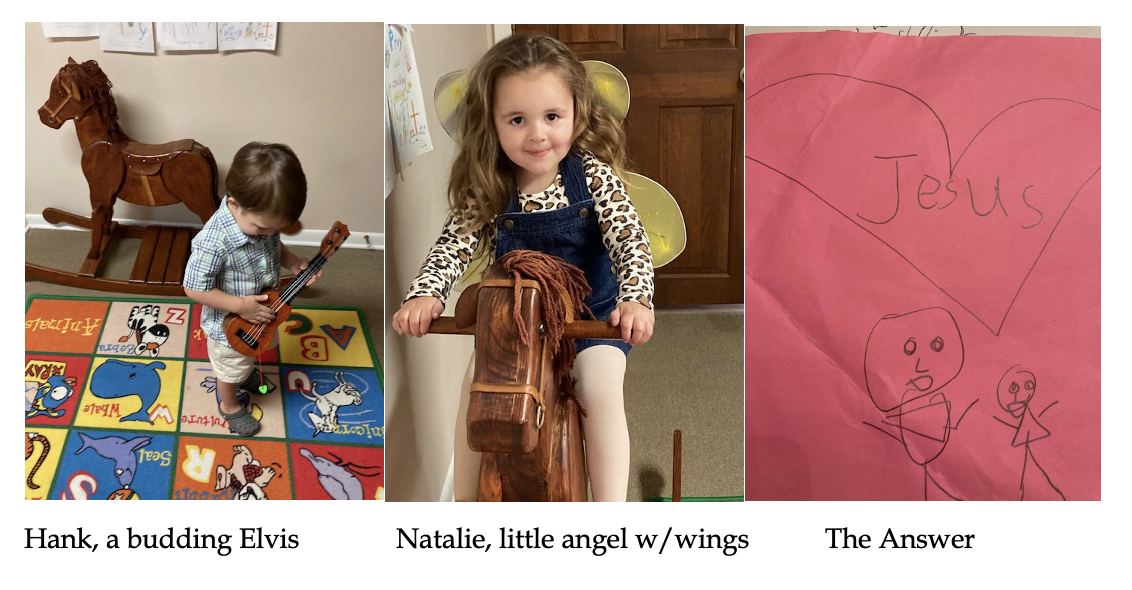
Every Sunday, I come home from church blessed and filled with joy by the little angels I teach, God’s children. Hank and Nat are two of my youngest, both adorable, enthusiastic, music-loving children. Hank has an impish grin and an equally impish sense of humor. Precocious Nat has dimples and loves nothing better than donning bumblebee wings and flying off on the antique horse Pete to wherever her big imagination takes her.
Every opportunity he gets, Hank dashes to the toy chest to grab a small plastic guitar and sing his version of his favorite songs. Deep and Wide used to come out “Dee and wi” but has now progressed to recognizable snatches of the actual song. He listens intently to all music, including the songs performed by the choir. His favorite choral song is Step into the Water.His grandmother tells the story of how he jumped into a mud puddle she had told him was off limits—and got by with it because he grinned at her and sang, “Step into the water!” Nobody can resist his smile and his unbounded enthusiasm!
Natalie loves wearing sparkly shoes and fancy dresses, and if you ask her to lead the children in a song, she marches to the corner of the room and belts out one of the many songs in her repertoire. This little songbird superstar-in-the-making does not remain still, either. She’s into the song, moving her tiny feet and pointing her forefingers to her dimples when she sings, “If you’re happy and you know it, then your smile will surely show it…” She mesmerizes all of us, particularly Hank who inches ever closer to her, fascinated and smiling.
Both Hank and Nat, as young as they are, sit obediently in their little chairs, listening to stories from the Children’s Bible. They particularly love it when I do voices. A big, thundery one for Goliath. Deep, growly ones for the Bible’s other villains. Nat usually sits patiently through the entire story because she’s eager to get to the craft part of the class where she gets to use colors, glue, and as many stick-on glittery pieces as she can get her tiny hands on.
Hank sometimes has busy-boy things on his mind, particularly the front of the Children’s Bible which pictures animals going two-by-two into the ark. Long before he could talk, he loved to climb into my lap or lean against my knee, take my one of my fingers in his little hand and point it to an animal. I would pause in the Bible story, turn to him and say, “Lion. Grrr,” then go on with the story. There were usually several more pauses where I had to name the other animals and make up sounds for them. No matter what I did, he was delighted and rewarded me with the sweetest little smile this side of Heaven.
My co-teacher Donna and I consider our class a success if we can teach the children that Jesus loves them and that they love Him, too. “Who loves Jesus?” I’ll ask them, and they all raise their hands and shout, “Me! Me!” Donna and I do this often so that thinking of God becomes second nature to them.
We’re doing a study of Moses now, and I always start the lesson by saying, “Who are we studying?” Sometimes one of my six-year-olds will answer “Moses.” But I will hear all these other little angels shouting, “Jesus!” or “God!”
My answer to all of them is, “You are right! The answer is always God. He is always there. Everywhere. All the time.”
Today’s post is going to be short and sweet. Somewhere in my daily travels I was exposed to Covid, which I am just getting over. In the early days, I laid on the couch and watched a lot of television. Let me say, the news did not do much to make me feel better. And about a week in, my television just stopped working. Out of the blue. Weird?
Maybe not.
This morning, I was reading Psalms. There are certain passages I’ve highlighted over the years and as I reread them, it made me realize that while news goes on around me, I don’t need to be negatively affected by local or world events. God’s Word reminds me why my eyes and spirit should be focused on Him. Being away from the daily hubbub has been a good way to reset, spend time with God, and renew my hope for the future.
I hope these scriptures encourage you today.
I keep my eyes always on the Lord. With him at my right hand, I will not be shaken. Psalm 16:8
You make known to me the path of life; you will fill me with joy in your presence. Psalm 16:11
Show me your ways, Lord, teach me your paths. Guide me in your truth and teach me, for you are God my Savior, for my hope is in you all day long. Psalm 25:4-5
The Lord is my strength and shield; my heart trusts in him, and he helps me. My heart leaps for joy, and with my song I praise him. Psalm 28:7
He says, “Be still, and know that I am God; I will be exalted among the nations, I will be exalted in the earth.” Psalm 46:10
Whoever dwells in the shelter of the Most High will rest in the shadow of the Almighty. I will say of the Lord, “He is my refuge and my fortress. My God, in whom I trust.” Psalm 91:1-2
Look to the Lord and his strength; seek his face always. Psalm 105:4
The Lord is near to all who call on him, to all who call on him in truth. Psalm 145:18
I find strength in God’s Word. While I might not be physically strong right now, I can take comfort knowing that my God is always there for me. Just like He is for you.
Tara Randel is an award-winning, USA Today bestselling author. Family values, a bit of mystery and of course, love and romance, are her favorite themes, because she believes love is the greatest gift of all. Look for a list of her Harlequin Heartwarming romance novels on her website at www.tararandel.com.Like her on Facebook at http://www.facebook.com/TaraRandelBooks. Sign up for Tara’s Newsletter.
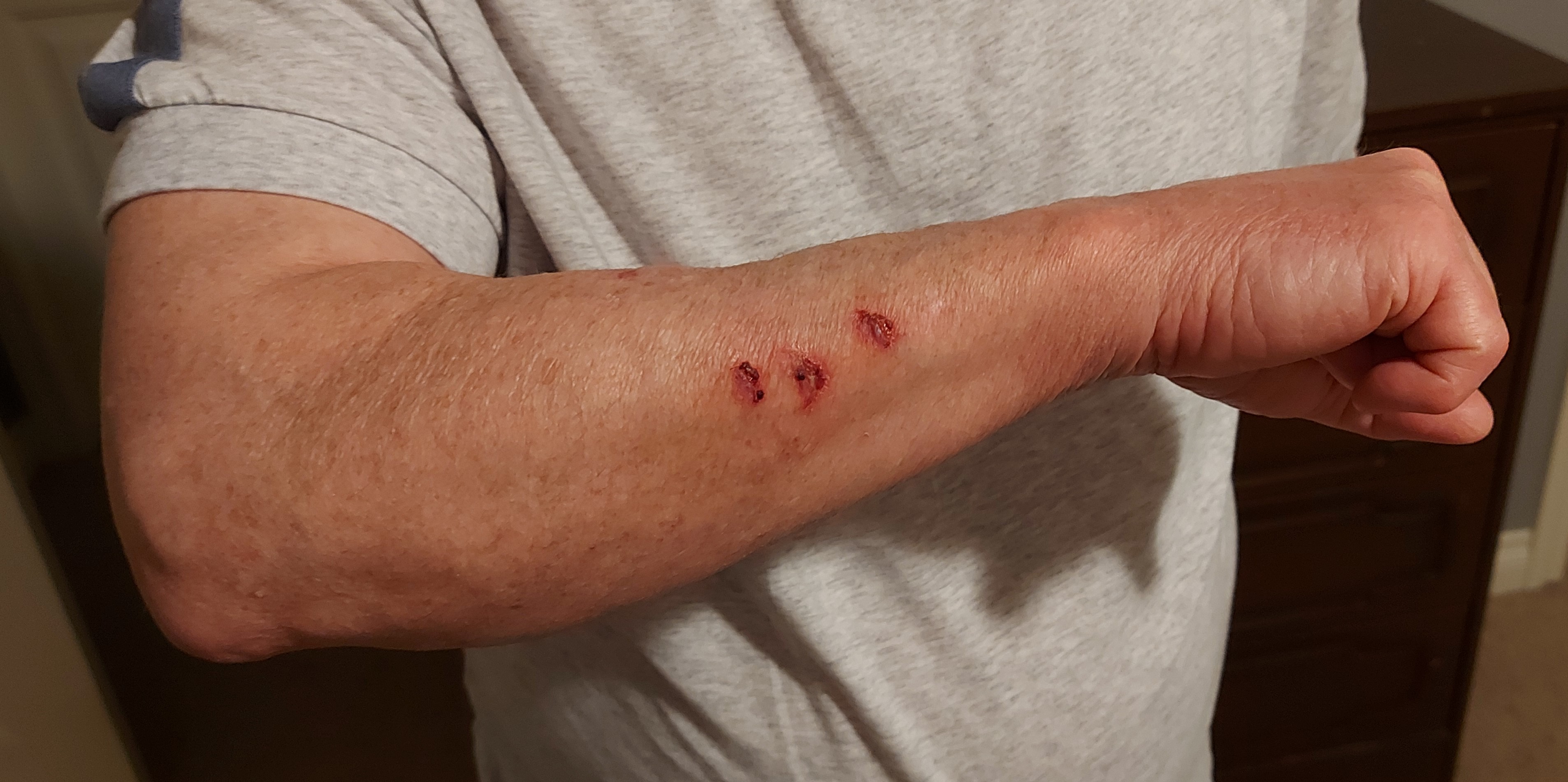
What you see in the accompanying photo is clear evidence of a cougar attack. It was painful, and the outcome could have been far worse.
Of course, as we all know, clear evidence can be misleading.
The reality is something more mundane. But a large feline was involved.
I was upstairs, and my wife called me down to the kitchen to help her with some household task. Probably to use my superhuman strength to twist the lid off a jar. Like a good husband, I rushed to her aid. Unknown to me, our cat followed me down the stairs. Just as I reached the bottom, the cat scooted between my feet and turned to rub against my leg. I stumbled, instinctively threw up my hands, and drove my forearm into the corner of the kitchen doorway. It bounced off as I continued forward and hit two more times before I regained my balance.
It was painful, and the outcome could have been far worse. I could have fallen forward, smashed my head into the corner of the doorway, and crushed my skull. Not a very glorious way to shuffle off this mortal coil.
You have to admit heroically fighting off a cougar attack makes a better story. After all, among other things, I am a novelist, and I write fiction. Or, as novelist W.O. Mitchell often said, his job was to tell lies.
On the other hand, it might be easier for readers to identify with the actual story. A lot of them have cats, and it is likely that some of them are as klutzy as I am. Not many of them have had to fight off a cougar attack.
I guess it all depends on how well you tell the story.
Are you content? I heard this question posed in conversation the other day and it got me to thinking. What does it mean to be content?
Contentment isn’t being happy. It doesn’t come from buying a new car, or house, or getting a promotion at work. It’s usually described as being satisfied in all circumstances in life, regardless of what’s happening. It’s not about having everything you want, and perhaps it may not be about having everything you need. But it is about knowing that God will walk with you always, no matter what the circumstances might be.
Philippians 4:11-13 says, Not that I speak in respect of want: for I have learned, in whatsoever state I am, therewith to be content. I know both how to be abased, and I know how to abound: every where and in all things I am instructed both to be full and to be hungry, both to abound and to suffer need. I can do all things through Christ which strengtheneth me.
We all know it’s easy to be content when things are going smoothly and there are no big decisions on the horizon, but how hard is it to say, “I’m content” when it feels as if everything is falling apart? When it appears God is silent, when we pray. When the decisions we face can affect those we love, whether it be a new job, a move, or a health issue.
In All Things Be Grateful. . .
Keep close to God through everything. It’s okay to pour out what you’re feeling to God.
Do not be anxious about anything, but in everything by prayer and supplication with thanksgiving let your requests be made known to God. And the peace of God, which surpasses all understanding, will guard your hearts and your minds in Christ Jesus. Philippians 4:6–7
Keep Your Focus on Jesus. . .
No matter how deep the waters of fear and discontentment get, don’t take your focus off Jesus.
John 16:33 says, “I have told you all this so that you may have peace in me. Here on Earth, you will have many trials and sorrows. But take heart, because I have overcome the world.”
Shut Out The Fear And The Voices Around You And Listen. . .
It’s okay to seek advice from those around us who we trust, but the ultimate authority on what is best for us is God. Listen for His answer.
Psalm 5:3 says, In the morning, Lord, you hear my voice; in the morning I lay my requests before you and wait expectantly.
We all go through those moments when our life feels as if it’s completely unraveling, and it’s hard to find contentment. In those moments, I try to look back on my life and see all the times past where I felt this way and I see how God worked a way out perfectly, even when I didn’t see a way.
Being content when things aren’t going well isn’t easy, but if we wait and pray and listen for God to respond, at just the right time, He will.
Many years ago, before I became a Christian, I went through a very difficult time. My husband died in a car accident, and I was trying to navigate life with a toddler and on my own.
I had been seeing a counselor for a short time and after our final session, as I was leaving the building, I stopped at the head of some stairs and looked down the hallway to an open room. There were people gathered there. They were doing some sort of meditation, not a service of prayer, but someone leading them, directing their thoughts.
They looked so peaceful, something I’d been struggling with. As I stood there, watching, I had the strangest feeling I was at the cusp of a change in my life. In that moment, I knew I had two clear choices. I could go to that room to see about joining in, or I could walk down the stairs and leave the building to go back to the life I was living.
It wasn’t an easy choice. Although I was learning to cope, I was lonely and still hurting. And those people looked so content.
Yet, deep inside, I somehow knew I should not go down that hallway to that room. In that moment of time, there were two forces warring within me and I didn’t understand why.
The book of Job gives us a clear picture of how much Satan wants to disrupt our lives and turn us away from God.
“Now there was a day when the sons of God came to present themselves before the Lord, and Satan also came among them. And the Lord said to Satan, “From where do you come?”
So Satan answered the Lord and said, “From going to and fro on the earth, and from walking back and forth on it.” Job 1:6-7
You probably know the story of how God allows Satan to afflict Job, who is a blameless and upright man. Thus begins a trial for Job with God and Satan each wanting his surrender. Through everything, Job stayed true to God, saying, “Though He slay me, yet will I trust Him.” Job 13:15a
There are many times in life when we are tested, maybe not with the severity of Job’s testing, but any trial seems harsh. It is important that we carefully consider the choices we’re faced with and choose wisely. It isn’t always easy.
That day, as I stood at the top of that stairway, I knew the choice I made would determine how the rest of my life played out. I can’t explain it, but that feeling was very strong. I turned my back on that classroom, walked down the stairs and never regretted that choice.
What I didn’t realize that was that God and Satan were fighting for me, each wanting me to choose them. After leaving, I spent the next few months struggling with decisions and how to live my life, finally coming to the point where I surrendered my life to Christ.
That was the best choice I have ever made.
How about you? Have you chosen Christ? Is Satan trying to influence you to choose Him? Consider these words from Deuteronomy and choose life:
“See, I have set before you today life and good, death and evil, in that I command you today to love the Lord your God, to walk in His ways, and to keep His commandments, His statutes, and His judgments, that you may live and multiply; and the Lord your God will bless you in the land which you go to possess.But if your heart turns away so that you do not hear, and are drawn away, and worship other gods and serve them,I announce to you today that you shall surely perish; you shall not prolong your days in the land which you cross over the Jordan to go in and possess. I call heaven and earth as witnesses today against you, that I have set before you life and death, blessing and cursing; therefore choose life, that both you and your descendants may live…”Deuteronomy 30:15-19
I’ve blogged here long enough that it wouldn’t surprise me if I’ve tackled this subject before. It came up again recently, and it certainly isn’t a theme I’ve mastered. I thought I’d share in case it encourages you.
Not long ago I was talking to a woman who has an adult child who is traveling. The adult child isn’t fresh out of college, or even in the stage of raising kids. The adult child is an empty nester and a grandmother. The woman I was talking to asked for traveling prayers, which of course I obliged.
We both then discussed how easy it is to worry, no matter how old our kids are. This month our youngest turns 20, and the oldest turns 40. I have more concerns now for their welfare than I ever did when they were babies. Worry? Absolutely. I’m guilty, and the other mom admitted no matter how perfect God’s track record is with her family, worry is still an issue.
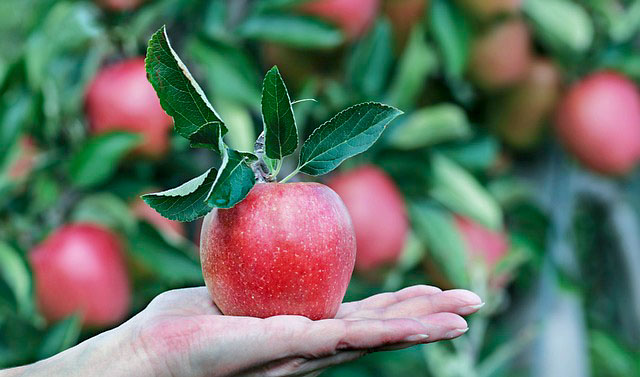
It was then I shared that the real sin in the Garden of Eden wasn’t biting the apple. Sure, God said don’t touch it, and Eve did. The sin started when Eve didn’t think God was enough.
Those are apples I feast on every day.
Like that other mom, God’s track record is perfect. He wants what’s best for those I love, so why would I ever worry? But I do. And when I worry, I know the core (see what I did there) issue is I don’t think God is enough.
Ugh.
Here’s the good news. God doesn’t limit our confessions. No matter how many times we go to Him, and how many times it’s the same exact thing I’m surrendering to Him, He will listen. He will forgive. He will show us the way. Our job is to follow Him.
The worst thing we could do is isolate ourselves out of shame. That’s exactly what the real defeated one wants. He doesn’t have the resources God does, so he has to be creative. Making you hide out of shame is a score for him. Don’t let him have a skirmish. Walk in victory.
With adult children, I struggle. Are they on the right path? What will be their provision? Will they go this way, or what way? I could stay up night after night fretting about them. Sometimes I do. But today can be our day when we draw a line and say no more.
God is enough.
Say it out loud.
God IS enough.
GOD IS ENOUGH!
No matter what you are facing, He is enough. He wants to show you the plan for your life. Don’t be afraid, don’t wait, and don’t worry.
And ignore all hissing that attempts to tell you otherwise.
I was an volunteer Bible College teacher with little income. Cindy, my traveling companion, had an accounting job with reliable income. It complicated our travels that we reached Tiberias on Thursday evening before Friday Sabbath/Shabbat. To stretch funds but enjoy the scenery, we bought one-way tickets on a boat to cross the Sea of Galilee. Jewish buses don’t run on the Sabbath. We would walk along the other side until sunset when life resumed and Jewish buses ran again.
The boat’s other passengers were a Dutch-Reformed church members from California. Their Arab Christian guide was alarmed when Cindy and I handed him one-way tickets.
He frowned. “How will you return? What is your plan?”
“We’ll be fine,” I insisted. “We’ll walk and explore the other side until sundown and then ride a Jewish bus.”
He didn’t like my idea. “We’re six hundred feet below sea level. You’ll get sunstroke.” He approached the tour group’s pastor.
That pastor came to us. “Here’s our itinerary. We’ll drive com- around the lake to see all the major sites, then drive to Lebanon’s border and past the Golan Heights. We’ll return to Tiberias by dark and drop you where you need to go.” He studied our faces. “Would you like to join us?”
The minimum cost for such tours was $50 US. Cindy had funds; I didn’t.
“That sounds wonderful, but what would you need to charge us?” I asked.
His blue eyes twinkled. “Could you each give one smile?”
We stopped at Tabgha, another significant place in Jesus’s life and ministry on the Sea of Galilee’s northwestern shore.
Next, we climbed the Mount of Beatitudes above it where five thousand men, women, and children gathered to hear Jesus teach and stayed for three days because they were hungry for more than food. There, Jesus used little to make much, multiplying five loaves and two fishes to feed them. Some translations say they didn’t nibble but ate all they wanted, and the disciples still gathered twelve baskets full. We joined the California pastor and his group on that same hillside overlooking the same sea.
He had reserved a private area and distributed Bibles for us to read from Matthew 5. My verse was Chapter 5:6, “Blessed are those who hunger and thirst for righteousness, for they shall be filled and abundantly satisfied.”
I sensed the Jesus standing among us, His arm sweeping around the countryside, inviting us to take in the view, saying, “Welcome to my land. This is My home. Enjoy. Let me show you around.”
He seemed joyful and personable, His voice warm. My throat constricted. While reading my verse, I uncharacteristically burst into tears, overwhelmed by such caring love in this place so central to His ministry as He fulfilled His name Emmanuel, God with us. He was the powerful historic Jesus yet fully present to meet our current needs.
That day was another divine appointment. I take thorough notes to share with those who can’t come on trips with me because such moments are not to be forgotten. I’m also blessed to stay in touch with many people there.
My newest book, A Traveling Grandma’s Guide to Israel: Adventures, Wit, and Wisdom just went live on Amazon Kindle here https://amzn.to/446gY3G and for pre-order in print. Look for an audio version later.
What do we think of when we hear the name “Jesus”? How do we picture Him? The baby in the manger in Bethlehem? The rabbi walking the streets of Galilee and Judea, preaching good news and healing people?
Hebrews 1:1-4 presents a much different picture, a picture of a cosmic Jesus, a Jesus far greater than His 33 years of life on this earth in human form. First, this passage says that it was through Jesus that God “made the universe”; that is, Jesus, the Son of God, participated with God the Father in the miracle of creation. This means that He predates everything else.
Second, Hebrews says that Jesus “is the radiance of God’s glory and the exact representation of his being”; that is, Jesus shows us what God is like because He is, in fact, God.
Third, Hebrews says that Jesus sustains “all things by his powerful word”; that is, He rules and controls the universe and keeps it operating.
Fourth, Hebrews says that Jesus “provided purification for sins”; that is, He paid the penalty for all human sin by dying on the cross, something that only a sinless and all-powerful Being could do.
Fifth, Hebrews says that Jesus “sat down at the right hand of the Majesty in heaven”; that is, Jesus is on the throne in heaven ruling the universe.
Hebrews thus stresses that Jesus is God, not a mere human, and certainly greater than Jewish expectations of the Messiah.
This morning I placed a call to my mail-order pharmacy, expecting to take care of business in an easy two-minute conversation with a representative. Instead, a robotic voice answered and immediately put me through a useless, time-consuming session of questions that did not relate to my problem and did nothing to solve it.
Finally, I hung up and called back, only to get caught up in the same round of robotic questions. I was never given an option to speak with an agent. Even when I asked to speak with a live person—repeatedly, in fact—I was still caught up in the insane, robotic loop that led nowhere.
If I had only needed the two prescriptions the robot had listed for me, I could have placed the order and gone about my business. But I needed a third the AI couldn’t find, although it was clearly part of my prescription list.
Three attempts and fifteen minutes later, I finally managed to get past the idiotic robot to a real person. In less than a minute, I had placed an order for my three prescriptions. I could have breathed a sigh of relief and gone about my business, but I knew the ordeal was not over. In the future, every time I call with a problem that doesn’t fit the robot’s programmed questions, I will go through the same time-wasting, blood-pressure elevating, senseless ordeal.
And not just with the online pharmacy, but with every other business who has chosen to dehumanize its customers by removing themselves and putting us in the hands of robots. Or as they like to call it, “automated customer service.” Don’t believe a word of it. There is no real service involved here. You, the customer, have become unimportant. The big companies don’t want to waste money hiring people to offer real customer service. They want to cut corners with AI. They want to remove themselves from you and make it next-to-impossible to hear what you have to say—good or bad.
I’m no conspiracy theorist, but I often wonder if using these misnamed “automated customer services,” the intent, all along, was to dehumanize us. It certainly was not designed to provide optimum customer service and satisfaction.
There is no good mental health without human interaction, no real quality of life, no opportunities for compassion, joy, love. There is only isolation, frustration, and the hopeless feeling that you might just be alone in this world.
Although I’m writing on a tough deadline and stretching myself to my limits every day to meet it, this morning I took the time to lodge a grievance with the mail-order pharmacy service. Will it do any good? I doubt it. But I will never give up. I’m human.
In those times when it seems everybody hurts, we often find ourselves burdened. Feeling as if everyone we encounter is reaching out a hand, wanting something from us—our money, influence, expertise, time.
We aren’t cold or indifferent—we want to help others. We consider it a duty and a privilege to do so. We know that everybody hurts, and next time, it well might be us, and we hope (and pray) someone will be there to offer us what we need. Yet the constant barrage wears on us and we feel overwhelmed. As if we can’t possibly do or take on one more thing—one more duty, responsibility, obligation or even hearing one more trouble of someone else’s without just collapsing.
We either give until it hurts, or it breaks. And when faced with the barrage, it is we who hurt or break and collapse. Let me share a specific example:
A few years ago, a woman did a lot of counseling. Partially in a mentor role and partially in a “people in trouble find me and want help” role. She did what she could, of course. But the flow kept coming and coming and next thing she knew, she was physically ill.
There was a relationship between the two. She didn’t counsel and forget it or even assign the situation to its proper place, feeling confident she’d offered what she had to offer. She worried about these people and their plights. And she kept worrying. And kept worrying.
The very attribute that enabled her to listen and express empathy and constructive solutions was the very thing that was weighing on her and making her ill. Unlike Jesus, she took everything in so deep and she held onto it, worrying. How could all that added stress and anxiety not make her ill?
There is an art to helping. An art to recognizing someone else’s pain and struggles. We see them and we want to help “fix” what’s broken because we genuinely and truly want others to be healthy and content. We do feel for others, and we do hurt with them. But we also must recognize that their issues are their issues and ultimately only they can fix them. That isn’t a “turn your back” or a blind eye to others comment. It’s a reality check that helpers need to keep in mind. Here are a few more:
Tips to Remember When Trying to Help
Tip 1. Some wounds are self-inflicted. That doesn’t mean one shouldn’t attempt to help. It means that if the consequences of a self-inflicted wound aren’t experienced, acknowledged, and responsibility isn’t accepted, odds are high that another similar self-inflicted wound will be inflicted. A second chance, if you will, to get what is needed to avoid the challenge in the future.
Example: Touch a hot stove and you get burned. The solution isn’t to remove the stove. The solution is to respect the stove and to learn that if you touch it when it’s hot, you will get burned. The objective is to learn to not touch a hot stove.
Why is that the better solution? Because you can’t follow someone around through life and remove every hot stove that might be in that person’s path.
I used the stove because it’s easy to illustrate the point. You can apply it to self-inflicted challenges and see the benefit in identifying, accepting, and finding a constructive solution—usually seated within. Hard lessons we don’t have to repeat over and again give us more content time and less anxious time.
Tip 2. We can’t fix other people’s challenges. We can listen, guide, teach, share. We can seek or refer to others who can listen, guide, teach, share, or instruct. But no matter how many people listen, guide, offer advice, share tools or coping skills, in the end, these are all only suggestions or recommendations. It is up to the person with the challenge to choose what to do to fix his or her challenge. And then to do the work required to actually fix the challenge—which might be none of the suggestions, but a new one that occurred to the person as a result of your discussions.
Tip 3. Offering help, giving help, doesn’t obligate the person to take it. It doesn’t obligate and it doesn’t mean that your suggestions or recommendations are in fact the best solution to the challenge for this person. Remember, situations relayed are not the whole picture. They’re a snapshot of a situation that includes only what the person wants to share and chooses to share at that time. The person with the challenge has the best big-picture view. So, whatever that person ends up doing, you can acknowledge that she or he is doing what s/he feels is best in this situation.
Tip 4. No offense, no judgment. Often people help others and then are frosted because their advice is ignored or amended. If you’d done what I said, you wouldn’t be in this mess, and now you want me to help you again? This happens. And while it might or might not be justified, it’s never constructive. When someone ignores your advice, you must remember that this is their life and not yours. They should do what they feel is best. Your advice is your opinion—sought because it is respected and desired. But it is not up to you to dictate what someone else does; that’s their choice. Ultimately, they’re going to live with the choices they make—and they, not you, will be responsible for those choices. Of course, they should be their own. And you should not judge them for their choices.
Listen, we learn as much from our mistakes as we do from our successes. Of course, we don’t want anyone to make mistakes that do them irreparable harm. Of course, we wish to spare others hard, painful lessons. And we can—if they choose to listen and form their own opinion and it proves sound.
We shouldn’t fool ourselves. We do what we can to help others avoid stepping in the mud puddles we’ve stepped in. Some will, some won’t; they’ll step in other mud puddles—and next time, that same person might be sharing his or her experience with us and offering us advice.
You see, we all have challenges and tough times and sometimes need help. We will all continue to have challenges and tough times.
Fortunately, we have each other to help during these tough times. We all have the opportunity to have or to be a mentor.
I live in the province of British Columbia on the west coast of Canada, also known as “the wet coast.” The prevailing west winds off the vast Pacific Ocean bring in copious amounts of rain, especially on British Columbia’s mountain ranges, allowing great forests to grow. The rain also supports agriculture in the river valleys. Starting about October each year, heavy rains come in, lasting for up to a week at a time. There is little snow, mostly just rain, in the river valleys, but heavy snow in the mountains, which feeds the rivers and streams and lakes and reservoirs all summer. The rain can get a little monotonous. Vancouver is the province’s largest city and major port, and the Vancouver Rain Festival is said to run from January 1 to December 31. It is an exaggeration. In summer, the land heats up and a high pressure ridge forms, deflecting the low pressure systems coming in off the ocean, so summers can be dry.
Two years ago, there was a summer “heat dome” with record high temperatures that killed lawns, shrubs, crops, trees (causing many forest fires), and people (over 600). While no heat dome is expected to develop this year, our current summer has again been again hot and dry, and rainfall has been below average for more than the past year. We are facing drought and water restrictions, and forest fires have already burned through more hectares of forest this year than in any other year in our history. I have no idea if this is a permanent climate change or an aberration.
Sunshine is often considered a metaphor for blessing, and rain a metaphor for hardship. But rain (water) is necessary for life. So, while the people in Vancouver enjoy the beaches, I pray for rain. The older I get, the more I realize that God controls the weather and there is little we can do about it.
Like British Columbia, Palestine is on a west-facing coast, and it benefits from rain coming in off the Mediterranean Sea. Rain is especially heavy in spring and fall, while summers are dry. This rain supports agriculture and also nourishes forests on the mountains (the famous cedars of Lebanon). When the people of Israel entered the Promised Land over three millennia ago, it was likely cooler and wetter than it is now. (Climate changes have been occurring throughout history.) Palestine was said to be a land flowing with milk and honey. Why milk and honey? They are liquids and therefore flow. Beyond that, milk comes from goats and cows. Honey comes from bees, which depend on the flowers of trees and other plants. In other words, this was a rich land that would support both ranching and farming. And both of those depend on rain. As an agricultural society, the ancient Israelites were heavily dependent on rain—and more aware of that dependence than modern city dwellers are.
As the people of Israel were about to enter the Promised Land, Moses gave them a long exhortation. He told them that if they would “fully obey the Lord your God and carefully follow all his commands,” then God (Yahweh) would give them a long list of blessings. One of them was that “The Lord will open the heavens, the storehouse of his bounty, to send rain on your land in season and to bless all the work of your hands” (Deuteronomy 28:1,12). On the other hand, if the people of Israel did not obey God, they would receive a long list of curses. Among them would be “scorching heat and drought…The sky over your head will be bronze, the ground beneath you iron. The Lord will turn the rain of your country into dust and powder” (Deuteronomy 28:22-24). Since God controls the weather, He could easily fulfill His promises of blessings and curses, rewarding the people for their faithfulness or punishing them for their unfaithfulness.
Years later, at the dedication of the temple, King Solomon repeated this idea in a prayer: “When the heavens are shut up and there is no rain because your people have sinned against you, and when they pray toward this place and give praise to your name and turn from their sin because you have afflicted them, then hear from heaven and forgive the sin of your servants, your people Israel. Teach them the right way to live, and send rain on the land you gave your people for an inheritance” (1 Kings 8:35-36).
It turned out that the Israelites did not obey God, until finally God sent the prophet Elijah to declare: “There will be neither dew nor rain in the next few years” (1 Kings 17:1). After three-and-a-half years of brutal drought, Elijah called the nation together for a contest between him and 400 prophets of Baal, the Sidonian rain god. When Elijah’s God sent down fire from heaven and Baal could not, the Israelites returned for a time to worshipping Yahweh. Yahweh responded by sending “heavy rain” (1 Kings 18:45).
But it did not last. Later on, the prophet Jeremiah told the Jews, the last remnant of Israel, that, because of their sin, “the showers have been withheld, and no spring rains have fallen” (Jeremiah 3:3). The prophet Amos repeated the message: “I gave you empty stomachs in every city and lack of bread in every town…I also withheld rain from you…People staggered from town to town for water but did not get enough to drink, yet you have not returned to me” (Amos 4:6-8).
Even after the return from exile in Babylon, the Jews continued to be unfaithful. But God continued to promise and warn: “Test me in this and see if I will not throw open the floodgates of heaven and pour out so much blessing that there will not be room enough to store it” (Malachi 3:10).
And so, here in British Columbia, we face heat and drought, and I continue to pray for rain. Could it be because of our sin and unfaithfulness that God does not answer?
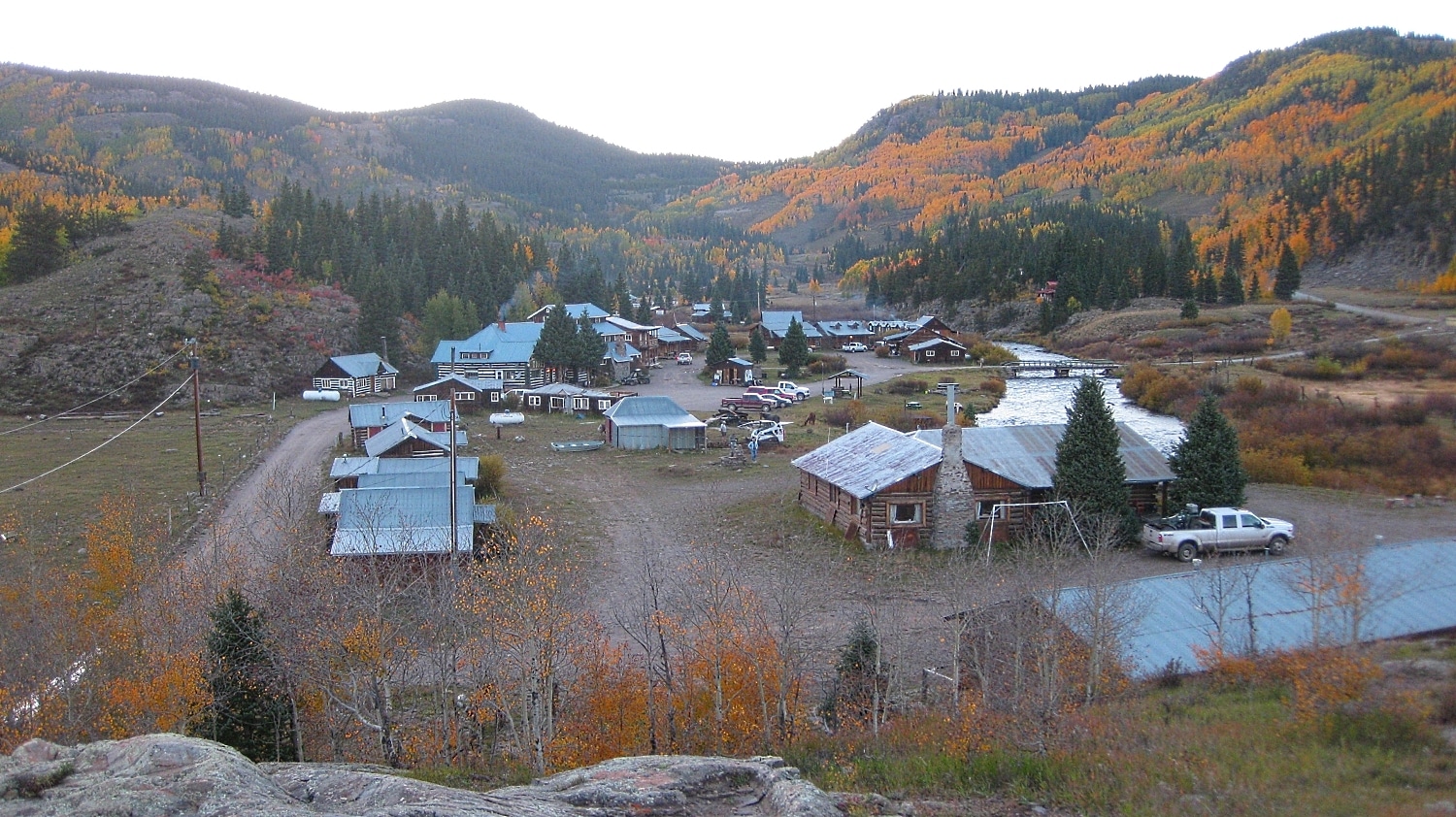
Summer is a great time to explore God’s creation with friends and family. My husband and I, along with our granddaughter, just came back from beautiful Colorado where we made the most of every day we were there. We stayed in South Fork, Colorado, where a small piece of the National Lampoon’s 1983 movie “Vacation” starring Chevy Chase was filmed.
We spent an entire day four-wheeling with one of our good friends near Platoro, a tiny mountain town in the Rio Grande National Forest. Our friend packed a picnic lunch, and we dined among the chipmunks and aspen and pine trees. And enjoyed the beauty that God created.
There was actually snow still up in the mountains, which was amazing to me coming from 100 degree weather here in Texas.
From there, we went to Silverton, which is a small mining town near the Million Dollar Highway located between Durango and Ouray. Although I’ve been to Silverton many times, it was such an amazing trip and one I’m ready to do again soon!
I think we all have a place where we go and feel closer to God. For me, it’s the mountains.
There’s something about them that always seems to refresh my soul and make me smile when I think about what an amazing God we have. He created mountains, and valleys–deserts and oceans–just for us.
No matter what part of our country is your special place, you can see God’s fingerprints everywhere you look. . .you just have to look.
Psalm 96:11-12 says,
Let the heavens rejoice, and let the earth be glad; let the sea roar, and the fulness thereof.
Let the field be joyful, and all that is therein: then shall all the trees of the wood rejoice.
No matter which part of the country you live in, you have to admit, this has been one hot summer. And this is coming from someone who lives in Florida. I’m used to working around the rising temperatures, but I’ve had to rework my schedule this year.
If you’ve been struggling with the heat, here are a few suggestions to enjoy the rest of the summer.
Rise early. This may sound logical, but if you aren’t an early riser, it can be difficult. However, getting up early to exercise outside or to do yard work before the mid-day heat becomes unbearable is worthwhile. I normally cut the grass later in the afternoon, but this summer I’ve been out first thing in the morning. My husband and I have been hiking more than usual, so we make sure to arrive as soon as the hiking trails open. We can get a few miles in before going back to the car to blast the air conditioner. Wearing the right clothing, like moisture-wicking shirts, is surprisingly helpful.
Drink lots of water. One of the problems with the heat is that we can easily get dehydrated. It can sneak up on you and doesn’t feel great when you experience this. I always carry a bottle of water with me, even if I’m just running errands. When doing yard work, I stop periodically to take a drink. It’s a good habit to establish anyway, so why not start now?
Take time for hobbies. If you are staying indoors, this can be a time to be involved with hobbies. I always recommend reading, but then as a lifetime reader and an author, that is my go-to. But what about needle crafts? Woodworking? Maybe start making handmade Christmas cards early. You can use this time to get caught up on paperwork or trying out new recipes. Put your imagination to use and be excited about what might happen.
Family Time. Even later in the day, when the sun is sinking, you may not want to go outside. Gather the family around the table for some fun. We used to play board games a lot when my daughters were young. Over the years we’ve gotten busy and I’ll admit, I miss that quality time together. Take an inventory of the games you’ve stored away. Find a deck of cards. Start new traditions with the younger family members. There is nothing like competition to create a fun family night.
Movie Night. This is a great time to catch up on movie watching. If you have little ones, make a tent or spread-out blankets so the kids can gather round to watch a new movie. Popcorn is always a must. I bought some of those cardboard popcorn boxes like you get at the movie theater, making the time special. Maybe throw in some ice cream. Dim the lights and get drawn into the drama or adventure of another world. Movie marathons are another great way to get everyone together.
These are just a few ways to beat the heat. Sometimes we limit ourselves with our routines and don’t venture out of our comfort zones. Before we know it, we’ll be enjoying the fall temperatures, but in the meantime, switch it up and try something new.
Tara Randel is an award-winning, USA Today bestselling author. Family values, a bit of mystery and of course, love and romance, are her favorite themes, because she believes love is the greatest gift of all. Look for her Harlequin Heartwarming romance, HER SURPRISE HOMETOWN MATCH, available now.For more information about her books, visit Tara at www.tararandel.com.Like her on Facebook at http://www.facebook.com/TaraRandelBooks. Sign up for Tara’s Newsletter.










































 Christians Read