News Flash – Thank God for the Israel/Hamas Hostage Release agreement. May it move forward and be perfectly completed.
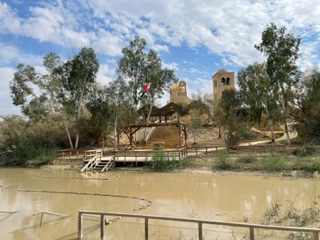
The Jordan River divides Jordan (photo #1) from Israel (photo #2). Both countries share the river which is divided by a rope carrying brown floats visible in photo #1.
The rise of our world’s civilizations depended on rivers. It still does. That’s especially true in the Middle East where desert nations threaten to fight wars over water.
Egypt rose along the Nile. Ninety-per-cent of its people still live along both sides of the Nile from Ethiopia’s highlands to the Mediterranean. Ancient Mesopotamia, between the Euphrates and Tigris, literally means land between the rivers. In desert lands and everywhere, life depends on water.
In Israel, Bible tours didn’t let us board their buses unless we each carried five to six liters of water each or had shekels to buy water because the low humidity, far-below sea level conditions dehydrate and endanger people. Lack of water can cause death.
In Deuteronomy 8, when the Israelites left Egypt, God promised a land of “flowing streams and pools of water,” with “fountains and springs that gush out in the valleys and hills.” When they reached the Jordan River to enter “a good and spacious land, a land flowing with milk and honey,” the river stopped flowing and became dry ground as soon as the priests put their feet in the water. With God’s help, they carried the ark of the covenant, the golden box portraying His powerful presence and protection, into their new land.
Water is still essential to lives. Human bodies are 50-75% water. Water to extinguish fires would have saved thousands of structures and precious lives in this month’s Los Angeles destruction.
When you picture Living Water, what do you see? The verses below describe the vast river of life available in our Lord every day.
“Ho! Everyone who thirsts, Come to the waters; And you who have no money, Come, buy and eat. Yes, come, buy wine and milk Without money and without price.” Isaiah 55:1 NKJV
In the last day, that great day of the feast, Jesus stood and cried, saying, If any man thirst, let him come unto me, and drink. He that believeth on me, as the scripture hath said, out of his belly shall flow rivers of living water. John 7:37-38 KJV
Drink abundantly each day. Take generous supplies to your family members, neighbors, cities and towns, nations–our thirsty world.
When my wife and I got married forty-six years ago, friends, family members, and church members gave us a wide variety of much needed gifts, helping us to get established as we set out to build a life and a family together.
Along with the gifts were cards, and often the cards had handwritten Bible verses on them. People did that in those days. They knew the Bible (better than most people today) and thought it relevant and important for life.
Some verses were prayers for and assurances of blessing (these are taken from the New American Standard Bible 1995):
• “The Lord bless you, and keep you; the Lord make His face shine on you, and be gracious to you; the Lord lift up His countenance on you, and give you peace” (Numbers 6:24-26).
• “The grace of the Lord Jesus Christ, and the love of God, and the fellowship of the Holy Spirit, be with you all” (2 Corinthians 13:14).
• “May the Lord cause you to increase and abound in love for one another, and for all people” (1 Thessalonians 3:12).
• “The Lord will open for you His good storehouse, the heavens, to give rain to your land in its season and to bless all the work of your hand” (Deuteronomy 28:12).
• “The Lord will continually guide you, and satisfy your desire in scorched places, and give strength to your bones; and you will be like a watered garden, and like a spring of water whose waters do not fail” (Isaiah 58:11).
• “He who dwells in the shelter of the Most High will abide in the shadow of the Almighty…You will not be afraid of the terror by night, or of the arrow that flies by day; of the pestilence that stalks in darkness, or of the destruction that lays waste at noon…No evil will befall you, nor will any plague come near your tent. For He will give His angels charge concerning you, to guard you in all your ways…‘With a long life I will satisfy him and let him see My salvation’” (Psalm 91:1,5,6,10,11,16).
• “Behold, God is my salvation, I will trust and not be afraid; for the Lord God is my strength and song and He has become my salvation…Give thanks to the Lord, call on His name…Praise the Lord in song, for He has done excellent things” (Isaiah 12:2,4,5).
Other verses acknowledged that life could and would be difficult and offered encouragement, admonishment, and guidance for those challenging times:
• “So, as those who have been chosen of God, holy and beloved, put on a heart of compassion, kindness, humility, gentleness and patience; bearing with one another, and forgiving each other, whoever has a complaint against anyone; just as the Lord forgave you, so also should you. Beyond all these things put on love, which is the perfect bond of unity. Let the peace of Christ rule in your hearts, to which indeed you were called in one body; and be thankful” (Colossians 3:12-15).
• “Since you have in obedience to the truth purified your souls for a sincere love of the brethren, fervently love one another from the heart” (1 Peter 1:22).
• “Be angry, and yet do not sin; do not let the sun go down on your anger” (Ephesians 4:26). This was the verse, given to us by two different people, that puzzled us the most. We loved each other and were confident that we could never be angry with each other. As time went on, we realized that it was one of the most useful pieces of advice we could have received. People are sinful, people see things differently, and it is inevitable that conflicts will arise, in marriage as in any other relationship. Following the advice given in this verse, we made it a rule never to go to bed angry. We might not have resolved the issue on which we disagreed, but we resolved to forgive and keep loving each other. Anger builds a wall, and if it is not torn down immediately and is still there the next morning, the wall will get bigger, day after day, until the two people can no longer see each other and the wall will be very difficult to tear down.
• “A friend loves at all times, and a brother is born for adversity” (Proverbs 17:17).
• “Cast all your anxiety on Him, because He cares for you” (1 Peter 5:7).
• “He who sows sparingly will also reap sparingly, and he who sows bountifully will also reap bountifully” (2 Corinthians 9:6). This verse reminded us that we will only get out of marriage what we put into it. Marriage requires a full effort and gives a full blessing.
• “Be subject to one another in the fear of Christ” (Ephesians 5:21).
• “Trust in the Lord with all your heart and do not lean on your own understanding. In all your ways acknowledge Him, and He will make your paths straight” (Proverbs 3:5-6).
Together, these verses offer useful guidance for marriage that is still valid today. They present a philosophy of marriage that is quite different from the romantic ideas that are so prevalent today. The people who gave us these verses knew from experience that marriage could be a great blessing. They also understood that marriage is a serious and important undertaking and requires serious commitment. They did not expect that life would be easy for a married couple and offered guidance for tough times and encouragement to persevere. They knew that we were imperfect people who would fail and need each other’s forgiveness and grace. They knew that we were not sufficient to achieve a successful marriage or a successful life on our own, but that we would need God’s help. In our marriage, they saw us as doing more than just loving each other and our family but also building and contributing to the society around us. They saw that our lives were to have a purpose that would go far beyond our relationship as husband and wife.
“Honor your father and your mother, so that you may live long in the land the Lord your God is giving you” (Exodus 20:12 NIV).
In our individualistic society, we tend to interpret the fifth of the Ten Commandments in an individual way. We think it means that if I personally honor my parents, then God will reward me with a long life. But this commandment was part of the covenant between God and the whole people of God, the Israelites. Although we should obey it individually, it is primarily a communal commandment. It was a foundational command for a whole society. The idea was that if the people generally honored their parents, then the whole society would benefit. Even on a strictly human plane, a society where parents are honored and parents care for their children will be a stable society. Where families are strong, societies are strong. When families collapse (as happens too often in our society), individuals are rootless and directionless, falling into despair, addiction, crime, and poverty.
But even more than that, in Israelite society, the intention was that faith in God and knowledge of God were to be passed down from one generation to the next: “These commandments that I give you today are to be on your hearts. Impress them on your children. Talk about them when you sit at home and when you walk along the road, when you lie down and when you get up” (Deuteronomy 6:6-7). If children honored their parents by accepting this teaching and then passing it on to their children, then the Israelites would worship and obey God generation after generation. If that happened, then the whole nation would be blessed by God and would be allowed to remain in the land that God was giving them, the Promised Land.
Further, the commandment was not even individual to a single generation. The command to honor father and mother did not just apply to immediate parents but to ancestors from previous generations. Honoring their parents would mean that the Israelites would cherish the legacy of faith that had been passed down from Abraham to Isaac to Jacob to Jacob’s twelve sons (who had founded the twelve tribes of Israel). It would mean being faithful to the covenant presented to them through Moses and reinforced by later prophets. If the Israelites had followed this commandment, their nation would have prospered, God would have blessed them, and they would have remained in the Promised Land instead of being punished with invasion and exile.
Each year has its lessons. Some are harder than others. 2024 had plenty for my husband and me.
Last year, we put our home on the market and planned to sell it and move to Colorado. This would be a major move for us. All our previous moves have been in Texas and usually within a fifty-mile radius.
But Colorado has been a dream of ours and we believed the timing was right.
When the house went under contract, we thought this is proof it’s the right time. The next step was getting rid of 40 years of junk. It wasn’t easy but we managed to clear away most of the clutter and kept the necessary things.
We were ready. . .and then the contract fell through. We were left wondering what to do next.
And then God spoke, “Not yet.” It wasn’t time for us to make this move yet no matter how ready we were. There were very clear signs that the timing was wrong. My husband and I realized we’d been listening to all the noises around us as well as the desires in our hearts over God’s wisdom. Until God said it was time, our plans would fall through.
So, we pulled the house from market and have been in prayer, listening to His voice to give us the “it’s time” okay.
Will it come this year, or will He have things for us to do here where we are? I don’t know, but I do know the One who will make it so clear that even we can’t miss the answer. We just have to listen above the noise.
Until next time dear friends, from my family to yours, we wish you the best New Year!
The new year is upon us, spurring thoughts of resolutions. What to do? Shall we pray more? Be kinder? Walk more? Eat less? Maybe we all take a deep breath and relax.
We can do it all, however, perfectly.
Yes, I said that.
Ever anxious me is an advocate of deep breathing, though, as it calms the body. Grace builds upon nature, too, not the best foundations I grant you.
Human beings have a manifestly fallen human nature. There’s no need to reference Adam and Eve. Anyone reading this blog post has experienced falling short at least once. Whatever we tell ourselves, there is a war between the flesh and the spirit that’s never quite over. That less-than-pure intention, a snippy comeback, subtle judgments, or plain old pride always finds a home inside us.
There is hope, however.
Perfection awaits us, every moment.
Don’t believe me?
That’s okay. I wouldn’t believe me either. The Master has this to say:
Matthew 19:26: But Jesus looked at them and said, ‘With man this is impossible, but with God all things are possible.’
Now, to my point of focusing on the Jesus parts. The Lord clearly says that all things are possible with God. That includes perfection. How you ask? Jesus also said that only God is good. Seems like a Catch-22, but here’s the rub.
God is goodness itself.
His ways are not our ways.
His thoughts are thoughts of peace.
Again, don’t take my word for it.
Jeremiah 29:11 “For I know the thoughts that I think toward you, says the Lord, thoughts of peace, and not of evil, to give you a future and a hope.”
That’s one loving Father!
Now, back to the Jesus parts.
Christ calls us to perfection every day.
The trick?
Not all things are meant for all people.
We muddle what perfection is by relying on our own ideas.
Perfection in sports would be me warming the bench. That’s all I was built to do in that arena. So, my sideline position would be the perfect play.
Similarly, the perfection of charity for me is to look to those around me and act with the spirit to the best of my ability, relying on God—perfection—to supply the rest. I am no Mother Theresa, and that is okay. Perfection for me doesn’t lie in my following her path, however holy and sacrificial and charitable it was.
Lean into the Lord who is perfection itself. That’s the way. Acceptance of our state as constantly striving-but-never-quite-getting-there creatures is where it’s at.
I hope you agree. The tendency to think less of ourselves, because we aren’t called to the same peaks as others, is an exercise in humility. Pride finds a home inside each of us and only God is good. I’ll give you a quote to drive that one home.
Luke 18:19: “Why dost thou call me good? None is good but God alone”
The desire to be seen as better, even in our own eyes, is vanity. Being harsh with ourselves, is to be harsh with the least of Christ’s brothers. We don’t want to hurt Our Lord, do we?
So, on the off chance that resolutions make you anxious like me, hold off. Consider wisely. To compare yourself disparagingly to another, even the you of the past, or an ideal that has yet to be, remember this:
John 21: 21-22 …Lord, and what shall this man (John) do? 22Jesus saith to him (Peter): So, I will have him to remain till I come, what is it to thee? Follow thou me.
Many people believe the New Year means a new start, and it often can mean that. After all, every day brings a new chance to change for the better. We can put off old habits and choose to be better, kinder people.
New starts or change doesn’t happen without work though. We must focus on the choices we make and decide deep within to follow God’s path instead of the intriguing path of the world. This isn’t easy no matter how determined we are.
I’ve been reading through the book of Genesis and thinking about the new beginnings in this book of the Bible and how each person’s choices led them either closer to God or away from God. Let’s look at a few.
Adam and Eve: This couple is the epitome of new beginnings. They were the first people, they walked with God, and had the whole Garden of Eden to themselves. Yet, they chose to disobey God and ended up outside the garden, working the land, and losing their one-on-one time with God.
Noah: Noah believed God when He asked him to build an ark despite there being no rain or water. He endured mocking from those around him. In the end, Noah, his wife, three sons and their wives, were the only humans to board the ark, saved from the flood. Noah’s choice to follow God’s leading, led to a fresh start.
Abraham: Abraham left most of his family and followed God’s leading to the wilderness. He made mistakes, but his heart was for God and God honored him throughout his life. Abraham was the father of Isaac and the grandfather of Jacob. His choice to follow God to the unknown led to the Jewish people, who eventually reached the promised land.
Lot: Lot was Abraham’s nephew and accompanied his uncle as he traveled, following God’s leading. When Abraham and Lot parted ways, Lot’s new beginning was in Sodom and the land surrounding the city. Lot chose to stay in the city peopled by those who didn’t honor God. Despite Abraham’s bargaining with God, Sodom was destroyed and Lot was set adrift with his two daughters. His choices led to a falling away from God.
I could continue to talk about Jacob and Joseph, even Joseph’s brothers, and the new beginnings they each had, but you get the picture. Throughout the Bible and in life, we see people making choices that bring them closer to God and choices that draw them away.
As we start 2025, we must each consider the choices ahead of us. Choosing God is not always the easiest, but it is always the right one. This year, consider focusing on your choices and choose to walk the path God has for you.
I can’t believe it’s another new year! Everyone says time passes quickly, but the last month sure flew by. After celebrating the holidays and just returning from a camping trip to usher in the new year, I have a few thoughts.
First, I hope 2025 is a fabulous year for all. I don’t make resolutions, but I do have goals I strive to keep each year. This year, my top issues are:
Bible Study.
I love studying the Word and there are so many great teachers out there. This is my time to grow closer to the Lord and I don’t give that up lightly.
Prayer.
I have a friend who will pray on big world issues while I tend to focus on our homeland. Late last year she asked if I would pray for specific topics. It was a very large reaching list, so I asked if we could meet and go over the areas that we feel are most important to each of us. I got a notebook and listed the topics so that when we get together, we can map out our prayer strategy.
Read more books than last year.
I wrote a post in September about keeping track of the number of books I read in 2024. My final count was 77. Not shabby! I ordered a book journal to keep track of the books I read this year as compared to a piece of paper where I tallied the numbers for last year.
Since my daughter has returned to reading, it’s been fun to exchange books and suggest new authors. This year is no exception.
Deadlines.
The first book in my Golden, Georgia series comes out in May. I’m handing in the manuscript for book two in January and I started writing book 3. Altogether there will be four books in this new series featuring estranged sisters who rediscover each other while falling in love.
These are goals I can accomplish. My prayer is that each of you will jot down the things you hope to achieve this year and do it! I’m looking forward to a great 2025!
~Tara
Tara Randel is an award-winning, USA Today bestselling author. Family values, a bit of mystery and of course, love and romance, are her favorite themes, because she believes love is the greatest gift of all. Look for her next Harlequin Heartwarming romance, THE SURPRISE NEXT DOOR, available May 2025.For more information about her books, visit Tara at www.tararandel.com.Like her on Facebook at http://www.facebook.com/TaraRandelBooks.
Over the holidays, my wife and I again took advantage of the opportunity to watch two classic movies— A Christmas Carol (the Alistair Sim version released in 1951 and based on the Charles Dickens novel of 1843) and It’s a Wonderful Life (1946). Both of these movies have endured, not only because of their production values, but also because of the themes they addressed. They are profoundly important stories. And they have very much in common.
1. The Message. The central message of both movies is the human obligation to serve and help other humans, especially the poor, including the working poor (Bob Cratchit and the many families housed by the Bailey Building and Loan). It is no accident that both stories were set in very difficult economic times—the aftermath of the Industrial Revolution in England and the Great Depression in the United States.
2. The Villain. Both movies have a central evil character—Ebeneezer Scrooge and the banker Henry Potter. While it might be tempting to view them as representatives of Satan himself, they are, in fact, very human. Both are rich capitalists who oppress rather than help the poor. And yet neither movie is communistic or socialistic in the sense of expecting the government to help the poor. Both applaud free enterprise (especially small businesses such as those owned by Scrooge’s Fezziwig and the small shop owners in Bedford Falls) and personal initiative. The assumption is that it is people who help people, not large institutions.
3. A Christian Worldview. Underlying both movies is a Christian worldview. This is no accident, as both stories were originally created during eras of Christian revival. Dickens wrote during the era of the Evangelical revivals, and It’s a Wonderful Life heralded the resurgence of church attendance in North America following the Second World War. Both movies include mention of church attendance, both take place on Christmas Eve, both include Christian carols, and both recognize the significance of Christian faith. The obligation to help the poor is not just a human obligation but a human obligation imposed by God, the Christian God.
4. Supernatural Intervention. In both movies, things are changed for the better by the intervention of spiritual beings—the ghost of Jacob Marley and the three “ghosts” of Christmas in A Christmas Carol and Angel Second Class Clarence Odbody in It’s a Wonderful Life. However, it is important to note that the alleviation of human suffering does not come directly from this intervention. Rather, the intervention inspires people to help the poor—and the helpers are very flawed and imperfect people at that. This also is in keeping with the Christian tradition. Jesus Christ chose that, after His death and resurrection, His mission would be carried on through His human followers. The Christian church is inspired and empowered by Jesus to continue His work, but throughout history it has been Christians (not angels) who have preached the gospel, fed the hungry, welcomed strangers, clothed the naked, looked after the sick, and visited those in prison (Matthew 25:31-46, John 14:12, Acts 1:1-8).
When so many modern Christian movies offer fluff and fantasy (with the gifts being magically delivered by Santa Claus, relieving humans of any obligation), these two classic movies still resonate. They remind us that widespread human suffering still exists in the world (the poor are always with us) and that it is our obligation, with God’s empowerment, to seek to alleviate that suffering.
2025 is Upon Us. That makes the question, “What will we do with it?”
When the door opens on a new year, new opportunities open, too. Those opportunities usually require action. So what can one do to make this your best year yet?
ACCEPT WHAT IS. Last year is gone. For some it was good. For others it wasn’t. For most of us it was a mixed bag of ups and downs, good and bad times, and it held moments of joy and challenges. How we recall the year depends on our view of its events, what events dominated our lives, and how they impacted us. Our view is rooted in our perception.
Our perception of what happened ranks more significant to us than what actually happened to us. That creates a unique opportunity. We gained wisdom from our year’s experiences and with it, we can look back and reflect on events. Reflection contains a treasure trove of useful information. We can use those insights to develop a plan to make this year better for us. A year when we actively seek the life we most want.
A few tips I find helpful:
1. Review and Refine. Look at what’s in our lives and choose what to keep and what to cull.
That creates change. Don’t get anxious. Yes, change means stepping into the unknown and sometimes we’re more at ease with what we know, but if we get more of what we want—more joy, more contentment, better circumstances, less conflict–then change is worth the temporary unease. After all, we didn’t know anything before we did, right? We learn as we go.
Change can be a pain. Others often don’t want us to change. (They prefer what they know, too.) And change is work. We’re already tired. But riding the same treadmill isn’t going to bring about a different result. If we’re not content or at peace, we’re not going to be content or peaceful unless we change. So we have choose. Either we park and pay (do nothing and pay the price, which is to continue to not be content) or we move and endure (do something and put up with the change conflicts until things get better) and become more content.
Gloss doesn’t change facts. If you want different, you must create different and deal with the pitfalls of refining your creation until you are content. Your changes are your choice. Your choice and your responsibility. Others will accept or reject your changes, and you must accept that is their choice.
Change is one part recognition, one part analysis, and one part action.
You can’t get off the treadmill if you don’t realize you’re on it. Why are you discontent? Take a hard, honest look at your life and peg the specifics. Now focus on solutions. What can you do to make wise, life-course corrections?
Once you know what has you discontent, you’ll know what needs to be done. Nail down the problems and the solutions. Be specific. This is the nature of your life you’re deciding. Choose well to live well.
Remember, you can recognize all the challenges in the world and deliberate on them for a lifetime, but if you don’t actually put a solution to work in your life, you’re not changing your situation for the better.
That means next New Year’s Day you’ll be sitting right where you are this one, complaining about the same things you complained about this year (and perhaps last year, and the one before that). Things could even be worse. So you must act. In short, if it’s broken, fix it.
It could take a couple attempts, a few solutions tried to hit on your “perfect” solution. Some will try one thing, not like the result, and consider that failure. It’s not. You know now that didn’t work. Try something else. It’s okay to not like solutions and keep seeking the right solution for you. This isn’t a one-size fits all bit of business. We’re talking about your contentment. That’s uniquely defined by you, so solutions are unique to you, too.
Many try one thing, don’t like it, and give up or give in—and remain discontent, considering it their lot in life. Who loses in that? Why do these people place so little value on their contentment and peace? Why do they quit and not try again? It’s heartbreaking that they cease trying to go for the gold that could be their lives!
But those who say, “Well, that didn’t work, I’ll try this next.” Those who keep searching will find the perfect-for-them solution. Bluntly put, they try and fail their way right to success.
We’ve been taught that failure is a bad thing. But if you try, you gain something–and knowing what you don’t want/what doesn’t work is every bit as important as knowing what you do want and what does work–then that’s growth. The attempt with growth is success.
Maybe you’re not where you want to be, but you’re closer. You know now these potential solutions you’ve tried don’t work for you. So try others. You dig enough, you’re going to find your perfect solution.
If you’ve been told repeatedly that failure is bad, then consider this your personal license to fail. Go ahead. You keep trying until you fail your way to success.
So review and refine. Look at the past year. Pinpoint the problem points. Seek solutions to neutralize them. Make them assets if you can. Then implement the changes needed. Nurture the good. Cull the bad.
2. Finish. Tie up loose ends to clear a path for new beginnings.
It’s hard to focus on new ventures when we’re bogged down in remnants of old ventures. Some overlap is inevitable, but the less of the old we must contend with in the time where our focus should be on the new, the better our odds are of improving our position and building momentum.
Momentum is a powerful force. We put down a foundation. Upon it, we build. If one section is framed, we’re limited on that one section. If two or three sections are framed, then expansion on all sections is possible. Momentum builds momentum. So the less time we spend in the past (deal with the old and get it done) the more time we have to invest in the future (welcome the new).
Clear the decks–which includes accepting what you can’t change. Don’t repress it, accept it. And then press on.
3. Ask and answer this question: What do you want most?
Do you know? Focus on it until you do.
Answer specifically. When you have, then ask: Why do you want it and what are you doing to get it?
In answering those three questions, you clarify, and that clarity creates and intensifies your determination. You also plant seeds in your mind for your plan of action.
Remember an immutable law that deals with free will. You are free to seek what you will. But you are not free to impose your will on any other. These questions should be about you. Not about anyone else. How you can improve yourself, your life, your future.
If you’re constantly replaying old unworthiness tapes, or you focus on what’s wrong with everyone else, you’re on the wrong track. Respect others and yourself and recognize that replaying those tapes isn’t accomplishing one beneficial thing.
If you need more on this, go into my On Writing blog on my vickihinze.com site and read or re-read Windshields and Rearview Mirrors and Are You a Candle or a Mirror?
Bottom line: Look within. Your answers (and benefits) reside there.
4. Set a goal. Make a plan. I can’t go into specifics here, but if you haven’t read Why We Need a Plan, I recommend it. (It’s also in the On Writing blog on my website. If you’re not a writer, read it anyway. The principles in it remain the same regardless of career specifics.)
Far too many go through the motions of living without investing in anything that excites them. There’s no passion in their work. That’s a problem and makes for a poor substitute of a life. Don’t get so caught up in busy-ness that you don’t even remember your wishes, hopes or dreams. If you have forgotten them, pull them out of cold storage, dust them off and see if they’re still your wishes, hopes and dreams or if it’s time for an update–or even an overhaul. If it is, do it. You should be excited about your life! Upshot: Don’t drift, design.
5. Try one new thing. You could find a new passion. If you don’t try, you won’t find anything, and you might be missing something that could come to mean a great deal to you. What’s the saddest thing about that? Unless you look, you might never know what it could have meant to you.
I’m reminded of a story I heard about a guy caught in a flood. On three different occasions help came: a neighbor, a camel and a guy in a boat. On each of these occasions the man stranded in the rising floodwaters refused help, saying he was waiting on God to come help him. Well, the stranded guy drowned, met his Maker, and he was angry. He demanded to know why God hadn’t come. God replied that he’d sent help three different times. What exactly did the guy want?
The moral of the story: Sometimes we’re so fixed on what we think opportunity looks like that we fail to recognize it when it comes. Of course, that won’t happen to you if you’re open to new things . . .
6. Nix cranky. Adopt an attitude of gratitude. Of all suggestions, this is by far the most important. It’s easy to fall into a hotbed of negativity or into a bad situation that sucks you dry, sows more seeds of discontent, or steals so much of your energy and focus that you grow inextricably mired in it and lose sight of what’s good and going right in your life.
When that happens, we react emotionally and that’s just not a good idea because our emotions aren’t reliable. We need balance to function with stability.
We all have challenges. No one escapes them. But if we focus only on the challenges (versus on solutions to them and other things) then we’re doomed to a very rocky, very unstable road and that is not in our best interests–or in anyone else’s.
To gain more balance–which leads to more stable, less dramatic (and melodramatic) events that inflict trauma on us (and often on unsuspecting others)–counter what’s wrong with what’s right. Counter the challenges with the blessings. See the good too, and be grateful for it.
Sometimes that’s easier to do than at other times. I overheard a pastor once say, “There are times when the best you can do is to be grateful you’re not like x. (He pointed mid-air and said like him/her–I don’t recall which. But the intent in what he said fits situations and events as well as people.) Be grateful for little things as well as the big ones.
We often learn most from the things we tag as “bad.” Yet even then we all have something to celebrate.
7. Where you focus, you follow. Before you act, you think. And if you allow your thoughts to run wild and unchecked, you diminish the chances of them being productive or in your best interest. Anyone, given enough time, can rationalize and reason himself right out of good sense–and rob himself of accomplishments and even his destiny.
If you spend your time focused on good and constructive things, you’ll be purpose-driven and accomplish. If you spend your time focused on negative or destructive things, you’ll follow that path and purpose and accomplishment (not to mention happiness and contentment) will elude you.
Which will you do? You choose what you focus on and give your energy to–how you spend your life. That’s as it should be. Again, you’re responsible and accountable for it, and you will live with the joy or regret of your choices.
There will always be commitments and gatherings to celebrate. Celebrate them, of course. But also think about your life. So that the quality of your future celebrations and the days in between are more aligned with the life you most want.
Contentment rarely just happens. We better our odds for it by knowing ourselves. Recognizing what we want, taking stock of where we are now and determining what it’ll take to get where we want to go.
Acting on our findings position us for meaningful personal gains. And for that, and so much more, we should be grateful.
As has been my custom at Christmas in recent years, I offer today a couple of my poems. Since no one has time to read blogs at Christmas, it is the perfect time to share poetry, since no one reads poetry anymore anyway. It is my gift to you, either the gift of poetry to read or the gift of time if you do not read. May your Christmas be blessed nevertheless.
The Visitation
It is expected that a doctor would visit an old woman―
but not to ask what she remembers.
You ask now.
You can be sure no one asked me such questions then
or would have believed the answers if they had.
Yet I committed these things to memory,
going over and over them in my heart,
so they are preserved whole,
perhaps precisely for this moment.
I am ready to be delivered of this burden
as I was ready to be delivered of another burden then.
The days are fulfilled for this too.
Do not doubt that the joy of the delivery
overshadows the pain till it is forgotten.
My service done, I can at last be dismissed in peace.
Someone else said that too, long ago.
I can tell you what I know,
what I saw and heard…and felt.
But to understand,
now that takes a lifetime of pondering,
and I am not done yet.
Even now, we can see only the beginning of what was meant.
It is barely morning,
and I will be gone long before it is full day,
but I can see it coming.
Why, I foretold it,
though I did not know then what I was saying.
Sit down and set down what I will tell you,
and you will be writing a prescription for all the world’s ills.
Perhaps your skill may even preserve an old woman’s memory.
I cannot say I was expecting this, but it, too, was planned long ago.
It is expected that a doctor would visit an old woman.
The angels have been part of Jesus’s life from the beginning until the end.
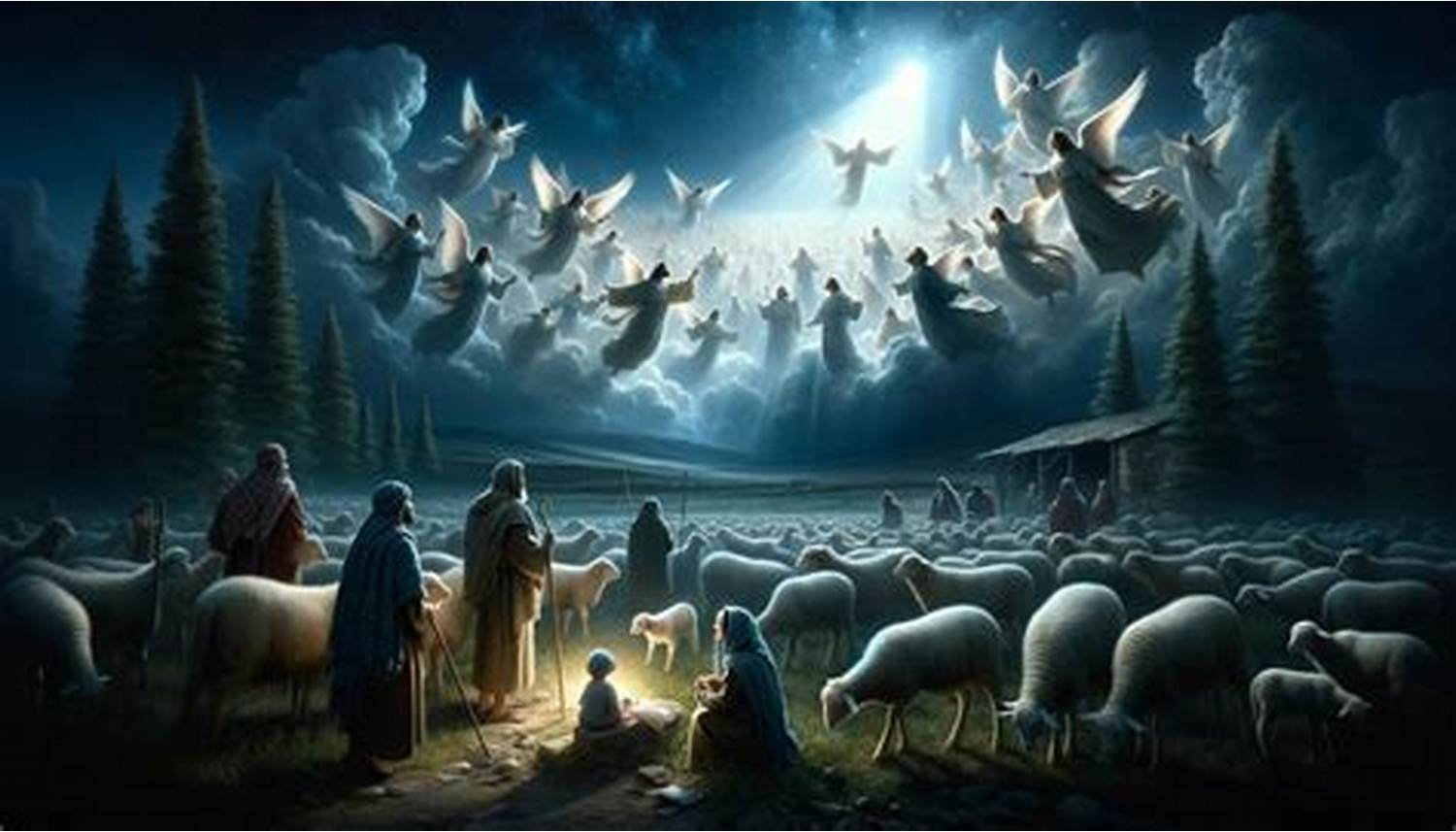
From Gabriel announcing His upcoming birth to Mary to the shepherds hearing the news of the Savior being born in the City of David.
I like to imagine the angels, silent witnesses to the events that would change human history down on earth, watching and holding their breaths as the long-awaited moment happened. A Baby’s cry split the night. Can you imagine the rejoicing that took place in heaven at that time. It must have been beautiful.
Throughout His life here on earth there are scriptures that mention angels. They ministered to Jesus following Satan’s temptation. Luke 22:43 mentions how an angel came to comfort Jesus when He prayed before being arrested and crucified.
Matthew 26:51-54, says, And, behold, one of them which were with Jesus stretched out his hand, and drew his sword, and struck a servant of the high priest’s, and smote off his ear.
Then said Jesus unto him, Put up again thy sword into his place: for all they that take the sword shall perish with the sword.
Thinkest thou that I cannot now pray to my Father, and he shall presently give me more than twelve legions of angels?
But how then shall the scriptures be fulfilled, that thus it must be?
I imagine the legions of angels watching and holding their breaths as they waited for the command while Jesus hung on the cross.
And then after His resurrection, an angel asked the women at the tomb why they sought the living among the dead. He is risen!
Throughout each moment of God’s perfect plan of salvation, the angels were present in different ways. Announcing news. Comforting Jesus. Standing ready to defend through each cry from His first cry that ended the silence between heaven and earth. His second cry which tore the veil that separated us from God. And the third cry? Well, that’s the one I’m looking forward to the most. The one that will tear open the sky and finish it all!
Until next time dear friends, from my family to yours, we wish you each a very Merry Christmas!
Tough times have many of us praying for our country these days. That’s a good thing and sorely needed. But we have to keep the nature of things in perspective or tough times will drain us of joy, laughter, and all else that makes life good and beautiful.
A few years ago, I wrote about a specific Christmas where everything seemed to be going wrong, everything was harder. What follows is an excerpt from what I wrote then about Christmas spirit:
After the prayer for our country (which included asking for patience for me; I am in short supply and admit it), I thought back to prior times of fear and uncertainty. To instances where I or my family were in jeopardy. Then I looked to other countries and how much jeopardy they are in right now. Global discord is rife, to be sure.
That brought to mind the real dangers Christ faced in His life. Dangers God knew Christ would face and watched play out, knowing how things would go and end for His Son. How heartbreaking that must have been, to be fully aware and not fearing the dubious or nebulous but with full knowledge. As a parent, the impact is staggering. Yet, God did it. They both did. For the love of us.
It was then, at that moment, that I felt it. That spark of hope and renewal. That spark of faith in the future. Christ was born. Not in a palace surrounded by guards willing to lay down their lives to protect Him. But to simple means and in a time of turmoil. He didn’t just exist in turbulent times, he flourished. Not without incidents or risks, not because His path was smooth and His way clear. He flourished because He believed. His faith, though sorely tempted repeatedly, remained steadfast.
Jesus was falsely accused, betrayed, ridiculed, abused and suffered many indignities and unfair acts. Yet, He persisted and endured staying true to His God and Himself, doing what He believed was right and honored His Father. There is deep dignity in faith.
Again, I paused from the travels inside my mind, and prayed for that for us all. For that dignity in faith. That it would be steadfast and we would have and exercise the wisdom He seemed to innately know that we flawed people must seek. I prayed for it for all, particularly for those I know have been struggling, and that’s when it occurred to me. It seemed so simple then.
When the Christmas Spirit seems elusive, it isn’t it that isn’t at home in us. We are focusing inward on ourselves too intently, shutting the door inside us to it. But when we turn our thoughts and deeds to others, the window opens wide. And the spirit of Christmas floods in.
Christ didn’t have to do what He did for us. God didn’t have to do what He did and does for us. They chose to, not for themselves but for us. I’m sure as certain a perfect parent would spare His child. I’m sure as certain that child would skip the trials and tribulations, too. So why didn’t they? They couldn’t skip the bad stuff and get to the good stuff for us, so they endured, and because they did, we too can flourish.
For me, knowledge of that opens all the doors and windows into the Christmas Spirit.
It seemed a good time to revisit that awakening moment in my life. I hope it brings some peace and perspective to you in yours. And I wish you all many blessings and a very merry Christmas.
Wishing you and yours many blessings and a very Merry Christmas!
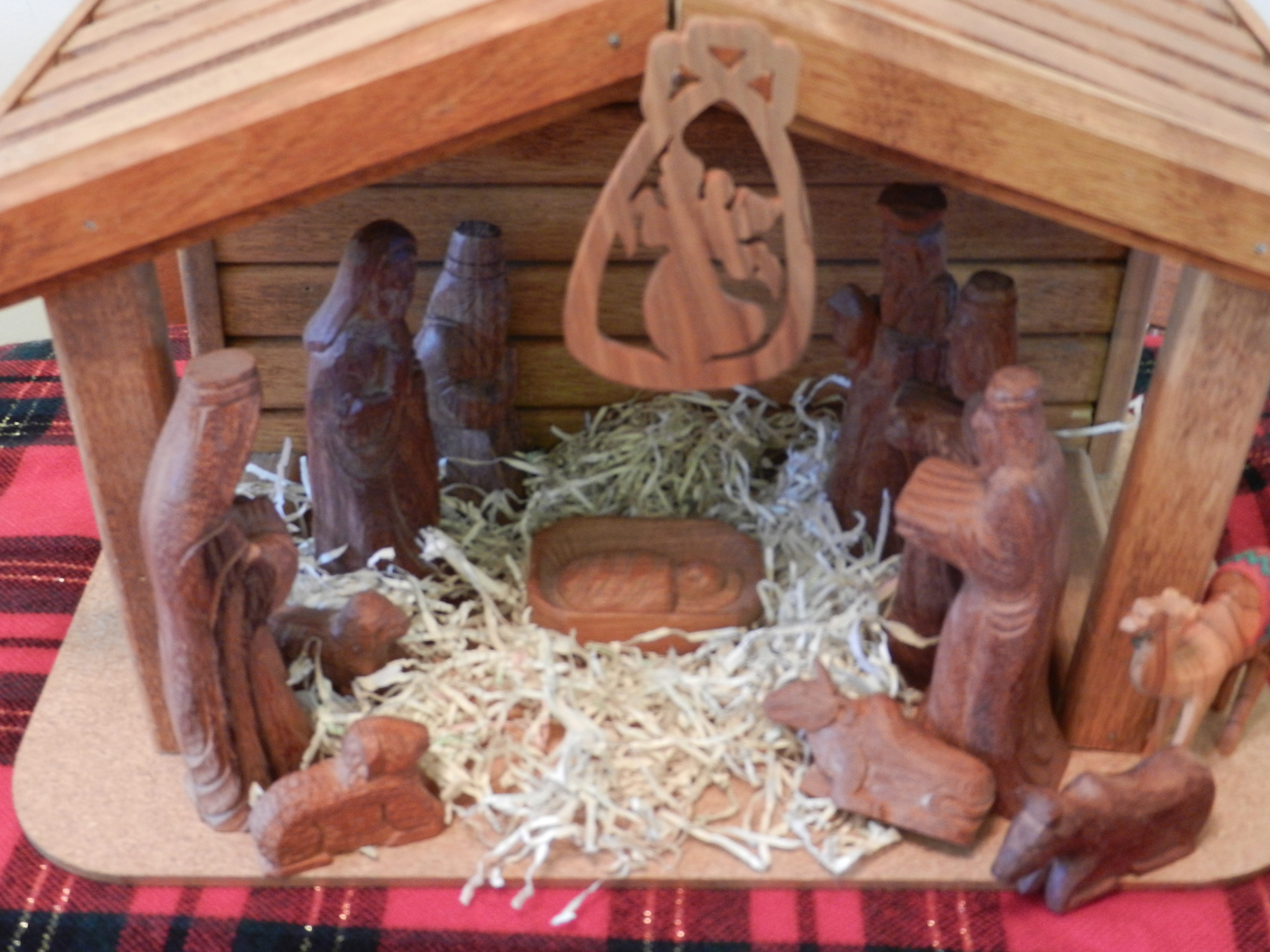
Wishing you a very Merry Christmas. My hope is that we all slow down, enjoy precious time with family and friends and remember Jesus being born in a manger for you and me. There is so much about this time of year to celebrate!
Before long we’ll be looking to next year, which is a different conversation all together! There is so much to be excited about and it starts by thanking the Lord for all good things.
Merry Christmas!
Tara
Tara Randel is an award-winning, USA Today bestselling author. Family values, a bit of mystery and of course, love and romance, are her favorite themes, because she believes love is the greatest gift of all. For more information about her books, visit Tara at www.tararandel.com.Like her on Facebook at http://www.facebook.com/TaraRandelBooks.
Right at the beginning of creation, God said, “Let there be light,” and there was light. God “saw that the light was good, and he separated the light from the darkness” (Genesis 1:3-4 NIV). This was before God created the sun, moon, and stars (Genesis 1:14-18). This means that before the earth was formed, God’s universe was fundamentally moral rather than physical. Light is good, and darkness is evil. Light represents truth and morality, while darkness represents ignorance and sin.
Light gives clarity and knowledge, while darkness brings confusion and chaos. You can’t see in the dark and don’t know what is going on. Jesus said, “Whoever walks in the dark does not know where they are going” (John 12:35). In the same verse, Jesus warned people to accept Him while they had the opportunity: “You are going to have the light just a little while longer. Walk while you have the light, before darkness overtakes you.”
Darkness is also depressing. People are more depressed in winter, when days are shorter and days are darker because of cloud. This type of depression is called Seasonally Affected Disorder (SAD). It is treated by “light therapy”— bright light that simulates sunlight. It is no accident that December, the darkest month, is when people put up Christmas lights, to cheer everyone up.
Darkness also represents sin and evil. It is no accident that most crimes are committed at night when they can be kept hidden. John explained: “People loved darkness instead of light because their deeds were evil. Everyone who does evil hates the light, and will not come into the light for fear that their deeds will be exposed” (John 3:19-20). Jesus pointed out to those who came to arrest and crucify Him that they had avoided doing so during the day but did so at night since “This is your hour—when darkness reigns” (Luke 22:53). But God sees what is done in the darkness and will expose it and punish or reward depending on what is done: “There is nothing concealed that will not be disclosed, or hidden that will not be made known” (Matthew 10:26); “Judge nothing before the appointed time; wait until the Lord comes. He will bring to light what is hidden in darkness and will expose the motives of the heart. At that time each will receive their praise from God” (1 Corinthians 4:5).
Darkness is negative, not something in itself, but just the absence of light. Therefore, it is not something to be attacked itself; instead, it needs to be replaced by light. Dark deeds need to be exposed. Bad deeds need to be replaced by good deeds. Someone once said, “It is better to light a candle than to curse the darkness”; that is, it is better to do even one small positive thing than to focus on criticizing negative things.
It is important to know that God brings light to dark places and to people in the dark:
“Christ Jesus came into the world to save sinners” (1 Timothy 1:15). “Jesus said, ‘It is not the healthy who need a doctor, but the sick…For I have not come to call the righteous, but sinners” (Matthew 9:12-13). The Old Testament prophet Isaiah said that Jesus would come as light: “The people walking in darkness have seen a great light; on those living in the land of deep darkness a light has dawned” (Isaiah 8:2). Both Matthew and Luke quoted this prophecy, saying that Jesus was fulfilling it (Matthew 4:16, Luke 1:79).The apostle John said that Jesus “was with God in the beginning. Through him all things were made; without him nothing was made that has been made” (John 1:2-3). This means that it was Jesus who said, “Let there be light” in the first place. John went on to say of Jesus, “In him was life, and that life was the light of all mankind. The light shines in the darkness, and the darkness has not overcome it” (John 1:4-5). Jesus spoke even more plainly: “I am the light of the world. Whoever follows me will never walk in darkness, but will have the light of life” (John 8:12) and “I have come into the world as a light, so that no one who believes in me should stay in darkness” (John 12:46).
Those who reject God remain in darkness. The Bible says that those who reject God will be thrown out “into the darkness” (Matthew 8:12, 22:13, 25:30). Therefore, there is a big gap between darkness and light, a huge difference between darkness and light, like two separate kingdoms. Jesus came to bring people out of darkness into light, but those who refuse to accept Him remain in the darkness. Paul described this in Colossians 1:12-14, saying that Christians should give “joyful thanks to the Father, who has qualified you to share in the inheritance of his holy people in the kingdom of light.For he has rescued us from the dominion of darkness and brought us into the kingdom of the Son he loves, in whom we have redemption, the forgiveness of sins.” Paul told King Agrippa that Jesus had commissioned him to preach to gentiles (non-Jews) “to open their eyes and turn them from darkness to light, and from the power of Satan to God, so that they may receive forgiveness of sins and a place among those who are sanctified by faith in me” (Acts 26:18). Paul, in Romans 13:12, taught that it is up to us to choose the light: “The night is nearly over; the day is almost here. So let us put aside the deeds of darkness and put on the armor of light.” Paul also warned: “Do not be yoked together with unbelievers. For what do righteousness and wickedness have in common? Or what fellowship can light have with darkness?” (2 Corinthians 6:14) and “For you were once darkness, but now you are light in the Lord. Live as children of light (for the fruit of the light consists in all goodness, righteousness and truth) and find out what pleases the Lord. Have nothing to do with the fruitless deeds of darkness, but rather expose them” (Ephesians 5:8-11).
Jesus is the light of the world, but He also said to His followers: “You are the light of the world. A town built on a hill cannot be hidden. Neither do people light a lamp and put it under a bowl. Instead they put it on its stand, and it gives light to everyone in the house. In the same way, let your light shine before others, that they may see your good deeds and glorify your Father in heaven” (Matthew 5:14-16). We are to let our light shine, but it is important to remember that we do not have the light in ourselves but we only reflect the light of Jesus, just as the moon does not have any light of its own but only reflects the light of the sun. This is stated in 2 Corinthians 4:6: “For God, who said, ‘Let light shine out of darkness,’ made his light shine in our hearts to give us the light of the knowledge of God’s glory displayed in the face of Christ.” When Moses came down from Mount Sinai after meeting with God, “his face was radiant because he had spoken with the Lord.” The other Israelites were somewhat afraid of him because of the glow, and so he would put a veil over his face after being with God (Exodus 34:29-35). The New Testament says this is a metaphor for how Christians reflect the light of Jesus: “We all, who with unveiled faces contemplate [reflect] the Lord’s glory, are being transformed into his image with ever-increasing glory, which comes from the Lord, who is the Spirit” (2 Corinthians 3:18)
Sometimes, when are here on earth, we have to endure a time of darkness (not just nighttime, but a time when there is evil, confusion, and depression). There is a famous poem that addressed this:
And I said to the man who stood at the gate of the year:
“Give me a light that I may tread safely into the unknown”.
And he replied:
“Go out into the darkness and put your hand into the Hand of God.
That shall be to you better than light and safer than a known way.”
– Minnie Louise Haskins, “The Gate of the Year”
This poem became popular during the early dark days of the Second World War, a very dark time. Sometimes we are in darkness, and then we have to believe that the God of light is still with us and guiding us and protecting us even when we cannot see. Then we are to believe that we are safe in the arms of God, for “God is light; in him there is no darkness at all” (1 John 1:5). We can also look forward to the day when we will live with God in heaven: We are told that the city of God will “not need the sun or the moon to shine on it, for the glory of God gives it light, and the Lamb is its lamp…On no day will its gates ever be shut, for there will be no night there” (Revelation 21:23-25).
In all of the Ten Commandments, perhaps the statement that causes the most concern to modern readers is “I, the Lord your God, am a jealous God, punishing the children for the sin of the parents to the third and fourth generation of those who hate me” (Exodus 20:6). Most concerning is the idea that innocent children should suffer for the sins of their parents. And yet the reality is that sin does great harm to subsequent generations, beginning with the sin of Adam and Eve but continuing even today. In evil societies, it is the children and the vulnerable who suffer the most from those who do evil.
Some might also question how to reconcile the idea of a jealous God with the last of the Ten Commandments: “You shall not covet your neighbor’s house. You shall not covet your neighbor’s wife, or his male or female servant, his ox or donkey, or anything that belongs to your neighbor” (Exodus 20:17). The Hebrew word for “jealous” is qinah, which is almost always used in the Bible of God’s attitude toward His wayward people but occasionally of a husband in regard to an adulterous wife. The Hebrew word in the tenth commandment is chamad, which means to “covet, delight in, desire.” The difference is that God’s “jealousy” is based on demanding faithfulness from someone who belongs to God (the Israelites accepted the covenant that God offered at Sinai, just as Christians have accepted a covenant with God through Jesus Christ), while “coveting” is desiring something that belongs to someone else.
But that still leaves us with the issue of God punishing sin to the third or fourth generation. This statement was made to inform the Israelites about God’s holiness and justice. God was telling them that there were very serious consequences to sin and that those consequences would affect not just those who sin but also other people. Later history shows that the Israelites’ sins (idolatry, murder, theft, oppression, sexual sin, etc.) harmed many innocent people. God’s stark statement was meant to shock the Israelites—and also many people today who gloss over sin and don’t take God’s justice seriously.
This statement also needs to be understood in the context of the rest of the statement: “But showing love to a thousand generations of those who love me and keep my commandments.” The point is that God is holy and just but that God’s mercy is even greater, hundreds of times greater. We need to fully understand the seriousness of sin and God’s justice. Only if we do so can we recognize the awesomeness of God’s mercy, for which we should be grateful every day. God’s mercy is marvelous but only and especially in light of God’s justice. If sin were not so terrible, we would not need God’s mercy. This message is repeated often in the New Testament: “But because of his great love for us, God, who is rich in mercy, made us alive with Christ even when we were dead in transgressions—it is by grace you have been saved” (Ephesians 2:4-5); “Praise be to the God and Father of our Lord Jesus Christ! In his great mercy he has given us new birth into a living hope through the resurrection of Jesus Christ from the dead” (1 Peter 1:3); “See what great love the Father has lavished on us, that we should be called children of God!” (1 John 3:1).