
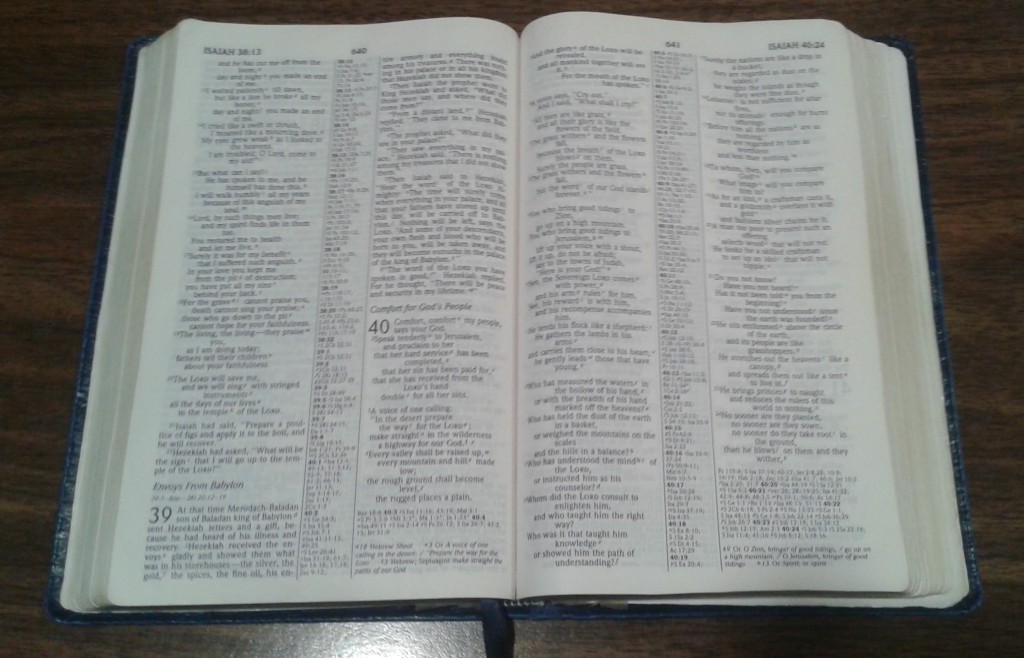
We are perhaps disturbed by 1 Peter 4:11: “If anyone speaks, they should do so as one who speaks the very words of God.” We have had too much experience of men (and women) claiming divine authority for their own opinions. In reaction, we find it safer to say, “This is how I understand God’s Word” or even “This is what I think.” Our pronouncements lack authority. Yet this, too, has a danger—of erring in the opposite direction. One unintended side effect is that when our words have proven a blessing, when our words have given good guidance and direction to someone else, when God has spoken His Word through our words, our attempted humility has the effect of giving us the credit for giving good advice or at least for figuring out God’s message.
The King James Version translates 1 Peter 4:11 as: “If any man speak, let him speak as the oracles of God.” An “oracle” in the Greco-Roman world was a mouthpiece for a god, as well as the message spoken by the mouthpiece of a god. An oracle was a channel through whom the god spoke. The Greek word translated “words” or “oracle” is logia, which means literally “words.” It is related to logos, which in John 1:1 is a name for Jesus, the Son of God and in essence God Himself. The word logia appears only three other times in the New Testament. In Acts 7:38, it refers to the “living words” that Moses received from God to pass on to God’s people, that is, the Mosaic Law. Romans 3:2 says that “the Jews have been entrusted with the very words of God,” referring to the entire Old Testament revelation. Hebrews 5:12 challenges immature Christians with the warning, “You need someone to teach you the elementary truths of God’s word all over again” (NIV) or “Ye have need that one teach you again which be the first principles of the oracles of God” (KJV)—referring to all of God’s revelation, both Old Testament and New Testament.
What 1 Peter 4:11 is challenging Christian preachers (and perhaps also other Christians) to do is to speak with all of the authority of His prophets: “Hear the word of the Lord” or “This is what the Lord says.” This is a high challenge. Those who speak in the church are to speak as channels of God’s revelation.
How on earth are we to rise to such a challenge? This means that we are to try as much as possible to speak God’s Word and as little as possible our own opinions. This requires prayer, sober reflection, deep commitment, a pure heart, diligent Bible study, and great care. If we are only voicing our opinion, we may feel free to say whatever seems good to us. If, however, we are speaking on behalf of God, we must do our best to examine every word we speak, to ensure it aligns with God’s Word.
Second, we should speak humbly, acknowledging that we are fallible and could be wrong but that God is never wrong.
Third, even though we confess that our understanding is not perfect, we should be quick to add that if our words are a blessing, God deserves the praise. We need to make clear that all good things, all abilities and spiritual blessings, come from God (James 1:17) and He deserves the credit.
Fourth, there are times when we can be sure of speaking God’s words. One example is when we are quoting God’s Word, even if, in our weakness, we choose an inappropriate passage for the occasion. No sermon which contains Scripture can be entirely valueless to the hearers. Another example is when we say, “May God bless you” (a prayer to an all-powerful God) instead of “I hope things work out for you.”





























 Christians Read
Christianity fosters a sense of purpose and meaning, inviting individuals to live with intentionality and to make a positive difference in the world.
LikeLike