
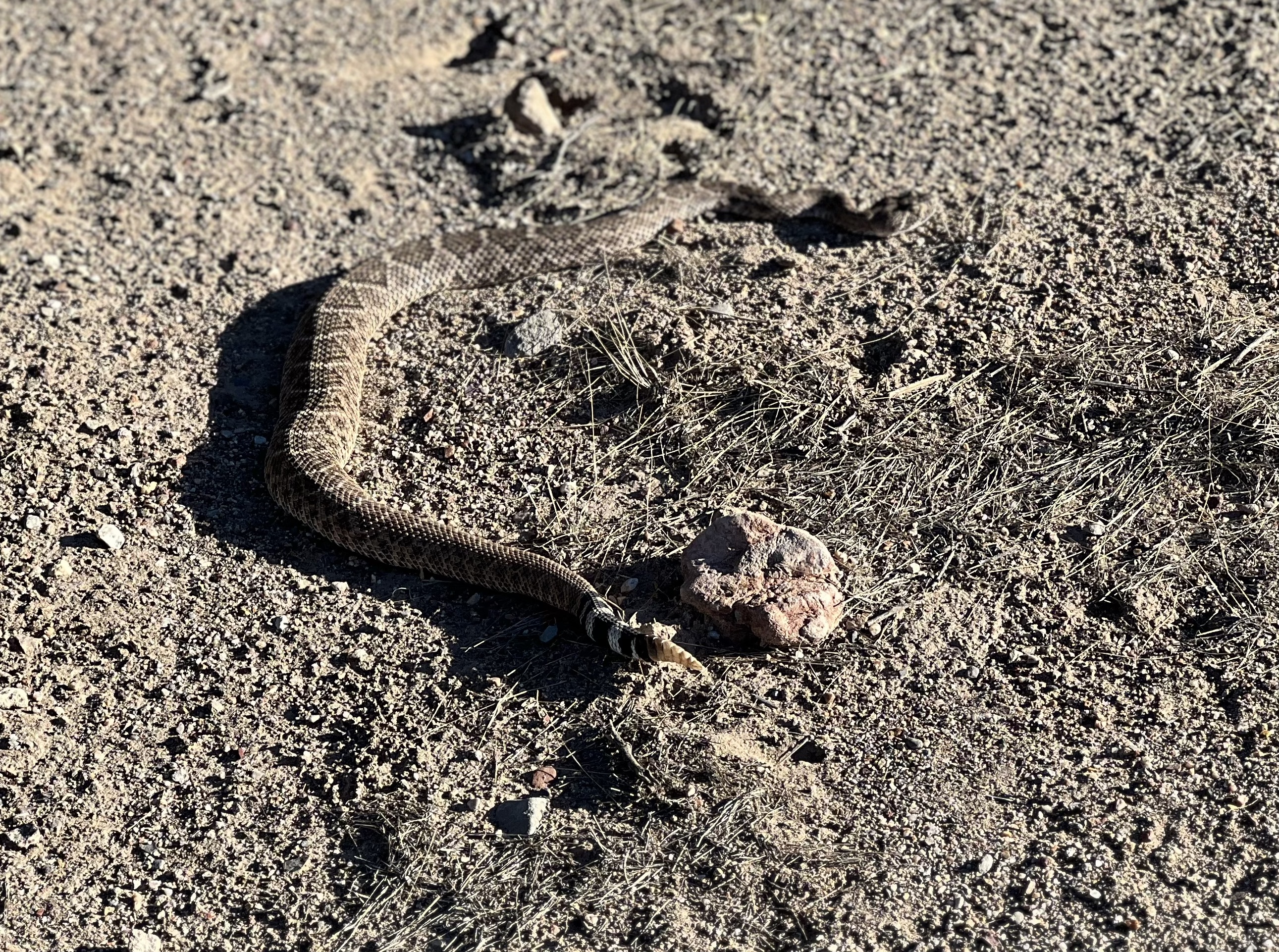
I’ve mentioned before the I take long walks in the desert pretty much every day. Over the years, I’ve seen several rattlesnakes. One thing that always happens is the snake does its best to get to safety—usually by hiding under a bush. Yes, they rattle as they go, but they’ve never struck at me, and they always escape as fast as possible.
A couple of weeks ago, I walked right by a rattlesnake—within easy striking distance. I was walking fast and was a few steps past the snake before it registered that I’d seen an “odd” stick that hadn’t been there before. I turned around and there was the snake (pictured above) frozen in that position.
Of course, I took pictures. Then I waited. I wanted video of the snake as it slithered away. But that didn’t happen. The snake didn’t rattle or move at all. It just stared at me frozen in place.
I keep thinking about being frozen in fear. That snake had no idea if I would kill it or walk away and leave it alone. Freezing in place could have been a very bad decision.
The same can be said for us in situations like this. When fear takes over, we can lose our ability to think clearly. We’re no longer able to act in a manner that keeps us safe or accomplishes what we need to do. Our whole focus is lost because we can’t see past our panic.
We begin to depend on our own perceptions rather than what God can do for us and His protection. If left to build, we can end up allowing that fear or terror to drive a wedge between us and God, harming our spiritual life.
Of course, prayer is endemic to being a Christian and we all know the first thing we should do is pray. But often alarm at what has disturbed us becomes overpowering and we forget to speak with God and let Him help.
There have been times this has happened to me. I’ve forgotten to pray because I’m consumed with fearfulness. As I’ve grown in my Christian walk, seeking God’s help has come much easier.
Remember the Israelites wandered in the desert for forty years before they were ready to cross into the promised land. As Joshua prepared to lead them across the Jordan, God reminded him to have courage. In fact, in the first nine verses of Joshua 1, God gives Joshua His promises and tells him three times to be courageous.
Joshua 1:9 says, “Have I not commanded you? Be strong and courageous! Do not be in dread or be dismayed, for Yahweh your God is with you wherever you go.”
Likewise, we, as Christians, have God with us wherever we go. He still asks us to be strong and courageous no matter what may come against us. No matter how dire our circumstances, God is with us and we only need to stand strong.
While we may be tempted to freeze in fear as that rattlesnake did, we must put our hope and trust in Jesus. God is there with us. There is no reason to fear.
“…for God gave us a spirit not of fear but of power and love and self-control.” 2 Timothy 1:7





































 Christians Read