
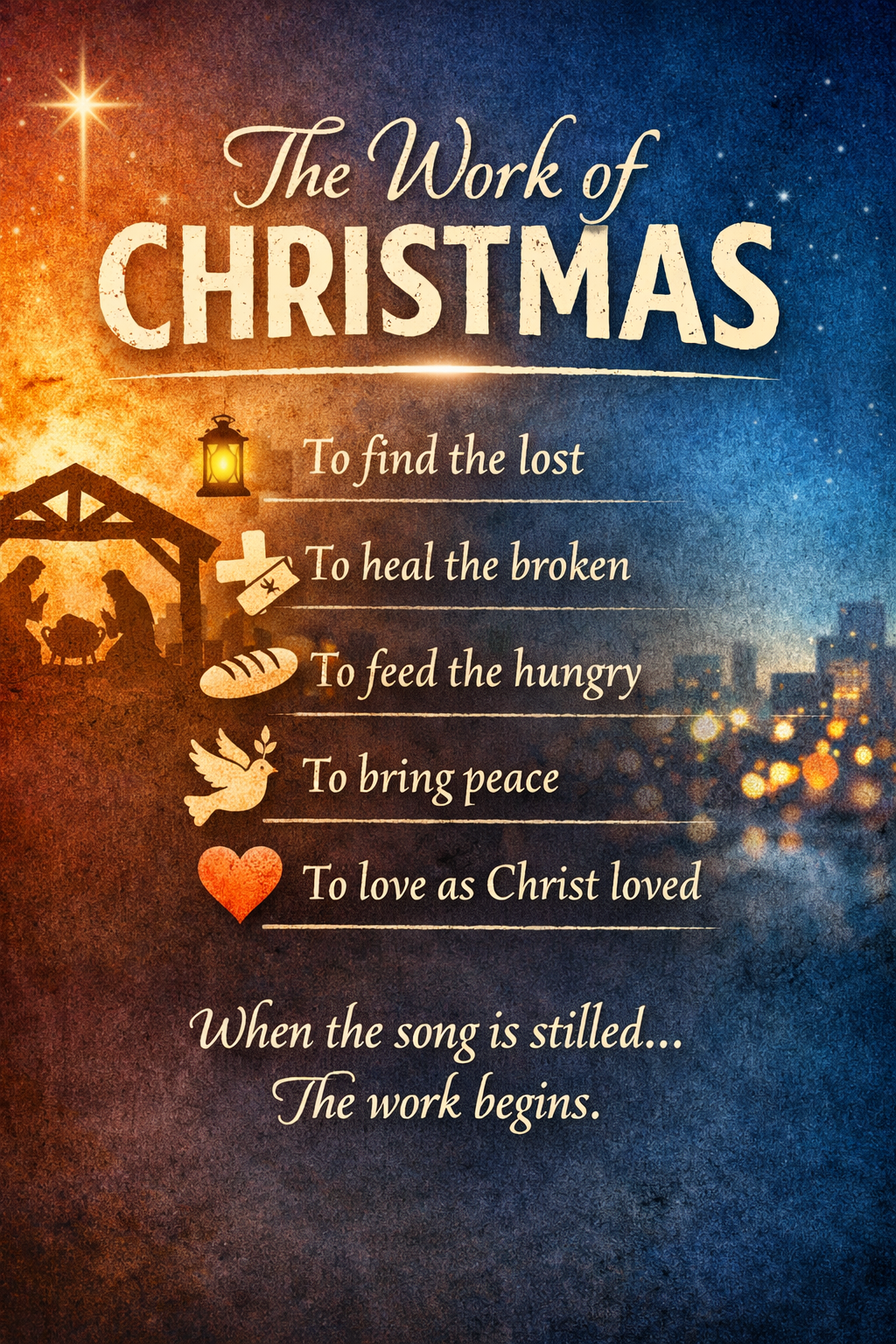
“When the song of the angels is stilled…”
Those familiar words come from Howard Thurman, whose poem The Work of Christmas has quietly challenged believers for generations. Not because it’s loud or dramatic—but because it’s true.
Christmas does not end when the decorations come down.
It begins there.
We spend weeks preparing for Christmas—planning, baking, wrapping, decorating, gathering. We linger in the holy beauty of the manger, the miracle of God stepping into the world as a child. And then, almost without noticing, we move on.
But the Incarnation was never meant to be admired and then shelved.
It was meant to be lived.
The Quiet After the Glory
The angels return to heaven.
The shepherds go back to their fields.
The stable grows quiet.
And Thurman presses us with an uncomfortable, necessary question:
What happens next?
His poem reminds us that the work of Christmas starts when the celebration fades—when the music ends and ordinary life resumes. When faith is no longer carried by candlelight and carols, but by obedience, compassion, and courage.
Christmas Was Never the Finish Line
Jesus did not come so we could admire a baby in a manger once a year.
He came to:
- Bring peace where there is division
- Offer hope where there is despair
- Heal the broken
- Seek the lost
- Teach us how to love when it costs us something
Christmas was not the destination.
It was the launching point.
Carrying Christmas Into Ordinary Days
The work of Christmas looks less like celebration and more like faithfulness.
It looks like:
- Choosing kindness when patience wears thin
- Speaking truth with grace
- Loving difficult people
- Standing quietly for justice
- Trusting God when the miracle feels far away
It is Christ carried into ordinary spaces—workplaces, strained relationships, grief, uncertainty, unanswered prayers.
It is Emmanuel—God with us—not just in December, but in February… in June… in the long, quiet weeks when no one is singing carols.
This Is Where Faith Takes Root
Anyone can celebrate Christmas when the lights are bright and the story is familiar.
The deeper work happens when:
- Faith is tested
- Hope feels fragile
- Obedience requires sacrifice
- Love demands more than comfort
That is where transformation grows—not in the manger scene, but in the daily choice to follow Christ when no one is watching.
So What Is the Work?
Howard Thurman’s answer is simple—and demanding:
- To find the lost
- To heal the broken
- To feed the hungry
- To bring peace
- To love as Christ loved
This is the work of Christmas.
Quiet. Faithful. Ongoing.
Because Christmas does not end.
It sends us.
Howard Thurman (1899–1981) was a theologian, philosopher, and civil rights leader whose writings explored how faith is meant to be lived beyond worship and ritual. A mentor to Dr. Martin Luther King Jr., Thurman believed Christianity must move from celebration into action—shaping how believers love, serve, and pursue justice in everyday life. His poem The Work of Christmas continues to challenge readers to carry Christ’s presence into the world long after the season ends.





























 Christians Read