
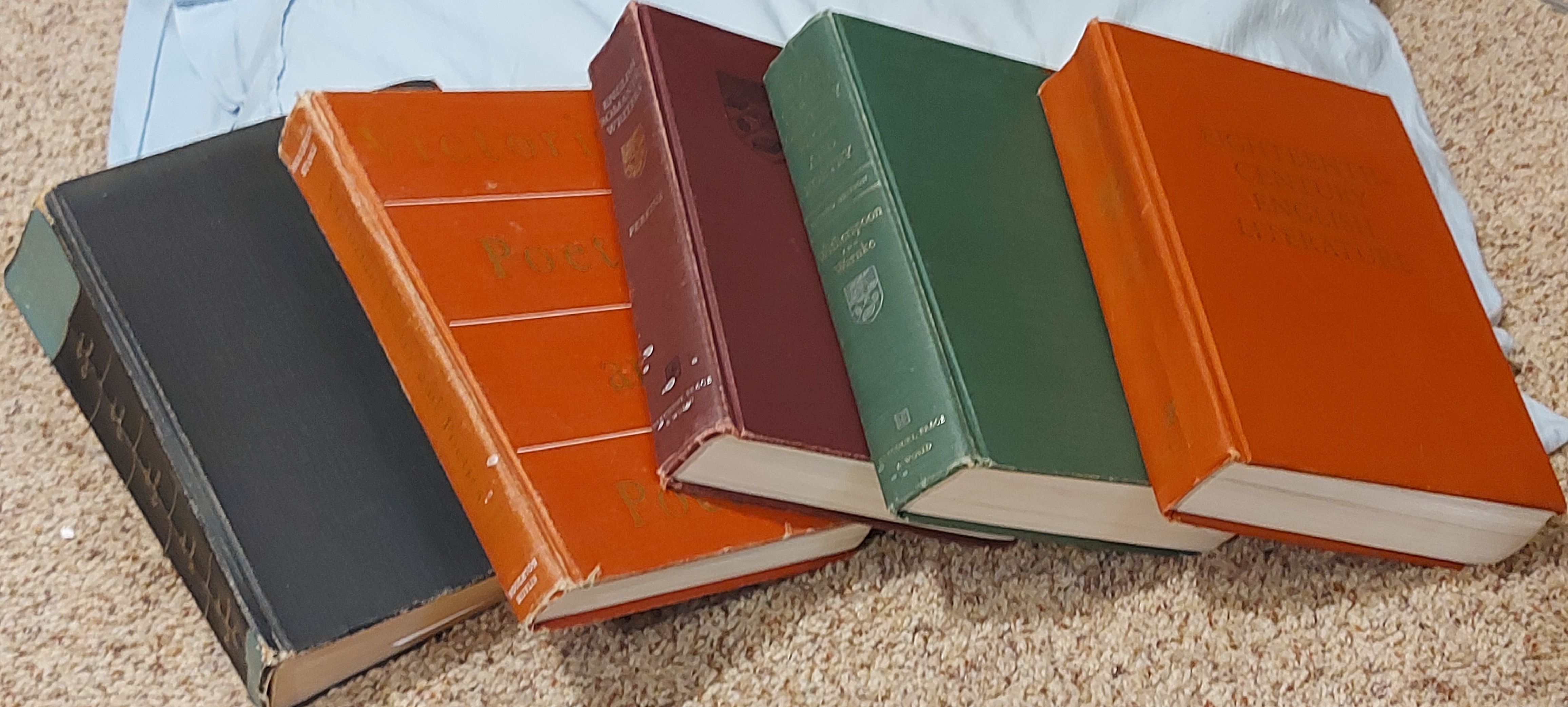
A long time ago in a land full of mystery,
I earned a BA in English and History.
Actually, it was the 1970s at McMaster University in Hamilton, Ontario. I received a wonderful education there, for which I am very grateful.
The English courses I took included a heavy focus on the many great English poets from the 17th to 19th centuries: William Shakespeare, Edmund Spenser, John Milton, John Donne, Alexander Pope, Robbie Burns, William Blake, William Wordsworth, Samuel Taylor Coleridge, Lord Byron, Percy Bysshe Shelley, John Keats, Alfred Lord Tennyson, Robert Browning, Rudyard Kipling, and more. This was truly the golden age of poetry.
I also studied some English poetry from earlier centuries (“Sithen the sege and the assaut was sesed…”) And there were some later poets of note, including T.S. Eliot and Robert Frost in the first half of the 20th century. Since then, it is hard to think of a poet of equal stature to the greats of the 17th to 19th centuries. Maybe Paul Simon and Bob Dylan, if they could be considered poets.
The great English poets of previous centuries were the rock stars of their age, widely read, widely admired, very influential, and well paid. Of course, many modern people would consider the golden age poets out of date and not worth studying. But there is no doubt that they were the supreme masters of their craft.
A question I never asked when I was in university but a question I have asked more recently is: Why did English poetry peak in the 17th-19th centuries? Why couldn’t earlier and later poets equal the masters of this golden age?
Why?
The answer of course, is technology.
There were “poets” in the years before the seventeenth century, dating back to Homer in the 8th century BC and beyond. But these were mostly “bards” or “troubadours.” Generally, they did not “write” poetry. They wandered from place to place and sang or recited their songs and poems in person, from memory. Some of their compositions were eventually written down and preserved, but these compositions were not initially widely read. Paper was expensive, and writing down anything by hand and making copies by hand required great labor by the few trained scribes who were available. The written works were preserved and occasionally read in monasteries and libraries. But there was no way to make these written compositions widely available. The primary means of bringing poetry to people was to do it in person via troubadours.
What changed everything was the invention of the printing press in the late 15th century and its gradual proliferation throughout the 16th century, as well as the accompanying spread of literacy. The printing press allowed poets to reach the masses quickly, easily, and inexpensively. Their words could spread in all directions at once to many more people than a single troubadour could reach. Poetry was still memorized and recited, but by anyone who could get hold of a written copy, not necessarily the author.
What brought an end to the great age of poetry was not originally a decline in literacy or poetic skill but further advances in technology, notably the development of radio, television, and the computer.
Words are still used in public discourse, but they are accompanied by pictures (even computer enhanced moving pictures) and sound.
I greatly admire the golden age poets. They had to convey meaning and emotion and understanding with words alone. That is very difficult to do and required great skill (as any modern person can attest after experiencing the many misunderstandings conveyed through texting).
Today, with the multi-layered means available to them, modern “poets” and communicators must be skilled in many disciplines at once. “Writers” have been replaced by “content creators” and “influencers.” Because they need to focus on so many other things, word skill is neglected, which is why so many modern song lyrics are so idiotic and meaningless. Modern singers are admired for how they sound, the way they look, and the multimedia spectacles that accompany their performances. The lyrics are secondary. Words are the ideal medium for convey precise knowledge, facts, and objective truth. Other media are better suited to conveying feeling.
I am a man born after his time. Growing up in the 1950s, I read and wrote before I watched television and before there was much radio available in our small town. I am a word person, I admire the great poets, and I am skilled at using the written word. A rarity n the modern world, I am a published poet, although it would be an exaggeration to say that I am widely read, widely admired, very influential, or well paid.
























 Christians Read