
In 2018, I wrote an article on Human-Trafficking Awareness. Back then, it wasn’t on many people’s radars. Today, word of it is more prevalent but because the topic is so distasteful, many turn their heads and ignore it. We all wish there was no need for the topic to be newsworthy or to even exist, but there is, and it does.
We need to be aware (or to become aware) to protect ourselves and our loved ones as best we’re able. We can’t do that if we’re not aware trafficking is an issue, or if we are led to believe that it only happens elsewhere. We know now, it does not. Trafficking happens everywhere. To all kinds of people, women, men, teens and children, boys and girls, and even infants.
While January is the official awareness month, it seems anytime is an appropriate time to publish the article again. Here’s the original article:
Human-Trafficking Awareness Month (from 2018)
In January, by Presidential Proclamation, the U.S. monthly observance was on Human-Trafficking and Human-Rights Abuse. I want to share a bit about human-trafficking because there’s so much on it in the news right now—and likely will be in the near future.
How bad is it?
- At $32 Billion a year, the human-trafficking industry has passed up the illegal sale of arms, and it’s growing.
- Trafficking occurs in all 50 states.
- An estimated 4.5 million trafficked persons endure sexual exploitation.
There’s more to know. It’s uncomfortable, but keep reading…
In 2010, my husband and I went to south Texas. When we were returning home, we left very early to miss heavy traffic in Houston. If you’re familiar with that route, you know traffic governs what time many get on the road. Anyway, it was predawn. We stopped at a convenience store for gas, and I noticed a sign on the store’s front window. It was directing people who were victims of human trafficking to call this number. Or if anyone was spotted who appeared to be a victim of trafficking, you could report it to this same number.
That sign sent chills up and down my spine. That was the first mention of human trafficking in the United States I’d seen. Until that moment in time, in my mind, trafficking was something that happened far away in distant lands. Later that morning, we stopped again, and again I saw a sign about trafficking on the store’s front window. That chill stayed with me the rest of the trip.
I decided to look into the situation and see what in the world was going on. To be honest, I had hoped to put my mind at ease. But that isn’t what happened.
I learned that trafficking happened here. A lot. That some saw it as a more profitable trade than selling drugs. Drugs, they could sell once. But people could be sold over and over and over. I read about cases where ordinary women doing ordinary things were abducted and vanished. Lost to trafficking. Things like pumping gas, walking to their cars in shopping mall parking garages or lots, and broken down with a flat tire on the side of the highway. Everyday situations we all easily see ourselves in and could be in on any given day.
So rather than setting my mind at ease, I became more disturbed. So much so that I set aside the book I was working on and started a new one that delicately addressed human trafficking. If I, a news hound, had been unaware of all this, I felt certain others were unaware of it, too. We needed to change that. Deadly Ties was born.
 A year later, the book was released as the second book in my Crossroads Crisis Center series, and I began hearing from readers the same shock I had experienced on discovering trafficking was happening in the United States. That there were routes where these imprisoned victims were forced to walk through the Canadian wilderness, being driven along the I-10 corridor in trucks and vehicles, being moved from place to place. Some were sold for the expected purpose, but others were sold to “entertain” by fighting to the death against other imprisoned victims. Under constant death threats and intense observations, some were being forced to work at outside jobs and to turn over all their earnings to their captors.
In the news lately, we’re hearing more and more about children being taken (or sold) and abused, even murdered and offered as sacrifices by cults. We’re hearing stories of organs being trafficked, and all manner of evil things.
I hope that this news doesn’t shock you. That you too have seen the news articles and are aware of the atrocities being committed. Bluntly put, we are failing to protect our children, and we honestly need to do a better job for them. For all victims.
If you are shocked, I hope your reaction will be to look into trafficking. The numbers are staggering. I read an article a few days ago about 10,000 children being missing, so be emotionally prepared for what you discover.
Here’s a little more information to help prepare you for what you’ll find. (Many thanks to Ark of Hope for Children Organization for sharing!)
- In 2012 the (UNODC) United Nations Office on Drugs and Crime reports the percentage of child victims had risen in a 3-year span from 20 per cent to 27 percent.
- Of every three child victims, two are girls and one is a boy.
- Gender and age profile of victims detected globally: 59% Women – 14% Men – 17% Girls and 10% were Boys.
- 600,000 to 800,000 women, children and men are bought and sold across international borders every year and exploited for forced labor or commercial sex (U.S. Government)
- When internal trafficking victims are added to the estimates, the number of victims annually is in the range of 2 to 4 million.
- 50% of those victims are estimated to be children.
- It is estimated that 76 percent of transactions for sex with underage girls start on the Internet.
- 2 million children are subjected to prostitution in the global commercial sex trade (UNICEF),
- There are 20.9 Million victims of Trafficking World wide as of 2012.
- 5 Million victims in the United States.
The impact:
Human trafficking has surpassed the illegal sale of arms and in the next few years, will surpass the sale of illegal drugs. Drugs are used once and they are gone. Victims of child trafficking can be used and abused over and over. Again, as a $32 billion-a-year industry, human trafficking is on the rise and it happens in all 50 states (U.S. Government). While
4.5 Million of trafficked persons are sexually exploited, be aware that up to 300,000 Americans under 18 are lured into the commercial sex trade every year. From 14,500 – 17,500 of those victims are trafficked annually into the United States.
There is hope. President Trump and Attorney General Jeff Sessions have invested in stopping trafficking. In the past year, there have been over 6,000 arrests. There is so much more to be done, and to aid in the effort, the President started a new program called HERO Child-Rescue Corps Program.
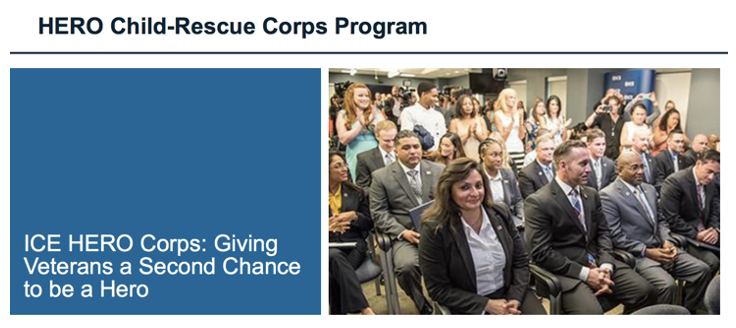
In this new HERO Child-Rescue Corps Program veterans with specialized skills will be working on child rescue.
(From the HERO website)
The Human Exploitation Rescue Operative (HERO) Child-Rescue Corps is a program developed by U.S. Immigration and Customs Enforcement’s (ICE) Homeland Security Investigations (HSI) and U.S. Special Operations Command (SOCOM) in conjunction with the National Association to Protect Children.
The HERO Child-Rescue Corps Program is designed for wounded, injured and ill Special Operations Forces to receive training in high-tech computer forensics and law enforcement skills, to assist federal agents in the fight against online child sexual exploitation. Upon successful completion of the program HERO interns will have the knowledge, skills and experience to apply for careers with federal, state and local police agencies, and other organizations, in the field of computer forensics.
Learn more on ICE HEROS (from US Immigration and Customs Enforcement @ https://www.ice.gov/hero):
Too often, we think we’re one person. What can we do? The answer is more than we think. When we set our collective minds to it, we can move mountains. We all know that. Just as individuals we know that once you become aware of a problem such as this, thoughts of it never leave you.
The process of awareness has been a long and difficult one. The idea of trafficking is so repugnant to us, so morally reprehensible, that we shun it. We have difficulty wrapping our minds, much less our hearts, around it. I know this. I too experienced it. But shunning does nothing to help the victims or to stop the abuse much less to solve the problem.
Which is why I am so grateful to our president for bringing trafficking to the foreground and declaring January an Awareness month. There are organizations dedicated to rescuing these children and they have enjoyed some success. We need to support them. There are people tirelessly working the issue. We’re grateful for them. Yet the problem is huge, and more people are needed to join in the fight.
While no one can do everything, everyone can do something. Things like these:
We can insist that the legal penalties for engaging in trafficking are so severe that those who would engage don’t.
We can, as a civilized society, refuse to accept that this problem is just something that occurs in modern society. If we object strongly enough, it won’t.
We can pray. For the victims, for those rescued who must heal and recover, for the rescuers, and, yes, for those engaging in the illicit activity, that their hearts and minds might be turned, and they’ll stop.
And we can be aware enough that if we see something that doesn’t sit right, we report it. We heed our instincts.
As I said, when we make up our minds and choose to act, we can move mountains. And I hope we will. The victims—women, men and children (boys, girls and infants)—are counting on us…
Please, read and share to increase awareness.
Recent Presidential Actions battling Human Trafficking
President Trump Working to End Human Trafficking
Loopholes in Child Trafficking Laws Put Victims–American Citizens–at Risk
President Trump Proclaims January-2018 National Slavery Human Trafficking Prevention Month
President’s Listening Session on Domestic and International Human Trafficking
President Signs “Allow States and Victims to Fight Online Sex Trafficking Act”
Presidential Executive Order Enforcing Federal Law Preventing International Trafficking
First 1/3 of 2018 National Monthly Observances by Presidential Proclamation:
January: Slavery and Human Trafficking Prevention Month
Stalking Awareness Month
February: Teen Dating Violence Awareness
April: National Child Abuse Prevention Month
National Sexual Assault Awareness Month
That’s the end of the original article.
It is now 2025, seven years later, and I wish I could say that this issue is no longer an issue, but despite efforts, the statistics have gotten worse, and we must recall that those statistics are not just numbers, they’re people, and many are children. Now, in 2025, we have hundreds of thousands of kids missing. So, the challenge has become more prevalent, and we now know, worldwide.
While we must be diligent in supporting those who fight these crimes, we must also be diligent in protecting our kids, our teens, and raising our own awareness so that if we see something, we recognize and report it. So that if a new abduction tactic is being used, we know it. We tell others who need to know it. We do what we can.
Yes, this is a hard topic to think about and to discuss. But if we ignore it, it will not go away. It has and will continue to get worse. Collectively, we all deserve better. And we must demand better from ourselves for our kids, for all kids and women and men who fall victim to this horrendous and merciless crime.
If you look into this matter and discover information you think would be helpful to others, please feel free to add it in the comments. Be sure to cite your source and where the original material can be found.
As I said, much has occurred on this topic since 2018, yet despite valiant efforts by some, the challenge persists. That’s harmful to the victims and to our society. This is not what we are about. We want our people safe and living healthy, hopeful lives.
Blessings,
Vicki





























 Christians Read
A Note: falsehoods about same-sex ‘unions’, sexuality and sex-change add to the number of possible victims by grooming lonely and confused young people.
LikeLike