
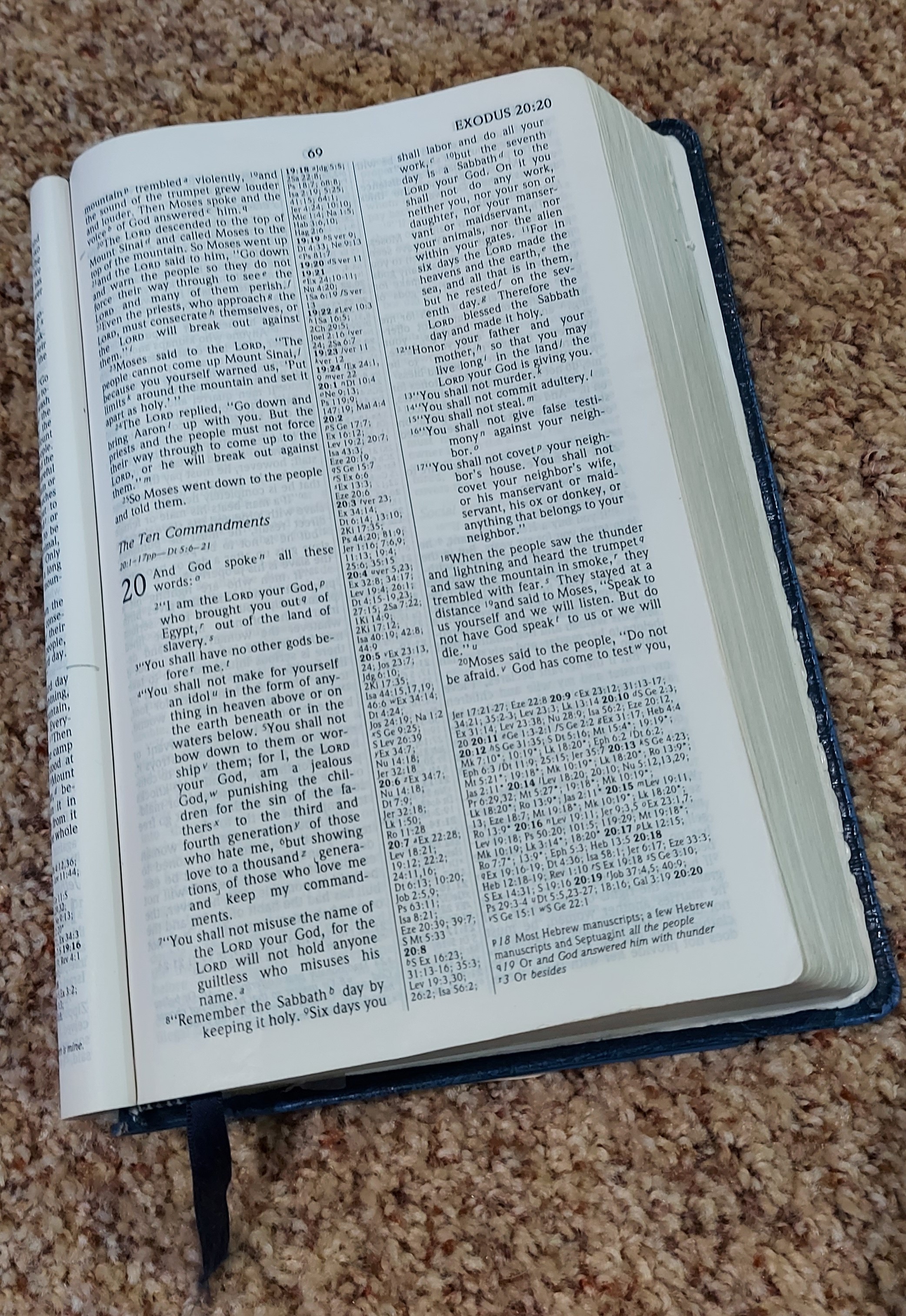
At Mount Sinai, God made a covenant, a formal agreement, with the Israelites, the essence of which was the document we know as the “Ten Commandments” (even though the Bible never calls it that). The Hebrew word for covenant is beriyth (Exodus 19:5, 24:7, 34:28). This was essentially a renewal and elaboration of the “covenant” God had made with Abraham (Genesis 15:18, 17:2-21). In Exodus, God said that He was rescuing the Israelites from Egypt because He “remembered his covenant with Abraham, with Isaac and with Jacob” (Exodus 2:24, 6:4-5 NIV). The two stone tablets on which the covenant was written and which were placed in the ark were called the “testimony” or “witness” (eduwth). That is, they would be the evidence or proof or documentation or reminder of the covenant (Exodus 25:16,21 31:18,29, 40:20). The ark itself was called the “ark of the testimony” (Exodus 25:22, 26:33, 30:6 and many more). The word for “ark” is arown, which means literally a “box.”
In Exodus, God also told the Israelites: “Be careful not to make a treaty with those who live in the land where you are going, or they will be a snare among you” (Exodus 34:12);
“Be careful not to make a treaty with those who live in the land; for when they prostitute themselves to their gods and sacrifice to them, they will invite you and you will eat their sacrifices” Exodus 34:15); “Do not make a covenant with them or with their gods” (Exodus 23:32). The Hebrew word for “treaty” is the same as the word for “covenant” (beriyth). The Israelites were not to make a covenant with other nations or other gods because they already had a covenant with the true God, Yahweh. They could not make another covenant without breaking their covenant with Yahweh. They were to have “no other gods before me” (Exodus 20:3), which would be equivalent to “committing adultery,” which was forbidden in their covenant with God (Exodus 20:14).





























 Christians Read