
After the Jews returned to Jerusalem from exile in Babylon and rebuilt the temple and the city wall under Ezra and Nehemiah, there is a gap in the biblical record of about four centuries. During this time, the Jews struggled to survive as a small, weak remnant in a hostile environment. They were trapped between two dueling successor states to Alexander the Great’s Greek Empire—the Seleucids based in Syria and the Ptolemies in Egypt. These were thoroughly “Hellenistic” empires; that is, they were not Greek by nationality but had largely adopted Greek culture. The prophet Daniel had prophesied about some of the wars that would take place (particularly in Daniel 11). Among the Seleucid kings would be one who would “exalt and magnify himself above every god” (Daniel 11:36). His armies would “desecrate the temple fortress…abolish the daily sacrifice [and] set up the abomination that causes desolation” (Daniel 11:31). While some scholars interpret this to be referring to an end-times antichrist, the usual interpretation is that this refers to Antiochus IV, who gave himself the title “Epiphanes” (“God manifest”). About 169 BC, Antiochus entered the Holy of Holies and looted the temple. Two years later, he set up an altar to the supreme Greek god Jupiter in the temple. This resulted in a rebellion of the Jews led by a family called “the Maccabees.” Their history is recounted in the extra-biblical books 1 and 2 Maccabees and the writings of the Jewish historian Josephus.
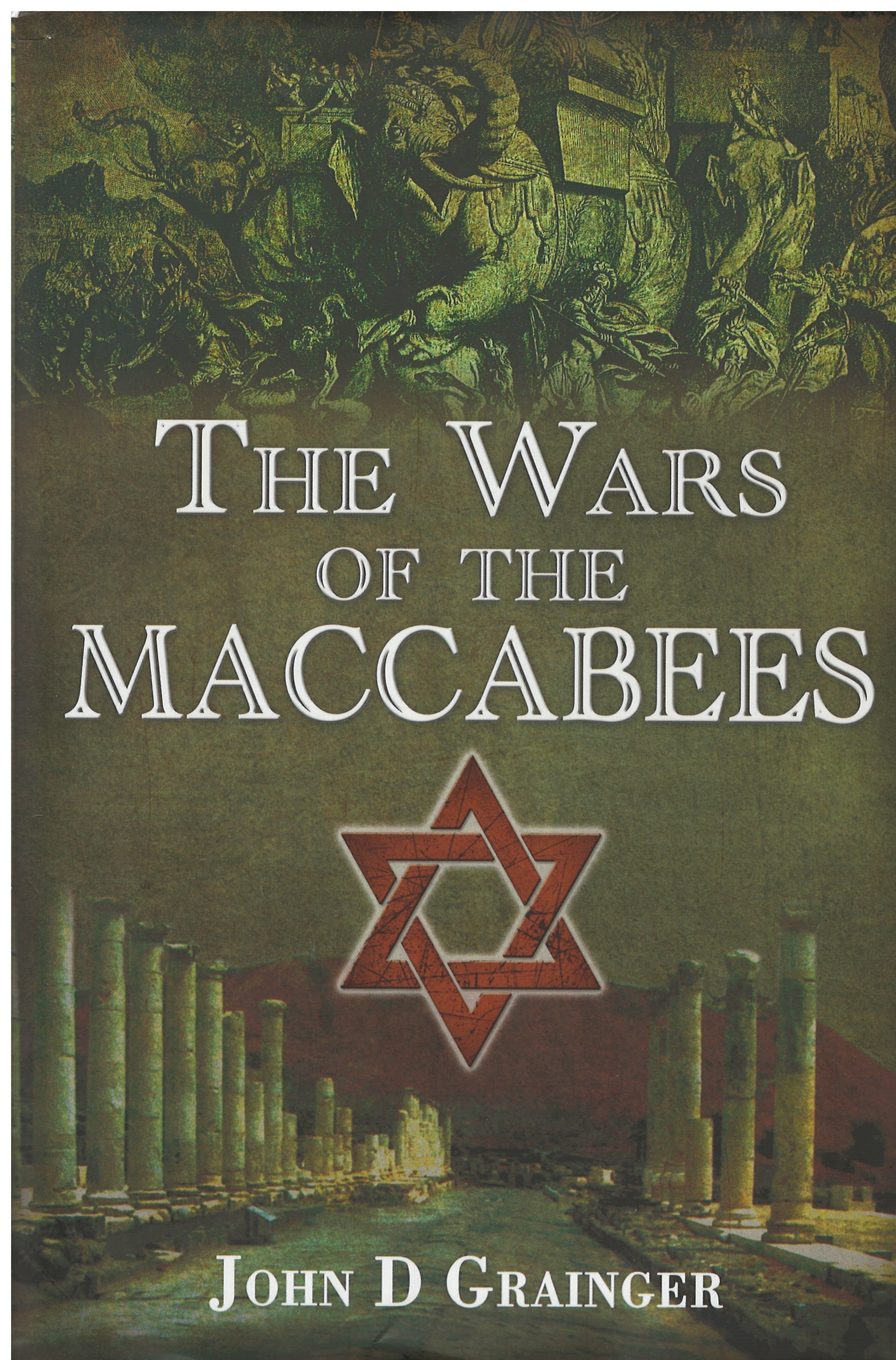
Like many Christians, I had very little knowledge about this “intertestamental period” (the time between the Old Testament and the New Testament). But I had become curious. So, when I came across a copy of a book called The Wars of the Maccabees by John D. Grainger at a charity garage sale (to help fund a Christian missionary effort), I snatched it up.
Grainger says at the beginning of his book that he will look at the wars (which were even more complex than suggested in Daniel’s prophecy) in purely secular terms. That is, he assumes the wars were simply struggles for power and not religious conflicts. He consistently describes the Maccabees as terrorists and imperialists (that is, as wanting to develop their own empire independent of other empires). Strangely, he never applies these terms to the empires (especially the Seleucids) that sought to subjugate the Jews—those empires are portrayed as legitimate governments. Grainger dismisses the Jews’ attempts to gain freedom and independence, saying that what the Jews really wanted was freedom to dominate their neighbors.
Grainger draws two interesting conclusions that may have relevance for our day. First, he says that the Jews were not unified but were roughly broken into three camps. There were devout Jews who mostly followed the Maccabees; there were Hellenistic Jews who enthusiastically accepted Greek culture and values and wanted to think and act and believe like Greeks; and in between there were Jews who were preoccupied with their own lives and didn’t care one way or the other. Therefore, Grainger argues that it was not Antiochus who set up the Jupiter idol in the temple, but Hellenistic Jews. This might be true, but the Seleucids also insisted on the right to appoint and replace the Jewish high priest (sometimes for money and sometimes for political advantage), so if it was the Hellenistic Jews who erected the Jupiter idol, they were empowered to do so by the Seleucids.
Second, Grainger asserts that it was the Maccabees who were intolerant rather than the Seleucids and Hellenists. Greeks, he argues, tolerated all religions at the same time; they were quite willing to let Jews worship their own God as long as they also worshiped the Greek gods. The Maccabees, however, insisted on worshiping only their own God, Yahweh.
It seems to me that Christians are facing the same issue in our day. The Christian church is not threatened so much by the world as by “Christians” who accept the world’s standards and want to change the church to be more in tune with the world around them. The Old Testament prophet Daniel commented on this problem, saying, “With flattery [the one who would exalt himself above every god] will corrupt those who have violated the covenant, but the people who know their God will firmly resist him” (Daniel 11:32 NIV). Daniel insisted that believers in the true God need to resist the efforts by enemy forces (and “unfaithful believers”) to make them conform to the world.
Modern Western society also strongly believes in tolerance. In fact, it insists that Christians must accept and affirm other religions and sinful lifestyles. What modern Western society will not tolerate is Christians who insist on worshiping only the true God. Jesus said that we cannot serve two masters (Matthew 6:24). Paul asked, “What agreement is there between the temple of God and idols?” (2 Corinthians 6:16). But Hellenistic thinking pervades modern Western society. Modern secularists/Greek thinkers are trying today to force others to follow their religion of “tolerance.” Erecting your idol in someone else’s temple is not tolerance. Trying to force Christians to give equal weight to other religions and accept sinful lifestyles is not tolerance.
War and More War
The wars of the Maccabees continued for more than a century. The Maccabees won some battles. They lost some battles. The Judean kingdom expanded and contracted, expanded and contracted. The Maccabees fought with and against various factions in the Seleucid and Ptolemaic kingdoms when those kingdoms were divided by civil wars. In the last century before Christ, they fought against the newly arisen Nabatean kingdom based in Petra in the desert lands to the east.
However, increasingly, the Maccabeans became what Grainger accuses them of being from the beginning. While the initial revolt was motivated by a desire to protect the temple and Jewish religion from corruption, later stages of the revolt became increasingly political and secular. The Maccabean leaders increasingly acted like the rulers of the kingdoms around them, seeking to extend their own power rather than build the kingdom of God. They hired foreign mercenaries to augment the Jewish armies. Competing claimants to the Maccabean throne fought civil wars against each other, with the Pharisees and Sadducees sometimes backing different claimants. The divisions in the kingdom eventually led to intervention by the Roman Empire as it expanded into the Middle East. A man named Antipater, “a man of great wealth and political acumen,” intervened in the Jewish civil wars. He was from Idumea, formerly Edom, the kingdom of the descendants of Esau, located to the south of Judah. The Romans later helped one of Antipater’s sons, Herod, conquer the Judean kingdom, and Herod was appointed king of Judah by the Romans.
The failure of the Maccabees to maintain political control of Judea was partly due to the strength of Judah’s external enemies. But it was also due to the inherent divisions within Jewish society. Hellenists, Pharisees, Sadducees, and power-hungry politicians all competed for power and weakened the state they were trying to establish. Like Old Testament Israel and her kings, they were not wholly committed to God and therefore lacked the power and divine blessing needed to succeed. Ultimately, they illustrated the inability of humans to build the kingdom of God by force. Only God can build His kingdom.
Christians preach only one God but should never try to force other people to worship Him (as it must be admitted they have done at certain times in history), any more than modern secularists should try to force Christians to worship their god of “tolerance.” Forced worship is never genuine, and using force in the name of religion is counter-productive.
The Conclusion
Grainger dismisses the Maccabees as terrorists who were doomed to fail because of the inherent conflict between the political and religious aims of the Jewish kingdom. He notes that the Jews continued to rebel against Rome—in 66-73 AD when Jerusalem was destroyed, in 115-117, and in 132-135. Grainger concludes, “The only way to control Judea was to destroy the Jewish community. This is the final lesson of the career of Judah Maccabee, whose methods were used eventually by the Romans against his people to destroy them.” Grainger here displays his anti-religious and ant-Jewish bias. He justifies the annihilation of the Jewish kingdom and the extermination of Jewish religion on the grounds that that religion is incompatible with Hellenistic thought. His ideal is for secular kingdoms to rule, untroubled by religious sensibilities. He never questions why the Seleucids or the Romans should claim the right to rule the Jews and their land. It is deeply concerning that he thinks the Jews deserved to be exterminated because they refused to surrender their political and religious independence.
Grainger’s analysis is thus flawed, but his volume helps to elucidate the political and religious situation in Judea when Jesus came to teach and preach and establish His kingdom.





























 Christians Read